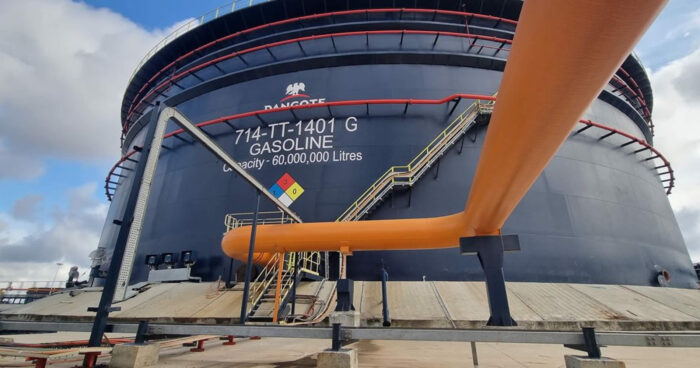
Nigeria’s Dangote Petroleum Refinery shipped roughly 466,000 metric tonnes of jet fuel to Europe in June, an estimated N757 billion cargo that pushed the country ahead of the United States as a supplier to the region and marked the highest volume of Nigerian aviation fuel sold into Europe since the nation turned into a net exporter of the product in 2024.
The figures, contained in a market report from S&P Global Commodity Insights, show Nigerian jet fuel flows to Europe doubling month-on-month, climbing from 232,000 metric tonnes in May to 466,000 metric tonnes in June. That volume is equivalent to about 582.5 million litres of fuel, and at a domestic reference price of N1,300 per litre, the shipment carries an estimated value of N757.25 billion.
The surge comes even as the European jet fuel market has swung from acute tightness to oversupply. Prices spiked earlier this year during the Middle East conflict before falling sharply as regional refiners restored output and additional barrels flowed in from multiple exporters, including Dangote.
By contrast, US cargoes to Europe have been shrinking steadily since the spring. Exports fell from a record 818,000 metric tonnes in April to 560,000 metric tonnes in May, and then to 399,000 metric tonnes in June, a decline that left Nigeria as the larger supplier to the region for the month, according to the report.
“Jet is oversupplied because of high local refinery production; refineries pushed back maintenance to make the most of the high prices,” a trader quoted in the report said, pointing to Dangote and the US as the two biggest contributors to the glut. “The US and Dangote also shipped large volumes. Now there are some flows resuming through the Suez, too, from the UAE, but let’s see how it goes.”
The pullback in prices has been steep. Platts’ Northwest Europe jet CIF cargo assessment for July settled at $981.75 a metric tonne on June 30, down sharply from an all-time high of $1,694.25 a metric tonne on March 30, at the peak of the Middle East hostilities. The August contract followed a similar path, dropping to $968.25 a metric tonne by June 30 from $1,507.50 a metric tonne three months earlier.
Traders now expect an oversupplied summer market in Europe, driven partly by aviation demand that has come in weaker than anticipated even during the peak travel season.
More barrels could be on the way. The report noted that the arbitrage window between East and West remains wide enough to keep pulling cargoes from the Middle East and India toward Europe.
Saudi Arabia’s shipments to the region jumped to about 106,000 metric tonnes in June from just 7,000 metric tonnes in May, while volumes from India rose to 197,000 metric tonnes from 129,000 metric tonnes over the same stretch. Flows from the United Arab Emirates and Kuwait, both significant suppliers earlier in the year, were absent from the June tally altogether.
Still, the outlook remains clouded by geopolitics. Two European jet fuel traders told Platts that the durability of the current oversupply hinges on developments in the Strait of Hormuz and how quickly Middle Eastern refiners recover from disruptions tied to the recent conflict. A renewed flare-up in the region, or a slower-than-expected restart of affected refining capacity, could tighten supply again and reverse the price slide.


Join BusinessDay whatsapp Channel, to stay up to date
Open In Whatsapp