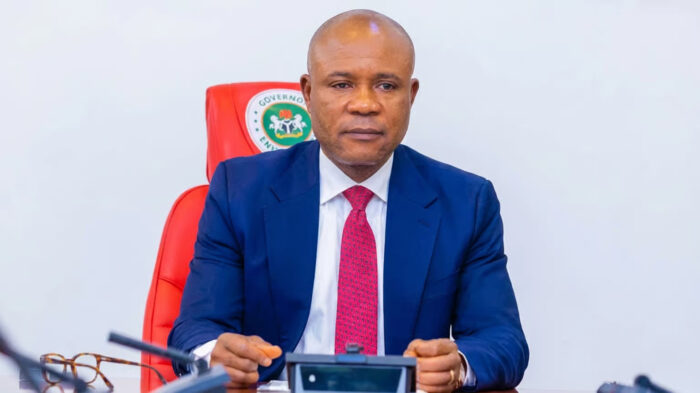
Peter Mbah, governor of Enugu State, has said that his administration was working round the clock to expand access to clean and safe water for every household across the state.
Mbah stated this on Friday at the grand finale of the Enugu Water Sustainability Summit (EWSS) 2026, held at the International Conference Centre, Enugu.
The summit, organised by the Enugu State Ministry of Water Resources in collaboration with development partners, had the theme: ‘Water for All: Driving Innovation for Water Equality, Sustainability and Resilience.’
The summit brought together government officials, development partners, private sector, academia, civil society organisations and young innovators to explore practical solutions for sustainable water supply and improved Water, Sanitation and Hygiene (WASH) services in the state.
Mbah represented by Chidiebere Onyia the Secretary to the State Government, said access to clean water remained a top priority of his administration, describing it as a fundamental right rather than a privilege.
He said that although the government had made significant progress in restoring water supply to the Enugu metropolis, attention was now focused on expanding distribution networks to neighbourhoods and ensuring the sustainability of the system.
According to him, the major challenge is extending water to the ninth mile through effective reticulation and developing a sustainable economic model that guarantees uninterrupted supply.
Mbah said the state government was replacing ageing asbestos pipelines with safer ductile pipes, rehabilitating existing water infrastructure and strengthening the capacity of water institutions to improve service delivery.
He added that the ongoing interventions, supported by development partners, including the African Development Bank (ADB), would extend potable water supply to underserved urban and rural communities across the state.
The governor stressed that government alone could not achieve universal access to safe water, calling for stronger collaboration among development partners and other stakeholders.
He also challenged young innovators to continue developing practical and scalable solutions to water and sanitation challenges, assuring them that government would support innovations capable of delivering lasting impact.
Mbah commended Ben-Collins Ndu Jr, commissioner for Water Resources, development partners and stakeholders for creating a platform that encouraged young people to contribute innovative ideas for improving water and sanitation services.
In her remarks, Jolly Maulit, UNICEF Nigeria WASH Manager, described access to safe water as essential to public health, education, human dignity and economic development.
She said that water challenge in the state was not due to a lack of water resources but was largely a consequence of geological conditions, infrastructure gaps and the need for integrated water resource management.
Maulit urged the people to move beyond dependence on isolated boreholes towards climate-resilient infrastructure, professionally managed utilities and evidence-based planning capable of delivering sustainable water services.
According to her, sustainable water supply depends on strong institutions, skilled professionals, reliable financing, effective partnerships and improved governance in the water sector.
She commended Mbah for developing a water master plan, rehabilitating the Ninth Mile Water Scheme and achieving Open Defecation Free (ODF) status in Igbo-Etiti Council Area.
She advocated innovative financing models involving government, development partners and the private sector.
Chika Mbah, managing director of the Enugu State Rural Water Supply and Sanitation Agency (ENRUWASA), urged innovators to focus not only on urban communities but also on unlocking the vast water and development potential in rural areas.
She expressed confidence that ideas from the summit would translate into practical interventions.
Earlier, Ben-Collins Ndu Jr had said that the summit was designed to engage young people in developing innovative solutions to the state’s water supply challenges and encourage public ownership of ongoing water sector reforms.
He also said that the government would review viable ideas presented by participants and integrate them into its water development programmes where applicable.
He added that although no definite completion timeline could be given for ongoing projects, the administration remained committed to delivering safe and potable water through careful planning and strict adherence to public health and safety standards.

Join BusinessDay whatsapp Channel, to stay up to date
Open In Whatsapp