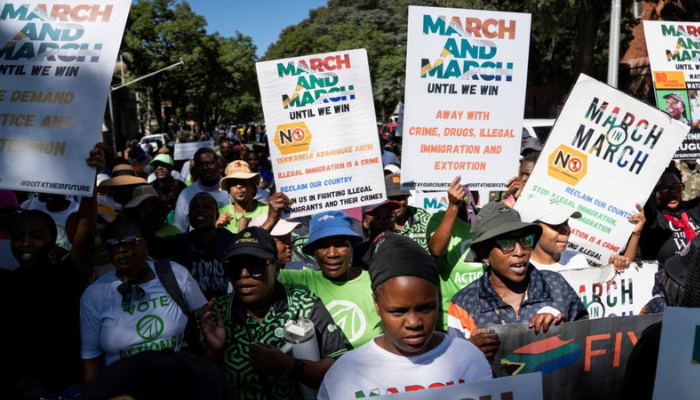
On June 30, 2026, Africans and the world helplessly watched as South Africa chased ‘undocumented’ nationals from other African countries out of their land in historic anti-migrant protests.
That day marked South Africa’s record protest in history as 120 protest marches were held, out of which 108 were peaceful while 12 were violent.
Sadly, thousands of protesters marched across cities in the country chanting “Abahambe!”, which literally translates to “They must go!”.
For some concerned South Africans, the protests did not represent the wish or stand of every South African citizen, especially the right-thinking ones, who foresee future backlash.
Some of them were worried that the protests were held despite some underground works and appeals from several quarters; pressure groups, investor communities and diplomatic circles.
“I know that many think that our government, particularly our president, supported the protests. That is not totally true. He held meetings with leadership of the groups organising the protests, pleaded and they still went ahead, insisting it is their civic right to protest,” Siphiso Mbela, a Johannesburg-based tour operator cried out.
He also recalled that major labour unions, including his association, warned over two million South African workers not to join the planned anti-immigrant protests or risk losing union protection, yet the people marched on the streets against fellow Africans.
“We are entering elections soon and many are taking advantage of it to make unnecessary demands from the government. On the other hand, the government is soft-pedaling on certain issues, including the anti-migrant protests because of votes from the people. It is sad watching fellow Africans leave because of the action and inaction of a few and the government. I totally blame the unfortunate incident of June 30th on the government,” Mbela said.
But while the June 30 anti-migrant protests are over, observers think that the huge damage has been done.
They decried that presently, South Africa is on the edge, as police have arrested more than 900 people for violence and looting during the protests, while also investigating overnight attacks.
“I think the protesters have created more problems than solving a few with the June 30th anti-migrant protest,” Marcel Kumalo, a Kenyan legal resident said.
“Yes, President Ramaphosa drew a line at unlawful behaviour for the protesters, but they neglected that. There were lootings of foreign-owned informal corner shops, they call them spaza shops here.
“With informal corner shops gone, the protesters will soon demand for the closing of foreign-owned formal businesses in the next round of protest, which may happen sooner than expected”.
Obanda Asiwih, a Cameroonian national, who relocated from Cape Town to Gaborone in Botswana in 2022, lamented that the protests are far from being over considering that the organisers are insisting on returning to the streets every Thursday until their demands on illegal immigration, crime, and unemployment are addressed.
“Now that the protesters have succeeded, all remaining illegal and even legal migrants from other African countries are no longer safe in South Africa,” he said.
“Imagine a coalition of more than 20 civil society groups insisting that all illegal immigrants must go and they have succeeded in having their way. It means champions of anti-migrants like the March and March movement and Operation Dudula will definitely take laws into their hands.
“The localised flare-ups that occurred during the June 30th protests are signs that victimisation is underway. My ultimate plan is to return finally to Duala, Cameroon, by 2030 and leave hatred behind.”
He also argued that people like Jacinta Ngobese-Zuma, leader of March and March, and the thousands who followed her in Durban during the protest to chant “Abahambe!” (“They must go!”), should know that they are also not welcomed in other African countries as one good turn deserves another.
Bringing a continent-wide perspective to the issue, Afam Onyali, a Nigerian lecturer in a Zimbabwean university, argued that while the core grievances of the protesters are illegal immigration, border management and pressure on public services, no African country has persisted with anti-migrant protests in the magnitude South Africa has done it.
“The question is who is a legal migrant, because even those with documents, those who lecture in South African universities, some friends at multinational companies like PWC, Ernst &Young and some law firms have been embarrassed and victimised by vigilante groups and even police.
South Africa should learn from how other countries handle migrant issues and not allow vigilante or self-appointed groups to decide who stays or leaves the country,” Onyali said.
On the other hand, Amnesty International South Africa decried the poor treatment of African migrants in South Africa, especially the avoidable June 30th protests, insisting that it is unfair to blame migrants for the country’s unemployment, inequality and struggling public services.
Shenilla Mohamed, executive director, Amnesty International South Africa, blamed the failures on the government.
“Scapegoating foreign nationals is a distraction from the government’s responsibility to address those underlying problems,” Mohamed said, while warning that misinformation and xenophobia risk fueling further violence against migrants.
But observers are also worried that the unrest in South Africa is coming at a time Africans need each other the most, considering the cultural and economic invasion of the continent by ‘some interests’, amid the infiltration of terrorist groups.
The anti-migrant issue, according to them, is worsening strained brotherhood in Africa, leaving a more divided continent.
“I don’t think Africa can speak with one voice now. If there is an emergency situation that requires a continental approach, I don’t think that situation can be addressed because Africa is more divided now than ever,” Sam Onikoyi, a Nigeria academic in Brussels, said.
“Six countries have been suspended from the Africa Union for one infraction or the other. Insecurity is escalating in some parts with notorious terror groups having inroads, China is trying to recolonize Africa, the West is fighting to reclaim its influence and most of our economies are not doing well,” Onikoyi said.
“We don’t need fight or unrest from any part, but support for each other, we should watch each other’s back and collaborate to defend ourselves, grow our capacities and our economies.”
Exit of Burkina Faso, Niger, Mali, others from the brotherhood
It would be recalled that six countries have been suspended from the African Union. Mali, since 2020; Sudan since 2021; Burkina Faso since 2022; Niger since 2023; Madagascar since 2025 and Guinea-Bissau since 2025. While the reasons for the suspensions have not been addressed, the continent is feeling their absence.
“The suspension means more borders, stricter conditions and division, which has held the continent down. It has also made Africa lose its respect in the international community. This is why we don’t need more divisions like the one the unrest in South Africa is breeding,” Onikoyi said.
He argued that now that lots of other African migrants have left the country, their respective home countries will reciprocate such a bad gesture, not necessarily by asking South African citizens to leave their countries, but through diplomatic means.
“I see some angry countries fighting back through some regulatory and diplomatic instruments,” Onikoyi said.
The above is becoming a reality as the mere protest marches on the streets are putting South African companies operating in other African markets at huge risks.
The companies that are most likely going to be affected include; MTN, Standard Bank, as the likes of Shoprite have exited most African markets in recent times.
According to Onyewuchi Akagbule, an economist and senior university lecturer, most governments, who repatriated their citizens from South Africa because of the anti-migrant unrests, would be strict on enforcements concerning South African companies operating in their countries.
“I don’t see countries sending back South African nationals in their respective countries because they are very few. But they will go after their companies. So, any default in payments or renewals, especially tax, may result in the companies being sealed,” he said.
“In our case here, the CBN or NCC can go after Stanbic IBTC Bank and MTN, which have huge South African equity, with stiffer regulations. Shoprite has existed and Multichoice is now owned by Canal, a French company, if not such regulatory instruments could apply to them also and you cannot question the government”.
While that applies to companies outside the country, those inside the country are also feeling the impact. According to Mbela, the tourism sector and related businesses are already taking the hit as African travellers cancel trips over anti-migrant unrest, amid huge damage to South Africa’s reputation as a leading tourism destination.
In May, South African Tourism (SAT) acknowledged booking cancellations by African travellers. By June, the cancellation peaked, according to Mbela, which warranted many tour companies in South Africa to rise in condemnation of the violence, while insisting that such does not represent most South Africans.
Mbela disclosed that African travellers are the country’s largest tourist arrivals; hence, he fears that with the persisting unrest, South Africa may not be able to maintain its appeal to African travellers.
‘Hostility will affect tourism in S/Africa’
Putting figures to the impending loss, Mbela noted that adventure tourism boosts South Africa’s economy with about $1.5 billion annually, amid creating over 100,000 jobs for locals.
“We expect less visitors from within Africa. The decline of visitors will negatively impact adventure tourism and especially, the MICE sector. Our hotels are bound to experience a decline especially, this summer holiday period,” he said.
Some also think that the country may not win hosting rights for sports, entertainment, and conference events like before as many organisers may consider majority views, which will likely not favour South Africa as the host country.
As well, with the growing division on the continent, observers think that it will be difficult for Africa to command the respect of the West, as lack of one voice will work against such effort.
“We need to put our house in order before inviting visitors. The West knows our weakness and would rather take advantage of it. That is why the African Union needs to be proactive and effective now more than ever to risk suspending more countries or some countries exiting the union voluntarily,” Onikoyi concluded.

Join BusinessDay whatsapp Channel, to stay up to date
Open In Whatsapp