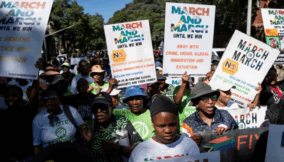
Nigeria’s development challenge is no longer a matter for abstract debate. It is a national emergency requiring urgent, deliberate and people-centred action.
Across the country, citizens are demanding accelerated progress: an economy that creates opportunities, communities that are safe, schools that prepare young people for the future, hospitals that save lives, and institutions that inspire confidence.
For many Nigerians, the desire is not merely to catch up with the world’s developed nations, but to reclaim the promise that once defined the country. Older citizens still speak nostalgically of the early post-independence years, when Nigeria was widely regarded as a nation of immense potential, strong public institutions and expanding opportunities. It was an era often recalled through the famous assertion that Nigeria’s problem was not money, but how to spend it.
Today, however, the country faces a far more sobering reality. Poverty, unemployment, insecurity, poor infrastructure, weak public services and declining confidence in institutions have combined to make daily life difficult for millions.
Recent poverty assessments have shown that a large number of Nigerians live in deprivation, struggling to afford food, shelter, healthcare, education and other basic necessities.
This reality demands more than isolated policies or short-term interventions. Nigeria needs a development framework that places the welfare, security and aspirations of its people at the centre of governance. One useful framework is Maslow’s Hierarchy of Needs.
Developed by psychologist Abraham Maslow, the theory explains that human needs exist in levels. At the base are physiological needs such as food, water, shelter and healthcare. Above these are safety needs, followed by love and belonging, esteem, and finally self-actualisation.
Maslow argued that people are more likely to pursue higher ambitions when their basic needs have been reasonably met.
Applied to Nigeria, this framework offers a practical roadmap for national development. It provides a way for policy makers to prioritise the needs of citizens and design programmes that move the country from survival to stability, productivity and prosperity.
The first responsibility of any government is to ensure that citizens can survive with dignity. Food, clean water, shelter, healthcare and access to basic services are not luxuries; they are fundamental human needs.
Yet, millions of Nigerian families are trapped in a daily struggle to feed themselves. Rising food prices, unemployment, poor wages and weak purchasing power have made hunger and malnutrition major concerns.
For many households, income is no longer sufficient to cover food, transport, rent, school fees and medical bills.
Government must therefore make food security a national priority. Investments in agriculture should go beyond ceremonial distribution of fertiliser or equipment.
Farmers need access to affordable credit, improved seedlings, irrigation facilities, storage systems, rural roads and reliable markets. Nigeria must also confront the insecurity that has prevented many farmers from cultivating their land.
Healthcare deserves similar urgency. A country cannot develop when citizens are dying from preventable diseases or when families are pushed into poverty by hospital bills. Primary healthcare centres should be functional, adequately staffed and equipped, especially in rural communities.
Housing must also be treated as a central development concern. Nigeria’s housing deficit remains enormous, leaving millions in overcrowded, unsafe or unaffordable accommodation. A serious national housing policy must encourage low-cost housing, strengthen mortgage systems, support local building materials and ensure that housing schemes reach ordinary workers, not only the wealthy.
Beyond survival is the need for safety. This includes physical security, economic stability, protection from violence and confidence in public institutions.
Nigeria’s insecurity has become one of the greatest threats to development. Kidnapping, banditry, terrorism, communal clashes, armed robbery and other forms of criminality have created fear across many parts of the country.
Farmers are afraid to go to their farms. Traders fear travelling on highways. Parents worry about the safety of their children in schools. Investors are reluctant to commit resources where lives and property are not secure.
No economy can thrive where fear has become a daily companion. Security must therefore be treated as a development issue, not merely a law-enforcement matter.
Government must improve intelligence gathering, strengthen policing, equip security agencies, reform the justice system and ensure that criminals are investigated and prosecuted without delay.
However, security cannot be achieved through force alone. Poverty, unemployment, drug abuse, corruption and social exclusion also fuel crime.
A comprehensive security strategy must therefore combine law enforcement with job creation, education, youth empowerment and community engagement.
When inflation erodes salaries and businesses collapse under the weight of high costs, insecurity grows.
A people constantly worried about the next meal, rent payment or medical emergency cannot devote their energy to innovation, enterprise or national progress.
Maslow’s framework also reminds us that human beings need love, belonging and a sense of community.
Nigeria’s diversity should be a source of strength, but ethnic, religious and regional tensions have often weakened national unity. Development cannot flourish in an atmosphere of division and suspicion. Nigerians must see themselves first as citizens with shared interests, shared responsibilities and a shared future.
Government, religious leaders, traditional institutions, schools and the media all have roles to play in promoting tolerance, dialogue and mutual respect.
A development agenda must restore the dignity of work and reward merit. Education should be linked to practical skills, innovation and employment. Vocational training must be strengthened.
Small businesses should receive easier access to finance, electricity, infrastructure and markets. Government must also recognise excellence in a credible manner.
Awards, appointments and honours should reflect genuine achievement, integrity and service. When recognition is reduced to political patronage, it loses meaning. A society that celebrates hard work, innovation and character inspires its people to aim higher.
At the highest level of Maslow’s hierarchy is self-actualisation: the opportunity for individuals to become the best version of themselves.
For Nigeria, this means creating an environment where citizens can innovate, create, lead, invent and contribute meaningfully to national progress.
Maslow’s Hierarchy of Needs offers Nigeria a simple but powerful lesson: a nation cannot expect its people to pursue greatness when they are still struggling to survive. Citizens who are hungry, unsafe, unemployed and excluded cannot fully contribute to national development.
Nigeria’s path to sustainable development must begin with meeting the basic needs of its people. From food security and healthcare to safety, social unity, education, innovation and self-fulfillment, every level matters.
When Nigerians are fed, secure, respected, empowered and given opportunities to thrive, the country will not merely recover its lost promise; it will build a stronger, more inclusive and more prosperous future.
. Ibekwe, lawmaker representing Bende North Constituency, Abia State.

Join BusinessDay whatsapp Channel, to stay up to date
Open In Whatsapp