…as supply struggles to keep pace
Nigeria’s two biggest listed palm oil producers are committing billions of naira to plantations, mills, and processing facilities despite already posting record earnings, wagering that Africa’s largest food market will remain structurally short of edible oil for years to come.
Rather than distributing the windfall from surging crude palm oil prices, Presco Plc and Okomu Oil Palm Plc, which posted a combined profit of N72.86 billion in the first quarter of 2026, compared to N69.32 billion, are recycling much of their cash into expanding production, reflecting growing confidence that domestic consumption will continue to outstrip local supply despite years of government efforts to revive the industry.
The investment drive comes as Nigeria, Africa’s most populous country, consumes an estimated 2.1 million to 2.2 million tonnes of edible oil annually but produces only about 1.9 million tonnes, leaving a supply gap that is filled largely through imports from countries such as Malaysia and Côte d’Ivoire, estimated at more than $600 million each year, which is worsening pressure on scarce foreign exchange reserves.
For investors, the latest quarterly results suggest the companies are positioning themselves not simply for another year of bumper profits but for a multi-year expansion cycle built around one of Nigeria’s most persistent agricultural deficits.
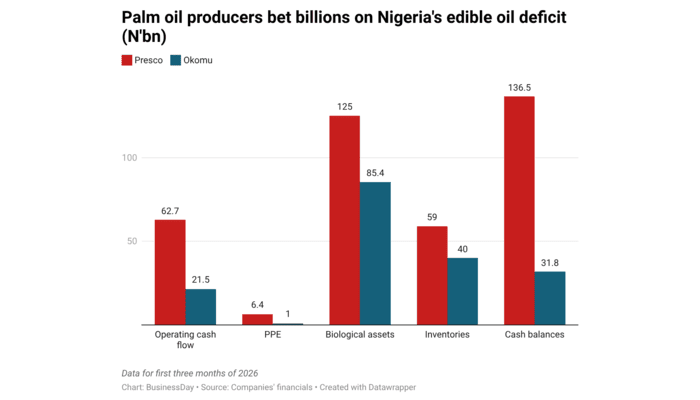
Presco generated N62.7 billion in operating cash flow during the first quarter, almost three times Okomu’s N21.5 billion, according to their latest financial statements.
Yet neither company treated the cash surge as an opportunity to reward shareholders immediately. Instead, both retained earnings to finance expansion after paying only final dividends for the 2025 financial year.
Presco spent about N6.4 billion on property, plant, and equipment during the quarter, more than double the amount invested in the same period last year, while Okomu invested close to N1 billion in capital projects and continued spending on immature plantations expected to generate future harvests.
The spending reflects an important distinction often obscured by headline earnings. Nigeria’s largest palm oil companies are no longer merely benefiting from favourable commodity prices; they are deploying those profits to increase future production capacity.
Balance sheets illustrate the scale of that commitment
Presco reported biological assets valued at almost N125 billion at the end of March, representing investments in oil palm plantations that will generate fruit over several decades.
Inventories stood at nearly N59 billion, while cash balances reached N136.5 billion despite ongoing investment. Okomu reported biological assets of N85.4 billion and inventories approaching N40 billion, alongside cash holdings of N31.8 billion.
Unlike annual crops, oil palm requires years before new trees become commercially productive. Every naira invested today, therefore, represents a bet on demand several years into the future.
That demand appears unlikely to weaken anytime soon.
Nigeria’s rapidly expanding population, estimated at more than 220 million people, continues to drive consumption of cooking oil, margarine, noodles, confectionery, and processed foods, all of which rely heavily on palm oil.
Industrial demand from soap manufacturers and other consumer goods producers has also expanded alongside urbanisation.
Long-term optimism masks growing stress across the wider industry
While Presco and Okomu are investing aggressively for future demand, smaller growers say a wave of cheaper palm oil entering Nigeria has pushed domestic prices below production costs, squeezing margins even during what is traditionally the lean production season.
Alphonsus Inyang, president of the National Palm Produce Association of Nigeria, said palm oil prices had fallen by about 50 percent in less than two months, leaving many producers unable to recover their production costs.
“Currently, at the price we are selling palm oil in this country, we are selling below production cost,” Inyang said in a recent interview. “Smallholder farmers depend on oil palm income for school fees, medicine, and their general economic well-being.”
He blamed porous land and maritime borders for allowing cheaper palm oil into Nigeria, saying illicit inflows were depressing domestic prices and undermining local producers.
“Government is losing revenue. The farmers are being suppressed through the influx of oil that comes in at very low prices,” he said.
The comments highlight one of the contradictions confronting Nigeria’s edible oil market. Although the country remains structurally dependent on imported edible oils to bridge a domestic supply gap, producers argue that smuggled imports are distorting market prices and weakening incentives for investment, particularly among smallholder farmers who account for much of Nigeria’s palm oil production.
While Nigeria remains one of the world’s largest producers of palm oil, decades of underinvestment, ageing plantations, weak rural infrastructure, and low-yield smallholder farming have prevented output from matching consumption.
The result is a structural deficit that has persisted despite repeated government programmes aimed at reviving the sector.
For companies operating at scale, however, that imbalance represents a rare long-term growth opportunity.
Analysts at CardinalStone argue that Presco has adopted a markedly different strategy from its closest rival.
The investment bank says the company’s recent acquisition of Ghana Oil Palm Development Company and Saro Oil Palm Limited in a combined deal worth $171.6 million expands its land bank by about 21,000 hectares while significantly increasing processing capacity through an additional 60-tonne-per-hour mill, giving Presco room to raise output over the coming years.
The acquisition also reflects a broader shift in strategy. Instead of relying solely on organic expansion within Nigeria, Presco is increasingly looking across West Africa for assets capable of accelerating production.
Okomu, by contrast, appears to be approaching growth from a different direction.
According to CardinalStone, management has indicated that the company has limited land available for large-scale new planting and is instead concentrating on improving yields, increasing extraction rates, and replanting ageing trees. Rather than expanding its footprint aggressively, Okomu is attempting to produce more palm oil from existing plantations.
‘Oil palm boom not ending soon’
Despite the current pressure on domestic prices, Inyang argued that the industry’s long-term fundamentals remain intact.
“The oil palm boom is not ending now. It will continue for as long as the food industry, chemical industry, and renewable energy sectors are thriving,” he said.
He said the association had proposed a 2.5 million-hectare oil palm cultivation programme to the federal government over the next five years, arguing that Nigeria should seize what he described as an opportunity created by tighter global supplies.
“There’s less palm oil from Indonesia, and so we’re proposing a 2.5 million hectare oil palm cultivation project that would run for five years to the government to plug this gap,” Inyang said.
He contrasted Nigeria’s approach with neighbouring Ghana, which he said had committed about $100 million this year to oil palm development under a structured national programme, arguing that Nigeria requires a similarly coordinated industrial strategy if it is to reduce dependence on imports and strengthen domestic production.
The differing strategies nevertheless point towards the same conclusion: both listed producers expect Nigeria’s edible oil deficit to remain large enough to absorb additional production.
Cash flow offers another indication of management priorities
After deducting capital expenditure, Presco generated roughly N56 billion in free cash flow during the quarter, while Okomu generated about N20.5 billion. Both companies, therefore, retained substantial financial flexibility even after funding expansion.
Presco’s balance sheet has also strengthened significantly following last year’s rights issue, which enabled the company to reduce borrowings sharply while maintaining one of the strongest cash positions in Nigeria’s agribusiness sector.
The healthy cash generation leaves both companies well-positioned should global palm oil prices become more volatile.
International prices remain supportive. Malaysian benchmark crude palm oil futures have risen over the past year, supporting higher revenues for producers across West Africa. While commodity prices remain cyclical, stronger pricing has encouraged companies to accelerate long-term investment rather than preserve cash.
The optimism, however, is not without risks. Climate change, erratic rainfall, rising fertiliser costs, labour shortages, environmental regulations, and currency volatility all threaten returns on long-term investments. Nigeria’s unpredictable trade and import policies could also reshape market economics.
For policymakers, the latest results provide evidence that private capital is willing to finance long-term agricultural investment where long-term demand is compelling.
Yet the concerns raised by producers over smuggling suggest that expanding plantations alone may not be enough. Without stronger border controls, improved rural infrastructure, and a coherent national oil palm strategy, investors warn that Nigeria could continue spending billions of dollars on edible oil imports even as local producers expand capacity.

Join BusinessDay whatsapp Channel, to stay up to date
Open In Whatsapp