Baker came to Nigeria chasing rhythm; what he found was something larger and more dangerous — Fela’s Afrobeat as politics, Lagos as fire, music as contraband, and the studio as a battlefield in the machinery of global commerce.
There are foreign musicians who come to Africa as tourists of rhythm. They arrive with microphones, romantic language and a hunger for authenticity, take what they need, return to Europe or America, and then allow the world to believe that African genius became important only when Western curiosity certified it.
Ginger Baker was not entirely outside that complicated history. No British rock star arriving in Lagos in the early 1970s could be. But Baker’s Nigerian story was not a simple case of musical tourism. He did not merely visit Lagos, record a little African rhythm, and leave. He entered the city with the recklessness of a man fleeing the limits of his own legend. He built a studio. He sat with Fela Kuti. He played with Africa ’70. He encountered Tony Allen’s rhythmic authority. He crossed paths with Paul McCartney. He quarrelled with record-business power. He was pulled into Fela’s outlaw orbit. And, in the end, Lagos both enlarged and burned him.
The story of Ginger Baker in Nigeria is not just the story of a white drummer discovering Afrobeat. It is the story of Lagos as a battlefield: a place where music, money, marijuana, ego, colonial memory and commercial control collided.
By the time Baker arrived in Nigeria, he was already famous. As the drummer of Cream, alongside Eric Clapton and Jack Bruce, he had helped turn the rock drum kit into a weapon of spectacle. Cream made him a star, but fame did not satisfy him. Baker was never merely a rock drummer. His deeper obsession was rhythm: jazz rhythm, African rhythm, ritual rhythm, rhythm as power, rhythm as possession. Rock had given him an audience. Africa offered him a larger grammar.
Lagos gave him that grammar with heat attached.
Lagos Before the Myth
The Lagos that received Baker was not a provincial outpost waiting for validation from London. It was already one of the great music cities of the twentieth century. Highlife, juju, jazz, soul, funk, indigenous percussion and postwar Nigerian ambition were colliding in clubs, hotels, bars, streets, military spaces and recording rooms. Nigeria was emerging from civil war. Oil money was beginning to change the economy. The city was volatile, brilliant, unruly and self-inventing.
Lagos in that period was not polite. It was a place of generators, sweat, police checkpoints, military anxieties, artistic audacity, street intelligence and night-long music. It punished illusion. Anyone who entered it with fantasy had to meet its reality.
At the centre of that reality stood Fela Anikulapo Kuti, then still often billed as Fela Ransome-Kuti. Fela was no longer simply a highlife-jazz musician. After his American experience and political awakening, he was building something more dangerous and original: Afrobeat as a total system of sound and resistance.
Afrobeat was not African colour added to Western pop. It was an architecture. Its bass lines moved like argument. Its horns spoke like public accusation. Its guitars ticked like machinery. Its percussion did not merely keep time; it created atmosphere. Its songs stretched beyond radio discipline into sermon, trance, satire and revolt.
And inside that architecture was Tony Allen, the drummer whose genius made Afrobeat breathe.
This is where Baker’s Lagos story must be handled carefully. Baker was important. He was famous. He was a serious drummer with genuine respect for African rhythm. But he did not invent Afrobeat. He did not give Fela authority. He did not rescue Nigerian music from obscurity. Fela, Tony Allen and Africa ’70 were already building a world.
Baker entered that world as a guest, a student, a collaborator, a provocateur and, at times, a disruptive foreign presence.
Fela and Baker: Two Difficult Men in One Fire
The association between Ginger Baker and Fela Kuti was powerful because it joined two difficult men who understood performance as command.
Fela was imperial, brilliant, funny, sensual, confrontational and politically fearless. Baker was volatile, abrasive, technically fearless and allergic to restraint. Both men were drawn to danger. Both believed music should not behave. Both had personalities too large for ordinary collaboration. But their similarities also concealed a crucial difference: Fela was building a political universe; Baker was searching for a musical one.
For Fela, music was not simply a groove. It was a government. The Shrine was not just a nightclub. It was parliament, temple, court, theatre, school and battlefield. Fela’s songs attacked soldiers, bureaucrats, colonial mentality, class imitation, corruption and spiritual cowardice. His stage was a republic of defiance.
Baker came to Lagos looking for rhythm. Fela was offering something larger: rhythm as rebellion.
That was the force that drew Baker in. He had known Fela from London’s jazz circles, but Lagos revealed the full magnitude of what Fela had become. In Nigeria, Fela was not simply a musician. He was a sovereign presence. Around him gathered singers, dancers, horn players, drummers, wives, political loyalists, hustlers, radicals, hangers-on and believers. To enter Fela’s orbit was to enter a world where art and danger were inseparable.
Baker did not stand outside that world. He moved through it. He recorded with Fela. He performed with him. He associated with Africa ’70. He saw, at close range, the machinery of Afrobeat and the turbulence of Fela’s life.
But if Fela’s world gave Baker musical revelation, it also brought trouble.
Live!: The Sound of Lagos in Abbey Road
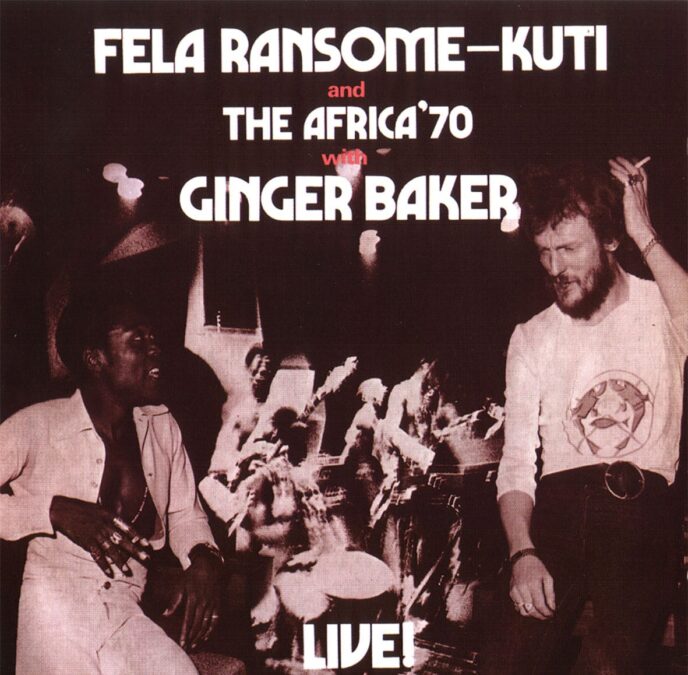
The key document of their collaboration remains Fela Ransome-Kuti and The Africa ’70 with Ginger Baker: Live!, recorded in 1971 at Abbey Road. The album carries one of the great ironies of modern music: a Nigerian band, already in full possession of its own sound, entering one of Britain’s most famous studios and refusing to become British.
The music does not bend toward London. It remains Lagos in command.
“Let’s Start” opens like both invitation and warning. “Black Man’s Cry” carries the ache and assertion of postcolonial consciousness. “Ye Ye De Smell” stretches into Fela’s gift for ridicule and groove. “Egbe Mi O” moves with the hypnotic patience of a band that understands duration not as excess but as method.
Baker’s presence is significant, but he does not overpower the band. He enters the current. That is the beauty of the record. It is not fusion in the lazy sense. It is negotiation. Baker brings attack, volume, rock authority and jazz instinct. Africa ’70 brings structure, patience, political heat and rhythmic depth.
But the engine remains Tony Allen.
Allen’s role cannot be overstated. He did not drum like Baker. Baker often played like a storm front: dramatic, explosive, theatrical. Allen played like a city’s hidden electrical system. His independence of limbs, restraint and internal complexity allowed Afrobeat to move with both discipline and looseness. He could make a large band sound inevitable.
This is why Baker’s respect for Allen matters. Baker was not easily impressed. Yet in Tony Allen he encountered a drummer whose sophistication could not be reduced to power. Allen’s genius was not in dominating the music but in making the entire machine breathe.
In later years, the Baker-Allen drum exchanges would become part of the mythology surrounding the Fela-Baker relationship. But the deeper lesson was already there in the Africa ’70 recordings: Baker may have been the international rock star, but inside Afrobeat, Allen was the master architect.
Batakota: The Studio as an Insult to Power
If Baker’s musical collaboration with Fela was one part of the Lagos story, his studio ambition was another.
Baker did not merely come to Nigeria to play. He came to build. His Batakota studio, also known as ARC Studios, was one of the boldest gestures of his life. A former Cream drummer could have stayed inside the protected circuit of British and American rock prestige. Instead, Baker chose to establish a serious recording facility in Lagos.
On the surface, this looked like a tribute to African music. In reality, it was also a provocation.
A studio is never just a studio. It is infrastructure. It is control. It is access. It determines who records, under what conditions, at what quality, and through whose channels the sound reaches the world. In a booming Nigerian music environment, a well-equipped studio owned by a famous British musician was bound to unsettle existing interests.
Baker’s own archive presents the conflict bluntly. After Paul McCartney and Wings recorded part of Band on the Run in Lagos and visited Baker’s studio, the sound quality at Batakota was said to surpass what EMI could offer locally at the time. Then came the warning. At a farewell party for Wings, an EMI executive allegedly told Baker, in effect, that Lagos was EMI territory and that they were going to make things difficult for him.
Whether one treats Baker’s version as complete truth or as the wounded memory of a combative man, the underlying tension is clear. Baker had entered not only a music scene but a commercial battlefield. The Nigerian recording industry had gatekeepers. Labels, executives and entrenched interests understood the value of control. Baker’s studio threatened that control.
This is the “studio war” at the heart of his Lagos story.
The phrase should not be understood only as a personal quarrel. It was also symbolic. Who would own the infrastructure of African sound? Who would profit from Nigerian music? Who would decide whether Lagos artists needed London, or whether London needed Lagos? Baker’s studio raised these questions even if Baker himself did not always frame them in such political terms.
For Nigerian musicians, the matter was complicated. On one hand, Baker brought equipment, attention and international possibility. On the other, he was still a white British star entering a postcolonial market with capital, access and foreign prestige. Admiration and suspicion could easily exist side by side.
This is why the Baker story cannot be told only as romance. It was also a struggle over territory.
Paul McCartney, Fela and the Lagos Reversal
Paul McCartney’s Lagos episode adds another layer to the drama. McCartney came to Nigeria to record Band on the Run, imagining, perhaps, a more relaxed African setting than the one he found. Instead, he encountered a tense city, practical difficulties and the force of Fela’s suspicion.
Fela reportedly challenged McCartney over whether he had come to exploit African music. That confrontation matters. It showed that Fela understood the politics of cultural extraction. He was not dazzled by Beatles fame. He saw the danger of Western musicians arriving in Africa, taking the sound, and selling it back to the world as their own adventure.
The great reversal is that Lagos became the judge. McCartney, Baker and other Western musicians were not entering an empty space. They were entering a city with its own authorities, its own stars, its own suspicions and its own standards.
Baker’s role in that scene was ambiguous. He was both insider and outsider. He could take McCartney to Fela. He could explain the scene to Western musicians. But he was also part of the very world Fela had reason to distrust.
This ambiguity is what makes him interesting. Baker was not simply an exploiter. He was also not simply an innocent student. He was a man moving between worlds, benefiting from both, wounded by both, and never fully belonging to either.
Grass, Heathrow and the Collapse of a Breakthrough
The most explosive episode in the Baker-Fela story concerns marijuana, a drum and a cancelled British tour.
After the Live! recording, plans emerged for Fela and Africa ’70 to undertake a UK tour. The tour could have been a major moment in Fela’s international expansion. Africa ’70 was at a formidable peak. Baker believed deeply in the band’s power and reportedly felt they could have achieved major success if the tour had gone ahead.
Then came the incident.
According to accounts associated with Baker’s archive and later retellings, a man linked to Fela’s circle arrived at Heathrow carrying marijuana hidden in a drum, with Baker’s address as the contact point. The courier was arrested. Baker’s name was pulled into the matter. His home was raided. He was reportedly found with a small quantity of marijuana for personal use. The scandal produced press attention, family consequences and, most importantly for the music, the cancellation of the planned Africa ’70 tour.
It is a remarkable and revealing story. Fela’s outlaw mythology was not theatre. It had real consequences. The same anti-establishment atmosphere that gave his music danger and moral force could also produce chaos around anyone close to him. Baker, who had lived much of his own life in defiance of respectability, now found himself implicated by another man’s republic of risk.
There is a sharp irony here. Baker’s name and address were supposed to provide access, legitimacy or safe passage. Instead, they became evidence. The British rock star who had entered Fela’s world as a bridge to international opportunity became, in that moment, a casualty of the very lawlessness that surrounded the movement.
The cancelled tour remains one of the great “what ifs” of Afrobeat history. What if Africa ’70 had toured Britain at that moment, with Baker’s support and the momentum of the Abbey Road recording? What if Fela’s most disciplined band had confronted British audiences not as an exotic curiosity but as a fully armed political orchestra? What if Afrobeat’s global reception had accelerated earlier?
We cannot know. But the loss was real.
Baker’s Lagos: Romance and Ruin
Baker’s Nigerian years should not be sentimentalised. He was not a saviour. He was not the white founder of Afrobeat. He was not the man who made Fela important. Such claims would be false and offensive to the historical record.
But neither should Baker be dismissed as a mere tourist. His Lagos period was too deep, too risky and too consequential for that. He lived inside the music more seriously than most Western musicians of his generation. He did not treat African rhythm as decorative seasoning. He recognised it as a higher discipline. He built infrastructure around it. He recorded with its masters. He allowed it to reshape his own musicianship.
At the same time, Lagos exposed his contradictions. Baker wanted freedom but brought with him the privileges and assumptions of a British rock aristocrat. He admired African music but entered a commercial system already loaded with postcolonial suspicion. He wanted to build a studio but found himself in conflict with entrenched recording interests. He loved Fela’s fire but was burned by the smoke around it.
That is why the Lagos story matters. It contains no clean heroes.
Fela was a genius, but his world could be reckless. Baker was a serious musical pilgrim, but also a chaotic egoist. EMI and other record-business interests were protecting territory, but their territoriality also revealed how valuable Lagos had become. Tony Allen was quieter than both Fela and Baker in the mythology, yet his drumming remains the deepest musical intelligence in the room.
And Lagos itself was the central character: seductive, hostile, brilliant, dangerous, generous and unforgiving.
The White Drummer in Fela’s Republic
The image remains powerful: Ginger Baker, red-haired, volatile and already mythologised by British rock, entering Lagos with drums, equipment, appetite and arrogance; Fela Kuti, imperial and insurgent, presiding over a sound that turned groove into government; Tony Allen, understated and impossible, building the rhythmic engine beneath them all; EMI executives watching territory shift; marijuana hidden in instruments; a British house raided; a tour cancelled; a studio dream slowly becoming untenable.
This was not a side chapter in rock history. It was a collision between Afrobeat’s revolutionary Lagos universe and the machinery of global music commerce.
Baker came to Nigeria chasing rhythm. What he found was larger and more dangerous. He found that rhythm could be infrastructure. Rhythm could be politics. Rhythm could be contraband. Rhythm could threaten record companies. Rhythm could build friendships and destroy plans. Rhythm could make a British rock drummer feel, perhaps for the first time, that London was not the centre of the musical world.
Fela showed him that music could be a republic.
Lagos showed him that every republic has a war.

Join BusinessDay whatsapp Channel, to stay up to date
Open In Whatsapp