Nigeria’s push to reduce food inflation and strengthen local feed production has put U.S.-Nigeria agricultural trade back on track.
As the feed mill industry struggles with rising input costs and processors scale up capacity, the U.S. Soybean Export Council, USSEC, is working with Nigerian stakeholders to improve efficiency, nutrition, and competitiveness.
One of the efforts was a recent ‘Nigeria: Now’ summit with the theme ‘Bridging Markets, Building Future’, organised by USSEC in Lagos, designed to deepen technical collaboration, precision nutrition, and trade partnerships that can help Nigerian agribusinesses cut costs, boost soy yields, and expand into export markets. Soybeans are a major feed source for animal and livestock agriculture.
The summit, which brought together over 150 agricultural leaders from across Nigeria, addressed the country’s protein deficit and how to enhance the food and feed industry’s production capabilities. The conference initiative centred on building sustainable long-term trade partnerships and improving protein security, which remains a vital issue for Nigeria.
It is said that Nigeria’s protein consumption per capita sits at roughly 45.4 grammes per day, which falls significantly below the UN FAO-recommended minimum of 60 grammes per day. The ‘Nigeria: Now’ conference highlighted how consistency in quality and sustainability of US soy can enhance animal performance, improve feed conversion ratios, and foster the development of the livestock and aquaculture sectors in Nigeria.
The summit was enriching, as feed millers, as expected, gained insights from different presentations. U.S. soy growers shared their experiences on sustainable farming and its impact on the quality of soybeans produced and what drives their passion in nourishing the world. The U.S.-Nigeria bilateral relations and opportunities for agricultural development were also one of the key highlights.
Brent Babb, executive director, Soy Excellence Centre & Sub-Saharan Africa (USSEC), provided more insight on the socioeconomic and commercial attraction that informed the council’s decision to collaborate with Nigeria to boost soybean production and usage.
Understandably, over 60% of the U.S. soy crop is exported around the world. The council, which is already working with Asia, North America and other regions, sees great opportunities in Sub-Saharan Africa, with Nigeria being the leader in that market.
Underscoring the importance of soybeans as offering one of the best, if not the best, proteins, especially for the feed industry, Brent said Nigeria’s population continues to grow and demand is also strong, but per capita consumption is still low. “So there are lots of opportunities to grow the product and its use here.
“There’s opportunity in soy foods as well. So, we are here to complement those industries and continue to build demand and to build the use for soy.”
He said USSEC sees its programmes as a complement to Nigeria. “Nigeria grows some soybeans, but as the demand continues to grow for consumption, the country may have to import more soybeans. So we’re here to work in complement, to work with the poultry, aquaculture, and livestock industries.”
On technical support that USSEC offers to livestock farmers and Nigerian feed millers and soy processors, Brent said they are working with the poultry industry in the formulation of the feed at the feed mill. “It is not just always about soy, but also helping to be more efficient within a feed mill.”
In 2025, Nigeria imported about 62,000 tonnes of U.S. soy, and Brent hopes that trade between Nigeria and the U.S. continues. “We’ve been in many markets for a long term without large exports, so it’s great to see exports like we saw last year from Nigeria buying from the U.S. I think the U.S. and Nigeria can continue to be partners on soy products.”
Brent acknowledged the energy and demand in Nigeria. He sees the energy, the financial investments coming in, and the value chain getting stronger every year. “We really see Nigeria taking advantage of all that energy and opportunity that’s here in the country.”
However, the challenge is to have all those energy and financial aspects pulled together to get a value chain that is consistent to stimulate demand.
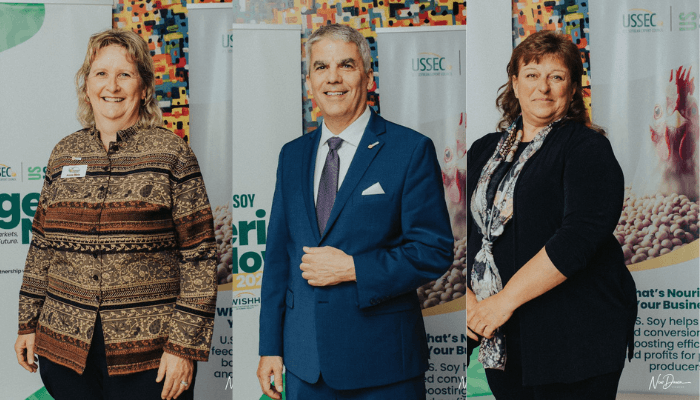
Corroborating Brent’s views, Cindy Pulskamp, Director, U.S. Soybean Export Council and United Soybean Board, North Dakota, USA, said they are collaborating to achieve Nigeria’s goal of closing the country’s animal protein deficit.
Cindy, whose farm is 114 years old and was inherited from her family, said they are working together with Nigerians to meet goals. “As a farmer in North Dakota, I’m looking to work with the agribusiness side, the food security side, working all together, sharing what we know. There’s a saying in the United States that ‘a rising tide helps all boats float,’ and that’s what we’re trying to do.”
Cindy also explained why U.S. soybeans are known for their lowest carbon footprint compared to other soybeans from other regions. She said it’s about soil health. According to her, soil is so important. We must ensure we are taking care of it so that it can produce a quality crop.
When planting, Cindy said they use precision agriculture. Some farmers use drones for crop protection instead of using heavy equipment.
On how her farm handles post-harvest losses, which cost Nigeria about $10 billion annually, representing 30-50 percent of agricultural output, according to media reports, Cindy said she employs on-farm storage. This depends on weather conditions, but the climate in North Dakota, where she farms, is an advantage.
At the event, Anne Meis, Chair, Soy Excellence Center Global Advisory Panel, Nebraska, USA, emphasised the importance of the free training they offer for farmers and millers in Nigeria. She was delighted that after the annual training, the farmers do things differently, change practices and get improved-quality information.
“This year alone, there were over 1,200 graduates in our programme. In the last five years, there have been over 5,000 participants that have gone through this programme in Nigeria. And they’ve taken this information back to their workplace,” she said.
Anne said on the feed mill side, “We also offer a course specifically for feed milling so that they can learn exactly the right combination and the high-quality feed that it takes to feed the animals.” ” Their reports indicate that they have incorporated the concept of full-fat soy and that their pellet production has increased 15% to 20%.”
She revealed that a survey shows 94% of the course participants said they have stronger job skills now after completing the programme, and 93% are saying their companies are more profitable.
Anne added, “We are here to support the livestock industry because Nigeria has great soy production, but as your population and your economic engine continue to increase in this country, your country is going to need more protein. We want to be here when that transition happens, where the livestock industry increases, and you need more soy for the feed mills and the poultry barns, and we want your country to have the preference for U.S. soy. It’s a competitive market,” she said.
She said U.S. Soy has established centres in five regions throughout the world to provide training. For Nigeria and others, the training offers best global practices. Through the training, developed by global experts, she says, “We want your country to succeed.”
Also speaking at the forum, Simeon Ohwofa, President of the Nigeria Institute of Animal Science, NIAS, who was represented by Eustace Ayemere Iyayi, Registrar of the Nigeria Institute of Animal Science, said the theme ‘Bridging Markets, Building Futures’ resonates with NIAS’s mission. “At NIAS, we believe that by working together, combining research and market development expertise with NIAS’s professional and regulatory functions, we can engender and accelerate the kind of sustainable growth in livestock and aquaculture productivity that benefits farmers, feed producers, and Nigerian animal protein consumers alike, thereby reducing or closing the protein gap in Nigeria.”
Ohwofa commended the U.S. Soybean Export Council for sustaining the conference since 2022.
Ruth Abisola Olusanya, Commissioner for Agriculture and Food Systems, Lagos State, represented by Emmanuel Audu at the conference, said food security is not just an agricultural conversation but an economic, social, and national development imperative.
Recognising that Nigeria faces a significant protein deficit, she said addressing this challenge requires deliberate investments in the poultry, aquaculture, and livestock sectors, all of which depend heavily on efficient feed systems and a strong soil value chain.
As protein security remains one of the most critical components of the food security agenda, the conference serves as a constant reminder of this and the opportunities therein for agriculturalists.

Join BusinessDay whatsapp Channel, to stay up to date
Open In Whatsapp