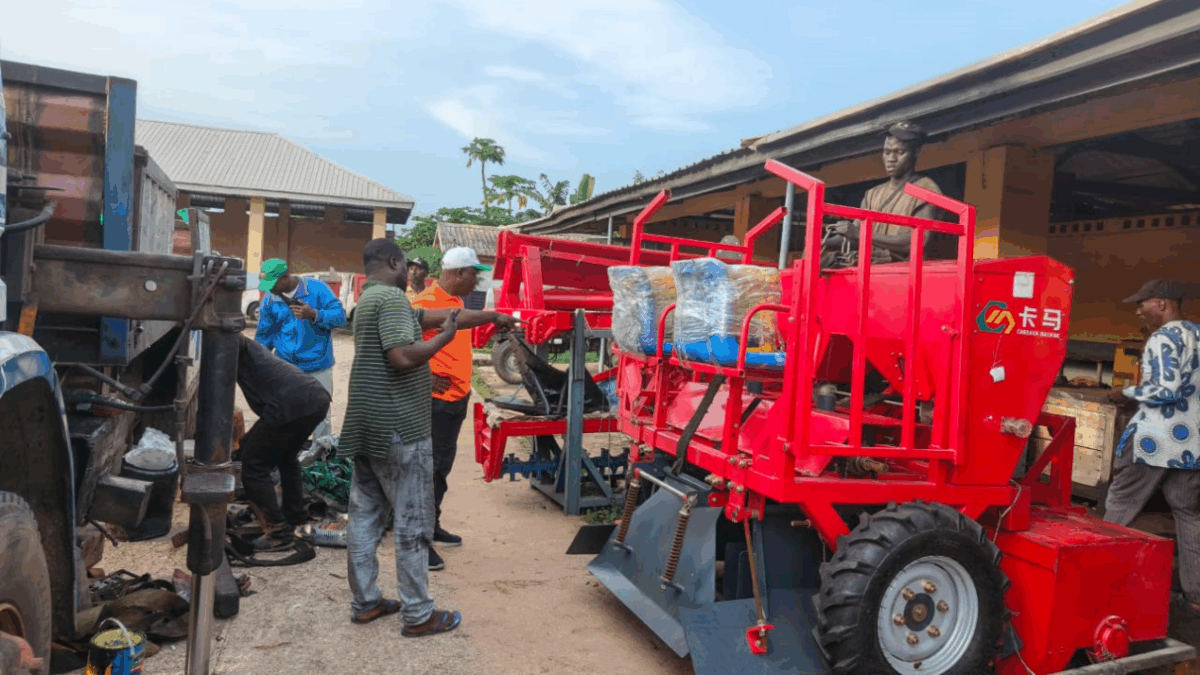
Nigeria’s drive to modernise agriculture and strengthen food security has received a major boost following the delivery of the country’s first complete set of full-cycle cassava mechanisation equipment from China to the National Root Crops Research Institute (NRCRI) in Umudike, Abia State.
The delivery represents an advancement in the growing agricultural science and technology partnership between Nigeria and China,
This was to enhance cassava production by reducing dependence on manual labour while improving efficiency and productivity across the value chain.
According to the Chinese Embassy in Abuja, the shipment, which arrived on June 17, comprises four sets of specialised cassava farming equipment designed to mechanise every stage of production.
“The equipment includes a deep plough for land preparation, a rotary tiller for soil cultivation, a combined ridging and cassava planter for efficient planting, and a vibrating-chain cassava harvester for mechanised harvesting.
“The integrated system will enable farmers to complete the entire cassava production cycle using modern machinery, significantly cutting production time, lowering labour costs, improving operational efficiency, and increasing output.
The equipment would to help transform cassava farming practices in Nigeria by promoting standardised production methods, improving farm productivity, and making commercial cassava cultivation more attractive and profitable for farmers.
“The initiative forms part of an ongoing collaboration between the Chinese Academy of Tropical Agricultural Sciences (CATAS) and the National Root Crops Research Institute, with support from the Hainan Provincial International Science and Technology Cooperation Project”, the Embassy said.
It also noted that the partnership has over the years focused on advancing cassava research through improved germplasm development, sustainable farming technologies, scientific exchange, and capacity building for researchers and farmers.
“As Africa’s foremost research institution dedicated to root and tuber crops, the NRCRI has continued to work closely with its Chinese counterpart to develop innovative technologies capable of addressing production challenges facing Nigeria’s cassava sector”, it added.
According to the statement, both institutions are also collaborating on the establishment of the China–Nigeria Joint Laboratory on Cassava, a research platform expected to accelerate the development of improved cassava varieties, locally adapted production technologies, and innovative solutions to increase yields and strengthen the country’s cassava value chain.
“The delivery of the mechanisation equipment is one of the early outcomes of the Africa Cassava Yield Doubling Initiative (ACYDI), launched by CATAS in 2023 under the framework of the Forum on China–Africa Cooperation (FOCAC) Beijing Action Plan (2025–2027).
“The initiative seeks to double cassava yields across Africa by integrating improved seed varieties, modern agronomic practices, mechanisation, farmer training, and technology transfer.
“Beyond increasing farm productivity, the programme aims to strengthen food security, enhance rural livelihoods, and promote sustainable agricultural development across participating African countries”, the Embassy said.
Nigeria remains the world’s largest producer of cassava, making the crop a strategic component of the country’s food system and agro-industrial development.
However, much of the country’s cassava cultivation is still carried out using traditional farming methods, resulting in relatively low productivity despite vast production volumes.
Stakeholders believe that introducing full-cycle mechanised farming systems could help bridge the productivity gap, reduce post-harvest losses, encourage large-scale commercial production, and improve the competitiveness of Nigeria’s cassava industry in regional and global markets.

Join BusinessDay whatsapp Channel, to stay up to date
Open In Whatsapp