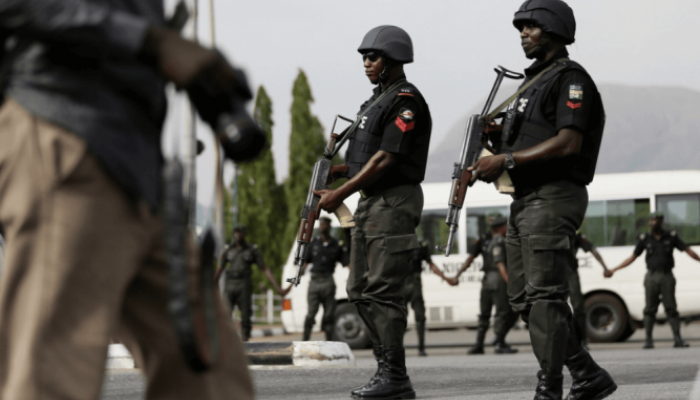
Security agencies have assured residents of the Federal Capital Territory (FCT) that the heavy deployment of security personnel and barricades across parts of Abuja is a routine security measure aimed at maintaining law and order, dismissing fears of any imminent security threat.
The assurance came on Thursday during a joint media briefing by security and intelligence agencies, following growing public concern over the increased security presence that has disrupted traffic and slowed movement across the city’s central business district.
In recent days, strategic roads within Abuja’s city centre have witnessed heightened security checks and barricades, resulting in long queues of vehicles and delays for thousands of commuters, including civil servants, business owners and other workers travelling to and from offices.
Addressing journalists, Anietie Iniedu, Force Public Relations Officer, explained that the operation was a coordinated effort involving multiple security agencies and should not be interpreted as a response to any specific security emergency.
“It is a joint operation. There is no cause for alarm at the moment,” Iniedu said.
According to him, security agencies decided to strengthen deployments after observing an increase in public protests within the nation’s capital, with the objective of preventing disruptions and ensuring public safety.
“We’ve noticed that there has been an upsurge of protests in the city centre, and we’re trying to maintain law and order as is our basic and primary responsibility.
The deployments are basically deployments with movement from one location to the other to ensure that our city centre is safe,” he stated.
The police spokesman noted that Abuja occupies a unique position as Nigeria’s seat of government and home to diplomatic missions, international organisations and major investment interests, making the protection of the city a national priority.
“Remember, we’re in the capital, and there’s a lot that has to be done to ensure confidence in those in the city centre and also for our foreign investors,” he added.
Iniedu also disclosed that the Nigeria Police Force has adopted an expanded security strategy that goes beyond conventional intelligence gathering by integrating stronger community participation.
He described the approach as “intelligence-led community collaborative policing,” explaining that security agencies increasingly recognise the importance of local communities in preventing crime and responding to emerging threats.
“We’ve seen that intelligence alone won’t help us. We have gone far to create collaborative processes with our communities,” he said.
Also speaking at the briefing, Kingsley Amako of the National Coordination Office of the Nigerian Financial Intelligence Unit (NFIU) said security agencies have continued to improve intelligence gathering and financial surveillance to disrupt terrorism financing and other organised criminal activities.
According to Amako, criminal and terrorist groups continually modify their methods, compelling security institutions to constantly adapt their operational strategies.
“We have very robust intelligence-gathering mechanisms. As they are evolving into new tricks and changing their tactics, we are also evolving with them,” he said.
While acknowledging that certain security operations cannot be disclosed publicly for operational reasons, Amako stressed that Nigeria’s security and intelligence agencies are working collaboratively to address evolving threats across the country.
He also encouraged journalists to maintain regular engagement with security institutions whenever clarification is required, noting that public communication remains essential in building confidence and preventing misinformation.

Join BusinessDay whatsapp Channel, to stay up to date
Open In Whatsapp