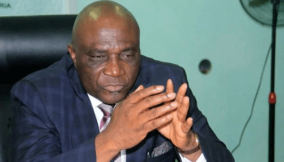
The implementation of the African Continental Free Trade Area (AfCFTA) is advancing much faster than is publicly perceived, even though many of the most critical reforms are taking place behind the scenes, according to George Elombi, Afreximbank President.
Responding to questions from journalists at a media roundtable in Abuja on Wednesday, Elombi rejected the view that Africa’s flagship trade pact has failed to meet expectations since trading under the agreement began, arguing that much of the work required to make the free trade area operational is largely invisible to the public.
The AfCFTA, which officially commenced trading in 2021, seeks to create a single African market by reducing tariffs and other barriers to trade among participating countries. While supporters say it has the potential to significantly boost intra-African commerce and industrialisation, implementation has been slowed by the need to harmonise regulations, improve infrastructure and address other non-tariff barriers.
“Free trade area is going faster on the invisible. Maybe on the visible, it’s slow. It is going extremely fast,” Elombi said.
He said the implementation of the agreement extends far beyond the movement of goods across borders, involving years of technical work to harmonise standards, negotiate protocols and establish the institutions needed to support cross-border trade.
According to him, one of the most significant tasks has been aligning product standards across participating countries, a process that requires regulators from dozens of African nations to agree on common specifications for thousands of products before trade can flow seamlessly.
“You have to harmonise the standards. Harmonising the standards means you take thousands and thousands. Then you harmonise the standards, and everybody agrees that that’s the standard,” he said, adding that hundreds of standards have already been agreed.
Beyond regulatory alignment, Elombi said payment systems and trade infrastructure remain essential building blocks for the agreement.
According to him, payment infrastructure, including the Pan-African Payment and Settlement System (PAPSS), was another critical pillar of the agreement, enabling businesses to settle cross-border transactions in local currencies without relying on correspondent banks outside the continent.
He noted that efforts to modernise border posts and facilitate customs procedures were beginning to change the way officials approached intra-African trade.
He cited Nigeria’s Comptroller-General of Customs as an example of the changing mindset among public officials, saying the agency had become a driving force behind plans to upgrade border infrastructure linking Nigeria with Cameroon.
Elombi explained that improved border facilities would make it easier for Nigerian goods, for instance, to access markets in Central Africa, including Cameroon, Chad, Gabon, the Republic of Congo and the Democratic Republic of Congo.
“The person pushing us now to reconstruct the border posts is the Director-General of Customs of Nigeria,” he said. “His reasoning is that if you put the right infrastructure on the Cameroon-Nigerian side, then you open the market for Nigerian goods.”
He said Afreximbank was prepared to finance feasibility studies and provide support for the planned border infrastructure where necessary, describing such investments as critical to unlocking the benefits of continental trade.
Elombi also pointed to the Intra-African Trade Fair as evidence that commercial activity under the AfCFTA is gathering momentum. The trade fair, organised by Afreximbank every two years, has consistently generated about $50 billion worth of trade and investment deals at each edition, he said, with more than two-thirds of those agreements eventually reaching completion.
He cited the example of a Nigerian oil services company that secured a major contract in Algeria during the last trade fair and subsequently received financing from Afreximbank.
While acknowledging that many Africans expect to judge the agreement by visible increases in cross-border trade, Elombi argued that conventional trade statistics often fail to capture the full scale of commerce taking place across the continent, particularly informal trade conducted by small businesses.
“The trade is happening, it’s just not so visible,” he said.
He said economists and policymakers would need to develop better methods of measuring intra-African commerce to reflect the realities of trade across the continent, where transactions are frequently conducted outside traditional reporting systems.
Looking ahead, Elombi announced that Lagos will host the next Intra-African Trade Fair from Nov. 5 to 11, 2027, expressing confidence that the event would attract businesses and investors from across the continent and further strengthen commercial ties under the AfCFTA.
He also disclosed that Lagos will host the Creative Africa Nexus (CanEx) weekend in November this year as part of Afreximbank’s efforts to expand opportunities in Africa’s creative economy.

Join BusinessDay whatsapp Channel, to stay up to date
Open In Whatsapp