For many years, discussions around accountability in Nigeria focused almost entirely on the Federal Government. State governments, despite managing large public resources and delivering essential services that affect citizens’ lives, operated with limited public scrutiny. Budgets were hard to access, procurement information was often hidden, and financial reporting remained inconsistent. Today, however, clear signs show subnational governments are improving transparency and accountability, even if significant gaps remain.
This gradual shift did not happen by accident. It emerged through years of institutional reforms, civil society pressure, citizen engagement, and partnerships aimed at opening state finances to public scrutiny. Among the organisations leading this transformation is BudgIT, a civic-tech organisation that has spent over a decade helping citizens understand public finance and demand better governance across Nigeria’s 36 states.
At the state level, BudgIT’s work goes beyond criticism or scorecards. The organisation supports subnational governments to improve fiscal transparency, budgeting processes, and citizen engagement. Through technical assistance, policy engagement, budget analysis, and fiscal data dissemination, BudgIT has helped create systems that let citizens better understand how public resources are allocated and spent.
The progress is visible. A decade ago, only a few Nigerian states publicly released budget documents. Today, most states publish proposed budgets, approved budgets, citizen budgets, quarterly reports, and other fiscal information, enabling citizens, journalists, researchers, and civil society groups to monitor government spending more effectively. While transparency levels still vary, governors and public officials increasingly recognise that openness is no longer optional.
Part of this progress traces to BudgIT’s sustained focus on subnational governance. Through research, advocacy, and institutional partnerships, the organisation has pushed state governments to adopt better transparency practices. More importantly, BudgIT has shown that transparency should not just mean publishing documents online but enabling citizens to understand and use them.
One of our flagship initiatives at the subnational level is the State of States series, a one-on-one, comprehensive conversation held on Wednesdays on X. The chat brings together stakeholders from different states and technical experts to look at state-level fiscal sustainability and performance. Since its commencement, the series has witnessed high levels of citizen engagement, with citizens meeting their state representatives to share their views on the progress and challenges of their state governments. It has also been a reference point for policymakers, development partners, investors, researchers, and citizens seeking to understand how states generate revenue, manage expenditure, and position themselves for long-term economic growth.
This chat goes beyond political narratives to evaluate focus states using measurable indicators, including internally generated revenue, debt sustainability, recurrent expenditure patterns, fiscal discipline, and economic resilience. By comparing performance across states, the State of States series has deepened conversations around prudent financial management, encouraged a healthy feedback channel from citizens to their governors, and helped unpack needs-based solutions to improve governance outcomes. We will have another X space session in the coming days, where we continue to engage citizens, commissioners and other stakeholders from states.
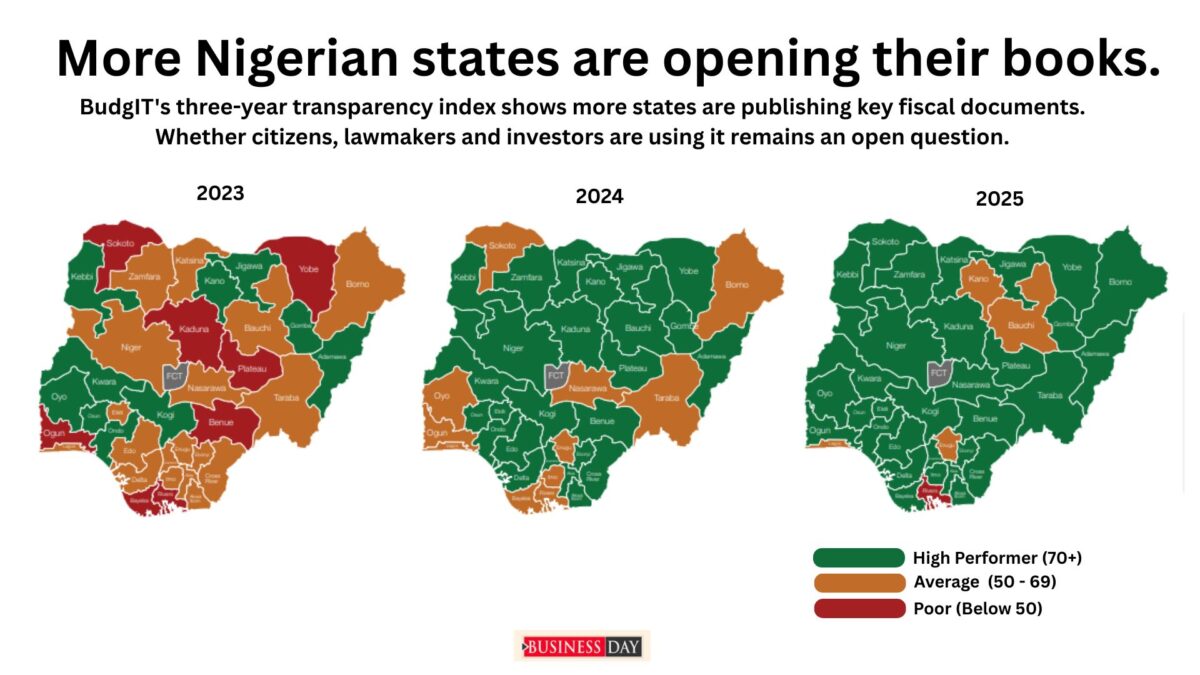
Complementing this effort is the State Fiscal Transparency League Table, another major initiative that evaluates how states publish and disclose key fiscal information. Instead of assessing fiscal outcomes alone, the league table focuses on transparency practices, measuring whether states publish critical documents such as Medium-Term Expenditure Frameworks, approved budgets, citizen budgets, quarterly reports, procurement records, and audit reports in a timely and accessible way.
This approach has helped normalise fiscal openness at the subnational level. Governors and commissioners increasingly understand that withholding public information harms their reputation, while transparent governance builds public trust and investor confidence. Since the inception of the States Fiscal Transparency League table, we have carried out quarterly reviews from the 1st quarter of 2023 to the 4th quarter of 2025, making a total of 12 reviews. We have seen a level of consistency, with states like Jigawa, Ekiti, Adamawa, Osun, Kogi, Ebonyi, & Kebbi staying at the top of the ranking throughout the 12 quarters. And Lagos, Enugu, and Nasarawa have consistently performed at an average level.
BudgIT has also moved from advocacy to strategic institutional collaboration with willing state governments. Recently, our organisation has been working closely with the government of Anambra, Ebonyi, Kaduna, Kogi and Delta where we signed a Memorandum of Understanding to strengthen transparency, accountability, and public financial management through deeper technical engagement and knowledge sharing. Such partnerships show a growing willingness among some states to embrace external expertise in improving governance systems.
Our most recent activity centered around an engagement framework with the Abia State Government to look for a pathway to come together and finalise MOU.
These partnerships matter because governance reforms are often more effective when accountability organisations and governments work collaboratively rather than in a confrontational manner. While independent scrutiny remains necessary, technical support helps governments overcome capacity challenges and institutional bottlenecks that limit transparency.
The most important question, however, is whether citizens feel the impact of this work.
The answer increasingly appears to be yes.
When state budgets become accessible, citizens are better equipped to ask informed questions about roads, hospitals, schools, water projects, and salaries. Journalists can investigate inconsistencies between allocations and project execution. Civil society organisations can monitor procurement and budget implementation more effectively. Community advocates gain stronger evidence to demand service delivery in areas where projects have been abandoned.
Transparency alone may not immediately solve governance failures, but it creates conditions for accountability. Citizens cannot hold governments accountable for information they cannot see.
Still, challenges persist. Procurement transparency remains weak in many states, implementation reports are often incomplete, and public awareness of available fiscal data remains limited. Many citizens do not yet know that state budget documents are available online or how to interpret them for advocacy.
This is why our state-level work remains important. Beyond pushing governments to release information, our organisation continues to simplify complex fiscal data, empower citizens with knowledge, and build systems encouraging accountability at the grassroots level.
Nigeria’s governance story is often told through the lens of Abuja, but in reality, the quality of life for most citizens is shaped more by decisions made in state capitals. Roads, schools, healthcare systems, local infrastructure, and economic opportunities depend heavily on subnational governance.
The progress may be gradual, and the journey remains unfinished, but one fact is becoming increasingly clear: transparency and accountability at the state level are improving, and we as an organisation will continue to help ensure that public finance moves closer to public understanding and ultimately, public benefit.
Oluwatosin Iseniyi is a Senior Research and Policy Analyst at BudgIT.

Join BusinessDay whatsapp Channel, to stay up to date
Open In Whatsapp