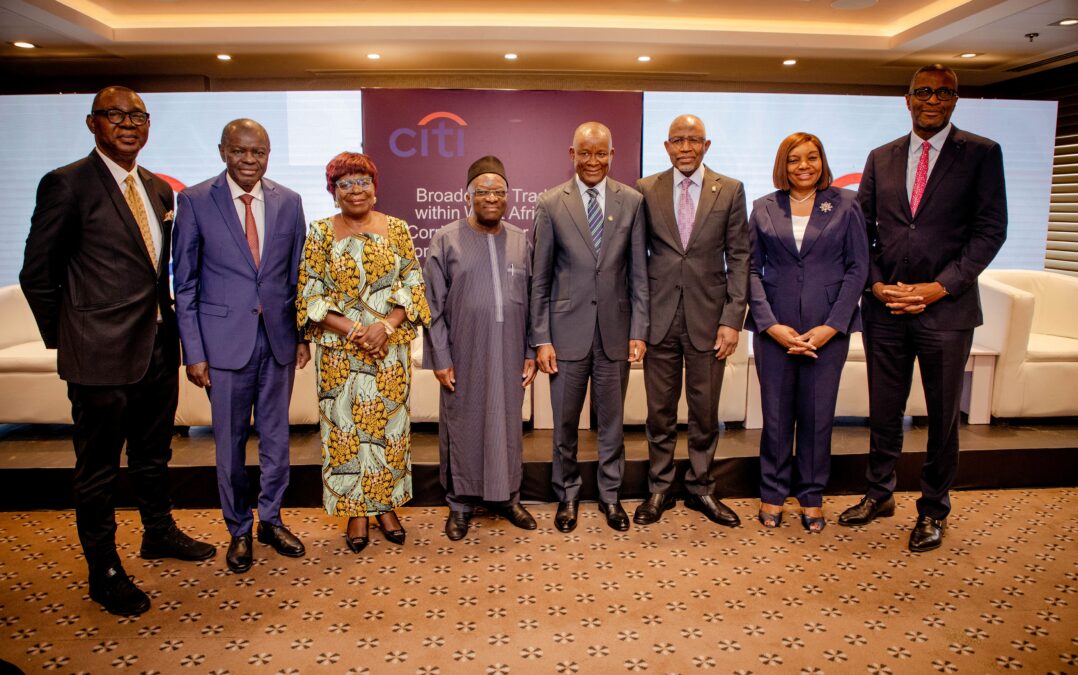
The Central Bank of Nigeria (CBN) and the Federal Ministry of Industry, Trade and Investment have called on businesses to play a more active role in shaping reforms needed to improve cross-border trade under the African Continental Free Trade Area (AfCFTA), as policymakers and industry leaders identified persistent barriers slowing regional commerce.
The call came during a regional business symposium in Abuja convened by Citi, which brought together public and private sector stakeholders from Nigeria, Ghana and Côte d’Ivoire to discuss how to strengthen West Africa’s major trade corridors and unlock greater benefits from AfCFTA.
Participants agreed that while the free trade agreement presents one of Africa’s biggest opportunities for economic integration, implementation continues to be constrained by non-tariff barriers, fragmented regulations, weak transport infrastructure, limited access to trade finance and inefficient border processes.
Lamido Yuguda, deputy governor for Financial System Stability at the Central Bank of Nigeria, in his address, said strengthening cross-border payment systems, improving foreign exchange market functionality, and expanding access to trade finance would be critical to reducing the cost of doing business across African markets.
“As intra-African trade scales under AfCFTA, the efficiency of financial intermediation will play a pivotal role,” Yuguda said, adding that the central bank would continue supporting initiatives that promote financial stability while advancing regional integration.
John Owan Enoh, minister of state for Industry, urged African economies to move beyond exporting raw materials and focus on value addition through industrialisation.
“AfCFTA presents a significant opportunity to accelerate Nigeria’s industrial growth and expand market access for our businesses,” Enoh said. “Our focus is on strengthening the competitiveness of Nigerian industries, improving the ease of doing business, and implementing policies that support export growth and regional value chains.”
He identified industrial policy as the “missing link” needed to unlock greater value from regional trade and highlighted the Lagos-Abidjan corridor as a strategic route for building value chains in sectors such as cocoa processing.
The CBN and the industry ministry jointly encouraged businesses to submit evidence-based proposals that could help reduce cross-border trade bottlenecks and inform future policy reforms.
Officials from Ghana and Côte d’Ivoire also stressed that AfCFTA’s success would depend on addressing practical obstacles including inconsistent product standards, inadequate infrastructure and regulatory fragmentation.
Kalilou Traoré, Côte d’Ivoire’s ambassador to Nigeria, said the continent’s ambition of creating a single market of more than 1.3 billion people would require stronger cooperation in financing trade, industrialisation and economic zones.
Gladys Mansa Yawa Feddy Akyea, Ghana’s deputy high commissioner to Nigeria, said the agreement would ultimately be judged by its ability to improve connectivity, mobilise finance and strengthen regional value chains.
Breakout sessions involving representatives from the Standards Organisation of Nigeria (SON), Nigerian Export Promotion Council (NEPC), Nigerian Investment Promotion Commission (NIPC), NAFDAC, Nigeria Customs Service, Afreximbank, NEXIM Bank and private sector participants identified customs bureaucracy, fragmented standards, currency convertibility challenges and a shortage of trade finance as some of the biggest impediments to regional trade.
Participants recommended wider adoption of digital customs systems, harmonised product standards, expanded use of the Pan-African Payment and Settlement System (PAPSS) for local currency settlements, and greater investment in transport infrastructure to facilitate trade across the region.
Nneka Enwereji, Managing Director and chief executive of Citibank Nigeria, said Nigeria would play a central role in determining the success of AfCFTA and that financial institutions have a role to play in supporting businesses expanding across African markets.

Join BusinessDay whatsapp Channel, to stay up to date
Open In Whatsapp