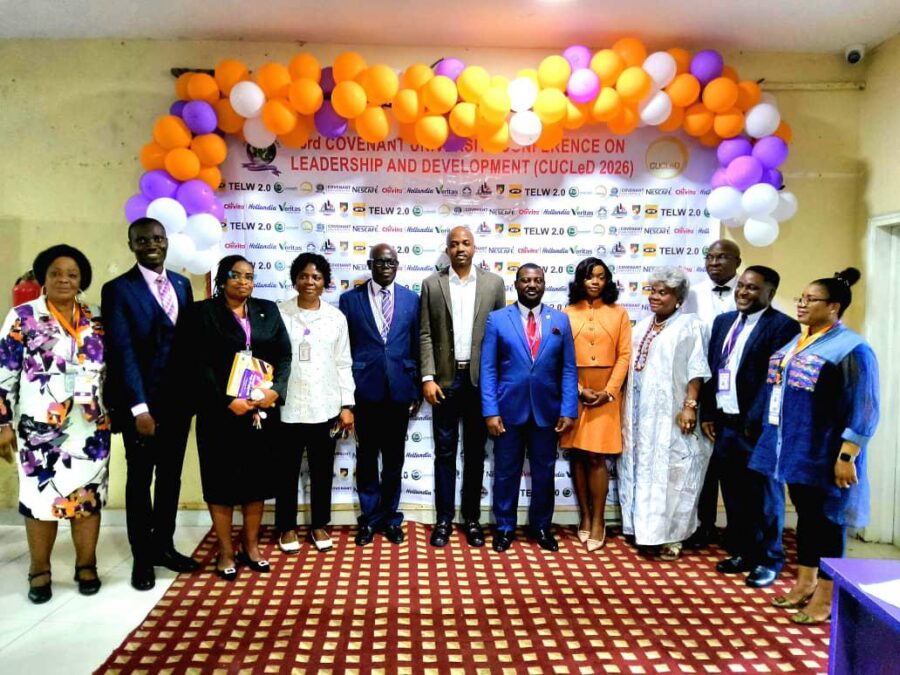
…as the university holds its 2026 leadership and development conference
Africa’s development challenges are rooted more in persistent deficit of effective leadership than in a lack of resources, Timothy Anake, vice-chancellor of Covenant University has said.
Anake, who was represented by Lanre Amodu, deputy vice-chancellor, speaking at the third Covenant University Conference on Leadership and Development (CUCLeD), emphasised that Africa’s greatest challenge was not the lack of human or natural resources, but a persistent leadership deficit that had weakened institutions and slowed development.
“Governance systems across Africa must be redesigned to become more transparent, resilient, innovative and responsive to present-day realities,” he said.
Besides, the vice-chancellor noted that the continent was grappling with economic uncertainty, insecurity, climate change, geopolitical shifts and rapid population growth, stressing that fragmented governance structures and outdated administrative systems could no longer meet Africa’s expanding needs.
“Sustainable progress can only be achieved through leadership that prioritises long-term development, embraces technology, promotes inclusive governance and upholds integrity in both public and private institutions,” Anake noted.
Speaking about Covenant University, he said, “We’re not just an institution of higher learning; we are a leadership academy committed to raising a new generation of leaders who will restore the dignity of the black race.”
Moreover, he said that the conference was designed not merely to identify Africa’s problems, but to generate practical and scalable solutions capable of transforming institutions across the continent.
The conference, themed “Re-Engineering Leadership Systems and Institutions for Sustainable Development in Africa,” brought together scholars, policymakers and development practitioners to examine practical ways of strengthening governance systems across the continent.
Thomas Odosi, a former senior technical adviser to the governor of the Central Bank of Nigeria, in his keynote address, said Nigeria remained trapped in a cycle of operational inefficiency, leadership failure and deep-seated corruption because successive administrations had replaced measurable performance with political rhetoric.
Odosi lamented that decades after political independence, Nigeria and many African countries were still burdened by institutional inequities, policy inconsistencies and weak entrepreneurial systems.
He expressed concern over rising insecurity and public apathy, referring to the recent kidnapping and killing of a young entrepreneur in Anambra State despite the payment of ransom.
“Little children of two or three years old are being burnt alive in conflicts, and yet you sit down in the comfort of your homes, drinking tea as if nothing is happening,” Odosi said.
He challenged religious institutions and young Nigerians to become more active in demanding accountability and good governance.
“Politicians, most of whom possess second-class brains, cannot continue to manipulate you like you do not have first-class brains,” he said.
Odosi urged young Nigerians to reject token political appointments and focus instead on building the capacity and courage needed to transform the country.
“Forget about being made a Special Assistant, a commissioner or a minister. Whatever you get will come to an end. Nigeria has a highly diverse and brilliant set of young people.
“You are the leaders of tomorrow, and you must deploy the raw dynamics required to push this country toward sustainable development. If we keep silent, the wicked and evil will continue to triumph,” he said.
Daniel Gberevbie, dean of the College of Leadership and Development Studies, described CUCLeD as an expanding platform for generating innovative ideas capable of reshaping governance across Africa.
Gberevbie said the continent could no longer depend on outdated leadership models if it hoped to unlock its enormous human and natural resources, and urged participants to champion reforms that would strengthen institutions, improve governance and inspire hope in communities.
Moses Duruji, chairman of the CUCLeD 2026 organising committee, challenged scholars, policymakers and development practitioners to translate research findings into practical actions that could reshape Africa’s future.
Drawing inspiration from former South African President Nelson Mandela and management expert Peter Drucker, Duruji said genuine leadership should be measured by service, justice and the ability to build institutions that work for the people rather than privileged interests.
Achiever Omoobajesu, an alumna of Covenant University, shared her experience of self-education and entrepreneurship, stressing the importance of continuous learning, discipline and spirituality in achieving success outside conventional academic pathways.
She urged students to take responsibility for their future by cultivating initiative, creating opportunities and avoiding dependence on others for employment.
Shoyinka Shodunke, the group chief information officer, executive core design and delivery at mtn.com, represented by Ebuka Ezewuzie, acting general manager, architecture and engineering at MTN Nigeria called for a shift from personality-driven leadership to institution-driven governance in Africa.
“Many African countries suffered from inconsistent government performance because of deeper systemic failures.
“Leaders must build systems that can adapt continuously to changing realities and remain effective regardless of who occupies public office,” he said.

Join BusinessDay whatsapp Channel, to stay up to date
Open In Whatsapp