…LBS hosts France-Nigeria business and human development forum
France has pledged deeper collaboration with Nigerian universities, researchers, and businesses as part of efforts to foster innovation, strengthen competitiveness and advance human capital development.
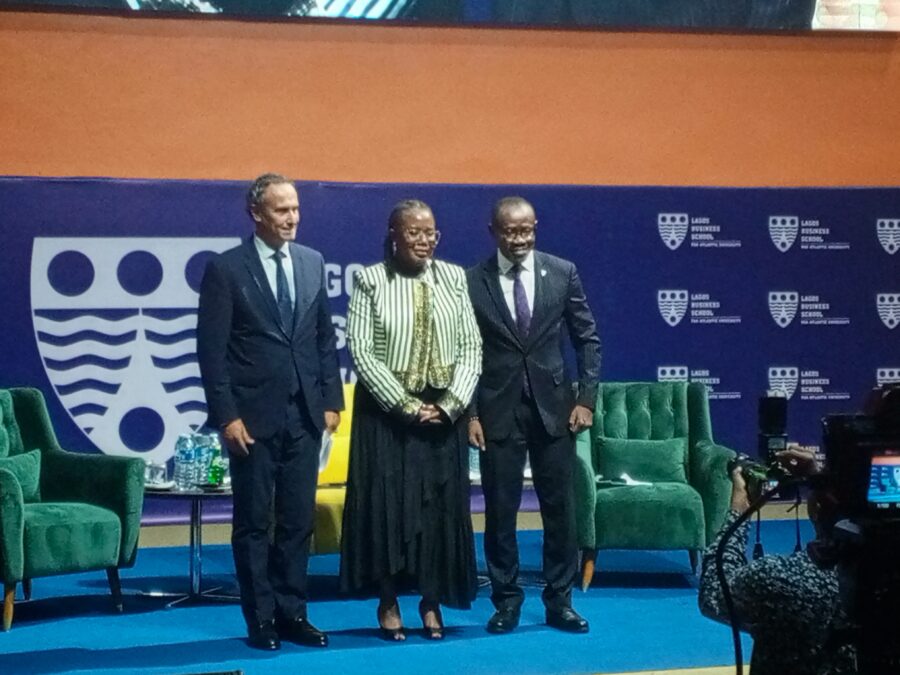
Marc Fonbaustier, the ambassador of France to the Federal Republic of Nigeria made this known at the France-Nigeria Business and Human Development Forum hosted by Lagos Business School (LBS), on Wednesday, which brought together key stakeholders to discuss partnerships in education, research and economic growth.
“In agriculture and beyond, France is committed to working with Nigerian universities, startups, researchers and business to develop informed innovation that serves people, strengthens competitiveness and creates opportunities for all.
“French expertise in agri-tech, sustainable farming, logistics and agro-processing can complement Nigeria’s immense agriculture potential to create more resilient food systems and stronger rural economies,” he said.
Fonbaustier emphasised that supporting Nigeria’s education, entrepreneurship and leadership is not a matter of fairness, but a moral obligation, and an economic top priority to his country.
“Innovation flourishes wherever talent circulates. Nigeria is Africa’s largest economy and one of the greatest reservoirs of entrepreneurial talent and creativity.
“That’s why student mobility, academic exchanges, joint research and scientific cooperation are among the strongest foundations of our relationship. Women and young people represent Nigeria’s greatest strategic assets,” he noted.
The ambassador affirmed that France is committed to walking this journey alongside Nigeria, not as a spectator, or as a competitor, but as a trusted, reliable, predictable and long-term partners.
Looking ahead to the next 10 years, he said that trust, shared vision and human capital development are the three main convictions that should be the defining pillars of the modern France-Nigeria partnership.
“Nigeria must trust France because it’s strong story, and I think both countries have a shared vision; Nigeria and France have something very much in common, we are attached to our sovereignty and to strategic autonomy.
“Thirdly, I believe Nigeria and France agrees in human capital development needs. Just think about the assets Nigeria has in its population of about 230 million people,” he stressed.
Olayinka David-West, dean at Lagos Business School described that forum themed; ‘Strengthening France-Nigeria Partnership Through Business, Innovation, Human Capital and Executive Education’, an opportunity to explore how both countries can work together to unlock new opportunities for economic growth, innovation, talent development and sustainable impact.
“In a world characterised by rapid technological change, economic uncertainty, shifting workforce dynamics and increasing global interconnectedness, partnerships have become more important than ever.
“The relationship between France, one of the world’s leading economies and centres of innovation, and Nigeria, Africa’s largest economy and one of the most dynamic markets, holds tremendous promise and opportunity. This conversation transcends trade and investment,” she said.
David-West noted that the partnership is about building the human capital, institutional capacity and innovation ecosystem required to drive long-term prosperity and shared progress.
“As we navigate the opportunities and challenges of the 21st century, countries, and institutions must work together to develop leaders, strengthen organisations, advance research and foster innovation, and equip future generations with the skills required to thrive in a rapidly changing world,” she said.
Bongo Adi, a professor of Economics at Pan Atlantic University (PAU), highlighted that development partnership is about co-investment in people, in technology, in food systems, and clean energy.
“That’s what not just Nigeria, but the rest of Africa would like to see. Besides, this is coming at a point where France-Africa relationship has come under severe stress; given what is happening in the Sahel,” he said.
However, Adi revealed that the partnership is germane because Nigeria is France’s number one trading partner with South Africa.
He said that Nigeria topped South Africa, Cote d’Ivoire in its bilateral trade in 2025, according to Dealroom report.
Nigeria’s bilateral trade with France peaked at $4.7 billion, ahead of South Africa’s $3 billion, and Cote d’Ivoire’s $2.5 billion.
“85 percent of Nigeria’s exports to France are crude oil and energy, which means diversifying the trade mix is a great opportunity that has to be explored,” he said.
Consequently, he disclosed that the Lagos Business School has been at the forefront of Nigeria’s private sector development and enhancement over the past three decades, and continues to be the beacon.
A panel session consisting of Jacky Amprou, AFO country director to Nigeria; Olaniwun Gbolabo, senior special assistant to Lagos State government on agriculture and food systems; Sally Ibrahim, Project manager at AFO Abuja, Nigeria; Kemisola Agbaoye, team leader at FEXTE Nigeria, Expertise France; Emmanuelle Boulestreau, head of the regional economic department at French Embassy; and Maxime Bieliaeff, commercial counsellor and director, business at France-Nigeria, discussed strategic sectors for collaboration.

Join BusinessDay whatsapp Channel, to stay up to date
Open In Whatsapp