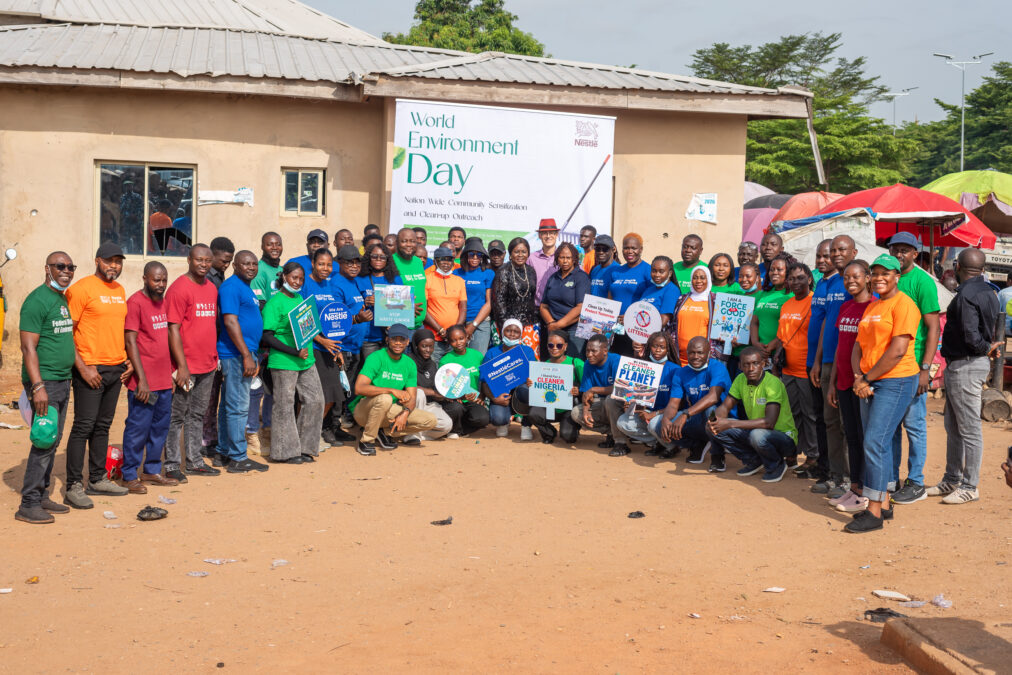
Nestlé Nigeria has taken its environmental campaign into a nationwide clean-up drive, deploying more than 400 volunteers across 12 locations in a move that underlines how consumer goods companies are increasingly using community partnerships to tackle Nigeria’s mounting waste challenge.
The food and beverage company said its 2026 World Environment Day campaign recovered 4,556 kilograms of waste, including 4,507.8 kilograms of solid waste and 48.2 kilograms of recyclable materials, through clean-up and sensitisation activities held in Lagos, Abuja, Agbara, Jos, Kano, Enugu, Awka, Ota, Abaji, Sagamu, Port Harcourt and Ibadan.
The exercise, carried out with support from the African Clean-Up Initiative and the Recyclers Association of Nigeria, involved 424 volunteers drawn from Nestlé’s employee volunteering platform, Nestlé Cares, as well as 15 coalition partners.
Read also: Food safety are embedded in every stage of our operations – Nestlé
For Nestlé, the campaign is more than a one-day environmental event. It is part of a wider corporate strategy to position waste recovery, recycling and community engagement as central pillars of its sustainability agenda in a market where weak waste collection systems, rising plastic consumption and poor disposal habits continue to strain urban environments.
Speaking on the initiative, Victoria Uwadoka, lead corporate communications, corporate affairs and sustainability, Nestlé Nigeria, said; “Environmental progress is most sustainable when communities see themselves as active participants rather than observers. What encouraged us most this year was not only the volume of waste recovered, but the willingness of volunteers, partners and community members to work together towards a shared goal. Lasting environmental progress depends on that sense of collective ownership, and it is often through small actions taken together that meaningful change begins.”
That framing is important. In Nigeria, environmental campaigns by corporates are increasingly judged not only by the tonnes of waste collected, but by whether they can help build lasting systems around sorting, recycling and public behaviour change. Nestlé’s latest intervention appears designed to speak to that shift by combining clean-up exercises with community sensitisation and by routing recovered waste into recycling and approved disposal channels rather than treating collection as an isolated publicity event.
The company said the programme was delivered through a multi-stakeholder framework involving regulators, development partners, recyclers, industry platforms and government institutions. That coalition model reflects a growing recognition that waste management in Nigeria cannot be solved by government alone, especially in cities where collection gaps, informal dumping and low recycling rates remain widespread.
At the Abuja leg of the campaign, the Federal Ministry of Environment said such partnerships are necessary if environmental goals are to move beyond policy statements.
Representing the minister of Environment, director of Pollution Control and Environmental Health, Adeola Omotunde, said consistent action by government, businesses and communities is needed to drive responsible environmental practices and deliver measurable results.
“Addressing environmental challenges requires consistent action at all levels. Initiatives such as this demonstrate how government, private sector and communities can work together to drive responsible environmental practices and deliver real impact,” Omotunde noted.
The National Plastics Action Partnership also used the event to reinforce the case for stronger collaboration on plastic waste.
Esther Chibueyin Fagbo, representing the country manager of NPAP, said, “Nigeria’s plastic pollution challenge requires bold, collaborative action, and this initiative demonstrates the value of bringing together communities, partners and the private sector around a shared goal. We are proud to have supported this effort and look forward to continuing our collaboration to advance circular economy solutions that create environmental and economic value.”
The significance of Nestlé’s campaign lies in its timing as much as its scale. Consumer goods manufacturers are under growing pressure from regulators, investors and the public to show that sustainability commitments are translating into action on the ground, particularly in markets where packaging waste is becoming more visible and politically sensitive.
Read also: Nestlé recovers 60,000 tonnes of plastic, launches bigger national waste alliance
For companies whose products reach millions of households, waste management is no longer just a compliance issue; it is becoming part of brand reputation, licence to operate and long-term market positioning.
Nestlé’s intervention does not solve the structural weaknesses in Nigeria’s waste economy. But it does show how large manufacturers are trying to move from isolated corporate social responsibility activities toward broader ecosystem building around recycling, public awareness and circularity.
If sustained and linked to stronger collection and recovery systems, that approach could give companies a bigger role in helping Nigeria close the gap between consumption growth and environmental protection.
For now, the 12-location clean-up drive offers a clear message, that, in a country where waste management remains one of the most visible signs of urban stress, environmental credibility will increasingly depend on what companies do in communities, not just what they say in sustainability reports.

Join BusinessDay whatsapp Channel, to stay up to date
Open In Whatsapp