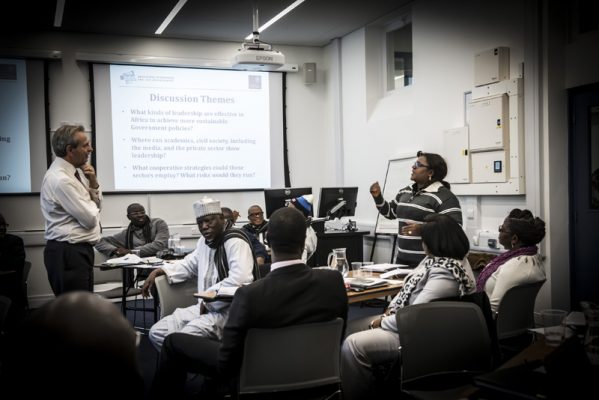
Caroline Lucas, Director, Special Projects at the United Kingdom based leadership development , TEXEM UK has admonished African leaders and CEOs to build their organisations primarily on adaptability.
Lucas gave the advice in a statement on TEXEM website, www.texem.co.uk
She said when an organisation is built primarily for efficiency rather than adaptability, it creates brittle structures adding that under pressure, these structures do not bend; they shatter.
“In our pursuit of growth, we often conflate scale with strength and momentum with stability.
“However, the true nature of an organisation, its architecture, its culture, and its strategic integrity, is rarely revealed in times of prosperity.
“Fragility is a hidden variable. It is a silent passenger that travels unnoticed during calm waters, only to manifest with devastating clarity when the storm hits.
“We have all witnessed the phenomenon: a company that appears invincible, boasting robust balance sheets and dominant market share, suddenly unravels under the weight of a singular disruption,” Lucas explained.
According to the director, this is called the “Illusion of Strength” which occurs when the organisation depends primarily on efficiency rather than adaptability.
Lucas said that for the African leader, operating in a landscape characterised by both profound opportunity and volatile complexity, the mandate should be that, resilience should not be viewed as the absence of stress, but the ability to integrate it.
She said in order to build a truly resilient enterprise, leaders must shift their focus from mere performance to structural anti-fragility.
While asking them to diagnose the invisible, Lucas said true leadership requires the courage to conduct “stress-tests” on their own organisation before the market does it for them.
“Seek out the hidden weaknesses, which include siloed information, over-reliance on single revenue streams, or a lack of psychological safety; that undermine your foundation.
“You should also redesign for redundancy, not just efficiency. This is because efficiency is the goal of a stable environment; redundancy is the insurance policy for a volatile one.
“Resilience requires building in the capacity to absorb shock without systemic failure,” she said.
The TEXEM director expressed the need for leaders and CEOs to foster adaptive culture, saying their greatest vulnerability is not a lack of capital, but a lack of agility.
“Resilience lives in the people who can pivot, rethink, and respond when the playbook becomes obsolete. A resilient culture is one where the truth about potential failure is discussed with the same vigor as the strategy for success.
“The African continent is rewriting the global narrative on growth. However, this growth will only be sustainable if it is built on enterprises that are engineered to survive, learn, and evolve through pressure.
“Let us commit to building organisations that do not just perform when things are easy, but thrive when things are difficult. Let us build the resilient enterprise,” Lucas said.
The statement also announced that TEXEM will be hosting a programme from 19th to 23rd July in Nairobi, Kenya titled: The Resilient Organisation, where African leaders and CEOs leaders will acquire more insights on resilience in leadership.
Two reputable TEXEM faculty, Professor Nic Cheeseman and Dr T. B. (Mac) McClelland Jr. will deliver the programme.
Nic Cheeseman is a former Professor at Oxford and best-selling author and advisor to world leaders.
He has featured on CNN his analysis has featured in the Economist, Le Monde, Financial Times, Newsweek, the Washington Post, New York Times and BBC.
Dr T. B. (Mac) McClelland Jr. is a former United States Marine Corps leader, former CEO of a subsidiary of a global multinational corporation, trusted adviser to world leaders, award-nominated author, and Chairman of the The Luxury Council International
Interested participants in the Nairobi programme are expected to click on the link: https://texem.co.uk/the-resilient-enterprise/
The following testimonials from past delegates of TEXEM programmes were also shared in the statement.
“We’re dealing with an organisation that’s relevant in today’s world and bringing in all that knowledge to bear. And so its quite a remarkable
organisation. So TEXEM will be good on my lips for recommendations going forward. Thank you,”. -Previous TEXEM delegate, Mr Abel Nsa Senior Technical Adviser (TSA) to the Minister of State Petroleum Resources (Gas), Ministry of Petroleum Resources Abuja.
“Wow! It’s so fully packed and the quality of the faculty is second to none…I think the quality of their presentation really got to me. I’ve realised…that practical and operational issues can be left to the middle level officers in the organisation while I focus more on the strategy to deliver and make my organisation better able to achieve its objective”. -Previous TEXEM delegate, Mr Oluwatoyin Ahmed Edu, Executive Director, Micro, Small and Medium Enterprises (MSME) Bank of Industry.
“The programme is quite rich, the content is very insightful, impactful and the content is in fact directed and tailored towards the contemporary leadership challenges we have in the country, or specific and that are directed towards leadership challenges in the country which is strategic leadership in the digital age because we are evolving and we have to be futuristic”. -Previous TEXEM delegate, Kingsley Emeka Egwuh, Assistant Comptroller General, Nigeria Customs Service.

Join BusinessDay whatsapp Channel, to stay up to date
Open In Whatsapp