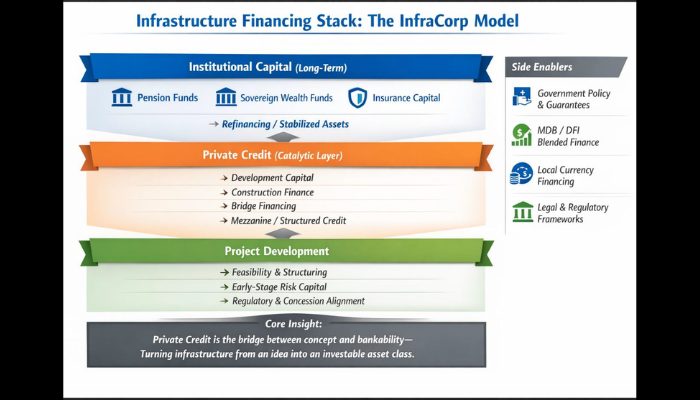
At this year’s Berlin Global Infrastructure Summit, one theme dominated both formal panels and private conversations: private credit is no longer a niche allocation—it is becoming a core pillar of infrastructure finance.
In mature markets, this shift has been both rapid and consequential. Over the past decade, private credit has grown into a multi-trillion-dollar asset class, driven by three structural forces. First, post-2008 banking regulation constrained traditional lenders’ ability to hold long-dated and higher-risk assets on their balance sheets. Second, a prolonged low-interest-rate environment pushed institutional investors, pension funds, insurers, and sovereign wealth funds, to seek higher-yielding alternatives. Third, borrowers increasingly turned to private markets for speed, flexibility, and certainty of execution, particularly in volatile public markets.
The result is a profound reconfiguration of credit intermediation. Private credit now sits at the intersection of opportunity and concern. It is praised for filling financing gaps and enabling complex transactions. Yet regulators increasingly question its opacity, interconnectedness with the banking system, and resilience under stress.
And yet, despite the depth of this debate, Africa remains largely absent. This is a strategic oversight. Because in Africa, private credit is not primarily about yield enhancement or regulatory arbitrage. It is about financing what would otherwise not be financed at all.
From financial innovation to development imperative
The developed markets’ narrative of private credit is built on abundance—excess capital seeking differentiated returns. Africa’s reality is the opposite. Capital is scarce, fragmented, and often misaligned with the long-term needs of infrastructure assets. The challenge is not that banks are stepping back. It is that there are too few institutions capable of stepping forward across the full risk spectrum. This is where private credit becomes transformative. Not as a substitute for banks, but as a builder of markets, structures, and investable pipelines.
Five lessons from Berlin—Reinterpreted for Africa
The Berlin discussions offer five important lessons. Viewed through an African lens—and through the practical experience of Infrastructure Corporation of Nigeria (InfraCorp)—they point toward a different and more constructive trajectory.
1. Private credit as catalyst for market creation: In mature economies, private credit fills gaps left by banks. In Africa, it must create the conditions for markets to exist in the first place. InfraCorp’s model demonstrates this clearly. By aggregating domestic institutional capital and deploying it through a professionally governed platform, InfraCorp is not merely allocating capital—it is designing investable ecosystems. Private credit in this context finances development stages, absorbs early risk, and enables projects to reach bankability—effectively laying the foundation upon which broader capital markets can participate.
2. What matters is cash flow discipline, not clever financial engineering: Berlin highlighted increasingly sophisticated credit structures. Africa requires a different priority: cash flow must come first. The most durable private credit strategies will be anchored in real, enforceable cash flows—transport corridors, energy systems, logistics platforms, and contracted infrastructure services. InfraCorp’s focus on commercially viable assets reinforces a key principle: in Africa, the success of private credit will depend less on financial engineering and more on cash flow visibility and contractual integrity. If cash flow doesn’t work, nothing else does.
3. Currency risk is the real risk: In mature markets, currency risk is largely an afterthought. In Africa, it is often the central risk – in other words, it is often the risk that determines where a project succeeds or fails. Dollar-denominated lending into local-currency revenue streams creates fragility. Many perceived credit failures are, in reality, currency mismatches. InfraCorp’s alignment with domestic pension and institutional capital creates a pathway for local-currency private credit, reducing systemic risk and unlocking deeper participation from onshore investors.
4. Build it right before you scale it: In Berlin, concerns about mature markets centred on opacity and hidden risks—valuation practices, leverage, and hidden interconnections. Africa has a rare opportunity: it can build the asset class with transparency and discipline from inception.
InfraCorp’s governance structure, anchored in fiduciary oversight and public-private alignment, illustrates how private credit can scale without sacrificing accountability.
5. Bridging the “Missing Middle”: Private credit thrives where traditional finance cannot operate efficiently. In Africa, this “missing middle” is expansive. Projects often stall between concept and bankability or struggle through construction and early operations. InfraCorp’s catalytic capital model addresses precisely this gap—enabling projects to transition from idea to execution to maturity. Private credit, properly deployed, becomes the bridge that makes infrastructure investment possible—not just financeable.
Implications
For investors, Africa is not a replication of mature markets’ private credit strategies. It is a structuring opportunity—one that rewards deep understanding of cash flows, currency, and local partnerships. In African infrastructure, structure cannot rescue weak cash flow, but strong cash flow can carry an imperfect structure. For project sponsors, private credit expands financing beyond financial close—supporting development, construction, and operational phases. For governments and MDBs, the priority is clear: create ecosystems that enable private credit to scale productively through local currency markets, risk-sharing instruments, and institutional platforms.
In mature markets, private credit emerged to optimise capital. In Africa, it must be deployed to create it. The real question is not whether private credit will come to Africa. It is whether Africa will shape it into a tool for transformation or inherit it as a diluted copy of someone else’s solution.
Dr Lazarus Angbazo ([email protected]) is managing director/CEO of InfraCorp, Nigeria’s infrastructure investment platform.

Join BusinessDay whatsapp Channel, to stay up to date
Open In Whatsapp