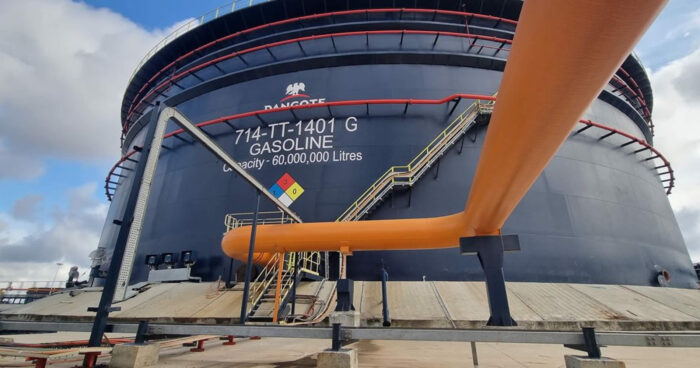
Dangote Petroleum Refinery fired back Tuesday against allegations that it has been exporting petroleum motor spirit to Lomé before quietly shipping the fuel back into Nigeria, dismissing the accusations as commercially illogical and contractually impossible, and vowing to correct what it called a deliberate campaign of misinformation.
The refinery, Africa’s largest and a centrepiece of Nigerian billionaire Aliko Dangote’s industrial empire, published a full-page statement, pointedly titled “Response to Unsubstantiated Claims and Tissue of Lies”, on June 23, 2026.
The statement laid out four distinct arguments against what it described as an ill-motivated web of falsehoods, spanning commercial logic, trade economics, contractual controls, and the refinery’s stated public policy positions.
“As a matter of policy, we do not respond to baseless and unsubstantiated claims,” the management statement read. “However, we have decided to clear the air on this ill-motivated web of falsehoods for posterity.”
The numbers
The refinery said the estimated logistics cost of moving petroleum products from its facility to Lomé and then back into Nigeria runs between $82 and $90 per metric ton.
Those additional costs, management argued, would obliterate any conceivable trading margin and render such a roundabout transaction commercially suicidal.
The company further noted that it does not offer export discount arrangements large enough to offset those logistics costs or to manufacture an arbitrage opportunity between its export and domestic prices.
Without such a pricing gap, there would be no financial incentive for any producer to absorb additional shipping, storage, financing, and handling costs just to re-enter its own home market l, the largest and closest market it already serves directly.
“Simply put, there is no evident commercial incentive for a producer to incur additional shipping, storage, financing and handling costs only for the product to return and compete in its largest and closest market,” the statement said.
Re-Importation
Dangote also argued that facilitating imports that compete directly with its own domestic production would be fundamentally self-defeating.
The refinery identified its core commercial objective as establishing and maintaining a leading position as a supplier of petroleum products to the Nigerian market.
Actively routing product through Lomé to undercut that same market, management said, would be inconsistent with everything the refinery is commercially designed to do.
Sales contracts and tender terms, the company noted, expressly prohibit the resale or re-importation of products into Nigeria. Buyers and counterparties are bound by destination declarations and compliance procedures that the refinery monitors through comprehensive product traceability systems covering lifting locations, nominated vessels, and consignees.
The Policy Contradiction
Perhaps the sharpest dimension of Dangote’s rebuttal was its appeal to its own long-standing public advocacy. The refinery has spent years championing the reduction of Nigeria’s structural dependence on imported petroleum products — a dependency that has historically drained the country’s foreign exchange reserves, pressured the naira, and suppressed domestic industrial development.
“It would therefore be inconsistent with both the refinery’s commercial interests and its publicly stated position to support or encourage practices that increase imports into Nigeria,” the statement said.
Broader Implications
The allegations, wherever they originated, arrive at a sensitive moment for Nigeria’s downstream petroleum sector. The Dangote refinery has been at the center of ongoing tensions between domestic refiners and established fuel importers over pricing, market share, and the allocation of foreign exchange for petroleum imports. Critics of the existing import-dependent system have long argued that entrenched interests benefit from Nigeria’s refining underperformance.
Dangote’s management declined to identify the source of the claims directly but characterised them as motivated by commercial or political interests hostile to the refinery’s growing market presence.
The refinery directed enquiries to its sales team and listed multiple contact numbers for what it described as on-record engagement. No specific regulatory body or government agency was named in the statement as having raised the allegations formally.

Join BusinessDay whatsapp Channel, to stay up to date
Open In Whatsapp