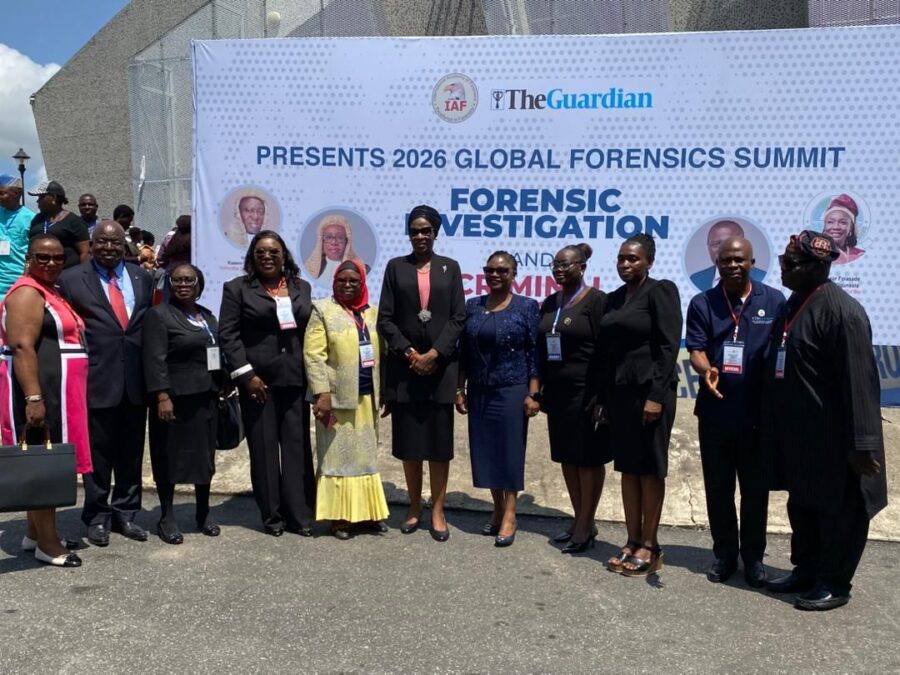
…as 2026 Global Forensics Summit kicks off in Lagos
Justice Kazeem Alogba, the chief judge of Lagos State, has said that Nigeria must strengthen its judicial system to create a business-friendly environment capable of attracting investment and fostering economic growth.
Alogba, represented by Olutoyin Ipaye, made this known in his keynote address at the 2026 Global Forensics Summit, when he said that strong justice systems help attract investment by creating certainty for businesses and protecting property rights.
Besides, he explained that technology has transformed crime and requires a scientific response.
“Technology has made crime more sophisticated, and investigations must be forensic-driven, science-led. Cyber intelligence and data analytics must be the watchword.
“Strong justice systems help attract investment by creating certainty for businesses and protecting property rights,” he said.
The legal luminary noted that investors prefer jurisdictions where contracts are enforceable, property rights are protected, and commercial disputes can be resolved efficiently.
“A credible judiciary that guarantees contract enforcement and timely dispute resolution remains a critical pillar of investor confidence and business protection,” he noted.
As criminals increasingly exploit digital technologies to evade detection, industry experts have stressed that Nigeria’s fight against crime can no longer rely solely on conventional policing methods.
Industry experts at the 2026 Global Forensics Summit in Lagos, insist that Nigeria must embrace digital forensics, artificial intelligence (AI), and data analytics if it hopes to close the gap between criminal investigations and successful prosecutions.
The four-day summit, organised by the International Academy of Forensics in collaboration with the Guardian Newspaper Nigeria, opened on Tuesday at the University of Lagos with Judges, forensic experts, lawyers, and security professionals, and policymakers discussing how technology can strengthen justice delivery.
Babajide Sanwo-Olu, the governor of Lagos State, represented by Aderinsola Olanrewaju, the permanent secretary under the ministry of justice in the citizens’ mediation bureau, said many criminal cases collapse because investigators fail to gather evidence that can survive scrutiny in court.
“Every year thousands of criminal cases in Nigeria are stalled not for want of witnesses, not for want of suspects, but for want of evidence that can withstand scrutiny in the court of law.
“The gap between investigation details and what prosecutors can prove in many cases is a forensic gap,” the governor said.
Sanwo-Olu highlighted a fact that Lagos State is home to the largest concentration of financial institutions, technology companies and international business activities on the continent, which he stressed need to be protected from the activities of criminals through digital forensics.
“The crimes that threaten this city are increasingly sophisticated, and the state has invested in forensic infrastructure, including the commissioning of West Africa’s first DNA and forensic center in 2017.
“The facility has supported investigations involving homicide, sexual offences, and human remains identification. Phase two of the project, covering toxicology and forensic chemistry, is currently underway,” he said.
Dele Olowokudejo, a fellow of the International Academy of Forensics, in his welcome address, said the summit was designed to encourage collaboration among forensic experts, security agencies, lawyers, academics, and policymakers.
“We are united by one common purpose: to explore innovative solutions that will strengthen justice systems, enhance accountability, combat crime, and improve public trust,” he said.
The 2026 summit is themed; ‘Forensic Investigation and Criminal Intelligence: Strengthening the Administration of Justice in the Age of Technological Advancement.’
Most of the experts, who spoke during the opening session of the four-day summit, said that modern crimes have become increasingly complex, ranging from financial fraud and identity theft to organized cybercrime.
Justice Alaba Omolaye-Ajileye in his paper presentation titled ‘Dissecting the Intersection between Forensic Investigation and Administration of Justice’, said Nigeria’s justice system has moved beyond relying solely on eyewitness accounts and confessions.
He emphasised that forensic science now plays a major role in helping courts establish facts through DNA analysis, digital investigations, forensic accounting, pathology, and cyber evidence.
Omolaye-Ajileye pointed out that a major turning point in Nigeria came with the Evidence Act 2011, particularly Section 84, which he said established rules for admitting electronic evidence in court.
“The law helped resolve years of uncertainty over whether digital records could be accepted as evidence,” he noted.
According to the organisers, participants in the 2026 Global Forensics Summit, are expected to examine emerging technologies including artificial intelligence, biometric identification, cyber intelligence, and advanced investigative tools during the summit, which is billed to end on Friday, June 26.
For many attendees, the central message was clear: modern crime requires modern evidence, and the future of justice will increasingly depend on science and technology.

Join BusinessDay whatsapp Channel, to stay up to date
Open In Whatsapp