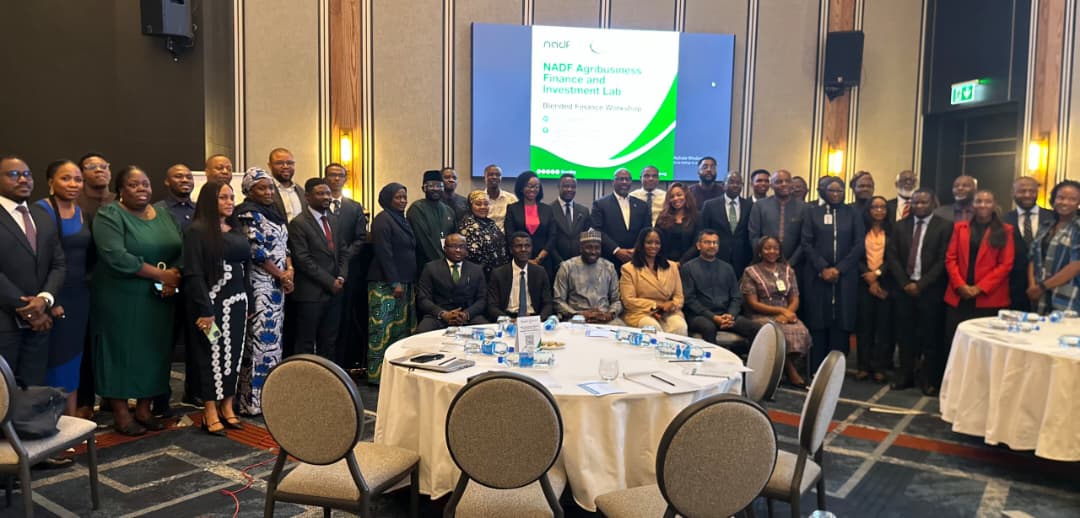
The National Agricultural Development Fund (NADF) is seeking to crowd-in private and institutional capital to support Nigeria’s agriculture and agribusinesses through a blended finance approach.
Mohammed Ibrahim, executive secretary of NADF, who made this known in a video address at a Blended Finance Workshop for Fund Managers in Lagos on Tuesday, stated that although agriculture is central to food security, job creation, rural livelihoods, and industrial growth, it continues to attract far less capital.
He noted that NADF believes that the challenge in the agricultural sector is not just the absence of capital but how opportunities in the sector can be structured in ways that make them more investable, bankable, and attractive to private and institutional capital.
“We want to examine the instruments, the risks, the constraints, and opportunities,” said Ibrahim, who is also the chief executive officer of NADF.
“Our intention is to make it as practical as possible and begin a conversation around how real agribusiness opportunities can be structured for finance,” he noted.
“One of our goals is to facilitate these blended transactions to the risk where appropriate and to crowd in other sources of capital into Nigeria’s agricultural sector,” he explained.
According to him, NADF has begun building a pipeline of credible agribusinesses requiring finance and aims to structure at least one practical blended finance transaction within the sector.
He added that his organisation is working with partners to develop financing models that can support viable agribusinesses and attract more investment into the sector.
Nasir Ingawa, head of partnerships and investor relations at NADF, said the engagement with fund managers was aimed at transferring knowledge and expertise.
“This is the second engagement that we’re having with fund managers within the span of a year,” Ingawa said. “The whole essence is to ensure that there is knowledge transfer amongst NADF and the fund managers that we’re engaging with.”
Ingawa emphasized the importance of blended finance in attracting capital to the agricultural sector. “Bringing in private capital alongside public patient capital has really gone a long way in terms of providing the kind of finance the agricultural sector needs,” he said.
“What the agricultural sector needs indeed is capital that is structured, that is institutional and to some extent that is patient.” “Blended finance is relatively new to Nigeria’s agricultural sector, but the rate of adoption is quite impressive,” Ingawa added.
In his presentation on ‘First Principles of Blended Finance,’ Aakif Merchant, head of Africa at Convergence, highlighted the potential of blended finance to mobilize capital for Nigerian agriculture.
“Agriculture contributes between 30 and 35 percent of employment in Nigeria.” “We need to mobilize capital that’s sitting on the sidelines in Nigerian pension funds, insurance companies, and even from across-border bases into the various SMEs so that we can enhance agricultural yields.”
Merchant explained that blended finance differs from previous investment initiatives in Nigerian agriculture because it aims to scale up investment and mobilize large-scale institutional investors.
“Blended finance is a function of scale.” “We want large-scale institutional investors to invest in agriculture, so we need to capitalize funds, and blended finance is one way to do that.”
He also emphasized the importance of framing agricultural investments in a way that appeals to a broader range of investors. “I encourage everyone to think about agriculture a bit broader than just agriculture,” he said. “It’s also a function and link to climate, especially climate resilience, adaptation, gender, livelihoods, food security, and employability.”
Investors should focus on mitigating currency risk, scaling up investment opportunities, and integrating into export value chains, Merchant said.
“How do we reduce the gap between the reality of risk and the perception of risk is what we want to talk about,” he added.

Join BusinessDay whatsapp Channel, to stay up to date
Open In Whatsapp