Nigeria’s electricity distribution companies are quietly crediting customer accounts with tens of thousands of naira in compensation, a consequence of their failure to meet the minimum supply hours mandated under the country’s Band A electricity tariff regime, a development that signals a tentative but significant shift in how the power sector is held to account.
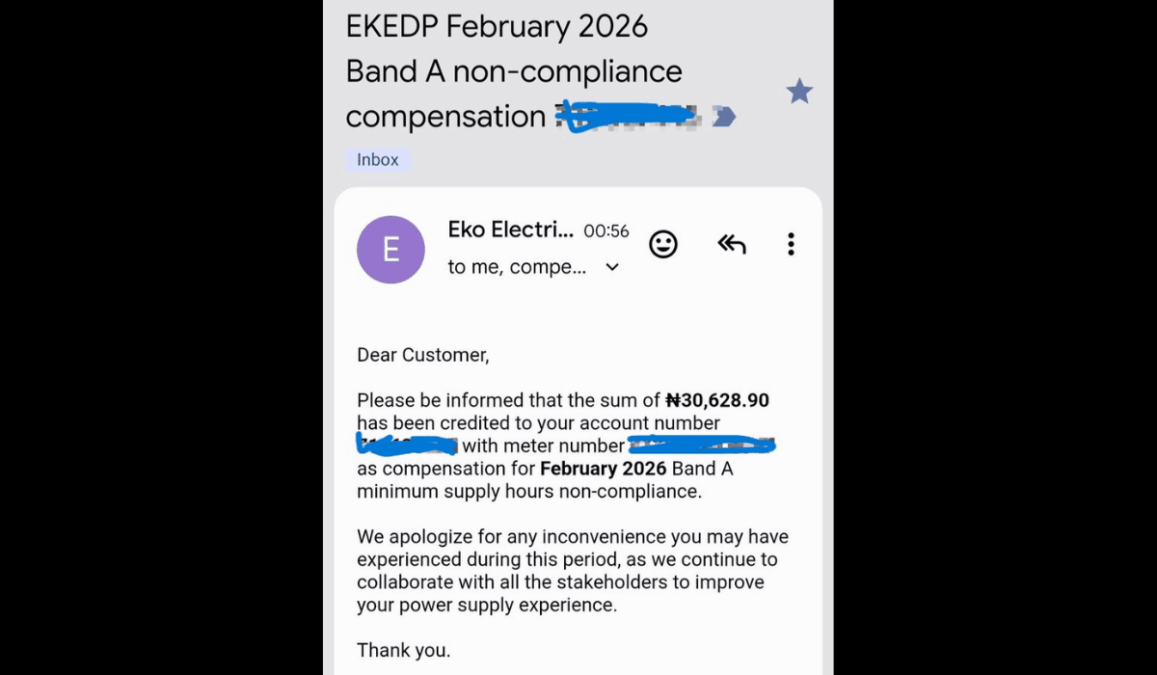
Eko Electricity Distribution Company, which serves Lagos and its suburbs, notified customers this month that it had credited accounts with sums running into the tens of thousands of naira.
One customer received a credit of N30,628.90, specifically described as compensation for February 2026 Band A minimum supply hours non-compliance.
The notification, sent by email, cited Eko DisCos, and referenced both account and meter numbers, leaving little ambiguity about the regulatory origin of the payment.
Band A customers pay the highest electricity tariff in Nigeria, currently above N200 per kilowatt-hour, on the basis that they will receive at least 20 hours of power supply daily.
Read also: The plot against the Electricity Act 2023
When distribution companies, known as Discos, fall short of that threshold, the Nigerian Electricity Regulatory Commission’s framework requires them to compensate affected consumers. The compensation is calculated against the shortfall in hours and billed units that customers were denied.
For years, this framework existed largely on paper. Discos routinely supplied far fewer hours than promised across all customer bands, yet compensation rarely materialised.
The latest compensation mechanism was introduced as part of broader tariff reforms meant to make the sector commercially viable while protecting consumers from paying premium prices for inferior service.
In theory, Discos that fail their Band A customers must pay for the failure, which is meant to motivate better performance or at least honest communication about supply capacity.
In practice, the rollout has been uneven. Many customers across Lagos, Abuja, Port Harcourt, and other major cities who are nominally on Band A have questioned whether their actual supply has ever consistently reached 20 hours.
The grid’s structural constraints, inadequate generation capacity, transmission losses, gas supply disruptions mean that Discos are frequently supplying whatever power they receive rather than what they have promised.
That context makes the compensation payments a double-edged story. On one hand, they represent a meaningful acknowledgement of failure and a direct financial remedy to customers. On the other, the need for widespread compensation underscores just how far actual supply still lags behind the tariff’s premise.
The Nigerian Electricity Regulatory Commission has, in recent months, signalled a harder stance on Disco performance. Officials have spoken publicly about the need to enforce service-level agreements and have flagged the compensation framework as a tool for doing so.
Whether that pressure translates into consistent enforcement across all distribution zones, including those serving less commercially visible customers, remains to be seen.


Join BusinessDay whatsapp Channel, to stay up to date
Open In Whatsapp