Manufacturers are quietly rebuilding supply chains, deepening local production and looking beyond Nigeria’s borders as Africa’s largest consumer market emerges from its toughest cost crisis in decades.
After two years of battling record inflation, naira devaluation, and shrinking consumer purchasing power, Nigeria’s fast-moving consumer goods (FMCG) sector is entering what industry executives describe as a transition from survival mode to recovery.
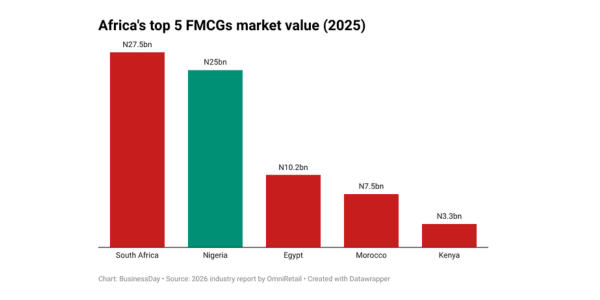
The country’s $25 billion consumer goods market, one of the largest in Africa, is expected to grow to more than $36 billion by 2030, supported by rapid urbanisation, a youthful population, expanding retail channels, and increasing digitisation, according to a new industry report by OmniRetail obtained by BusinessDay.
The optimism marks a turnaround for an industry that spent much of 2024 fighting unprecedented cost pressures brought on by President Bola Tinubu’s economic reforms, particularly the removal of fuel subsidies and the liberalisation of the foreign exchange market.
Those policies triggered sharp rises in transport costs, electricity tariffs, and imported raw material prices, squeezing margins across the consumer goods sector and forcing companies to raise prices repeatedly to preserve profitability.
Listed consumer goods companies including Nestlé Nigeria, Cadbury Nigeria, Unilever Nigeria, Nigerian Breweries, Guinness Nigeria, BUA Foods and Flour Mills of Nigeria, all grappled with mounting foreign exchange losses and weakening consumer demand during the period.
But with inflation beginning to moderate and exchange-rate volatility easing, manufacturers are shifting attention from merely preserving margins to rebuilding volumes and market share.
Producer price inflation fell to 54.5 percent in the first half of 2025 from nearly 198 percent in the corresponding period of 2024, providing companies with some breathing room.
Africa’s biggest consumer market still offers long-term promise
Despite the economic turbulence, Nigeria’s demographics remain one of the strongest attractions for manufacturers.
The country’s population has reached approximately 238 million people and is increasing by more than two million annually. More than half of the population is under the age of 30, while 56.4 percent are within the economically active 15-64 age bracket. Internet penetration has climbed to about 45 percent, equivalent to roughly 107 million users, opening up new channels for digital commerce and consumer engagement.
The size of the opportunity explains why multinational consumer companies have continued to invest despite recent setbacks.
Nigeria’s FMCG market is second only to South Africa’s $27.5 billion market on the continent and is more than twice the size of Egypt’s estimated $10.2 billion market.
Analysts say this demographic advantage will continue to support consumption over the long term, even if short-term macroeconomic challenges persist.
Manufacturers move away from import dependence
The most notable structural shift underway is the increasing reliance on local raw materials.
For decades, manufacturers depended heavily on imported inputs, making them vulnerable to currency depreciation. However, the severe foreign exchange shortages of the last two years have accelerated efforts to source locally.
According to the report, manufacturers are investing in backward integration and forging partnerships with domestic farmers and processors.
Unilever Nigeria has reportedly increased local sourcing to nearly 70 percent, while cassava, maize and palm oil supply chains are becoming increasingly important for food processors.
This trend mirrors strategies adopted by BUA Foods, Flour Mills of Nigeria, and Olam Agri, which have expanded local wheat substitution and agricultural supply programmes in a bid to reduce exposure to imported inputs.
The report disclosed that the localisation will not only reduce foreign exchange risks but also stimulate agriculture and create jobs along the value chain.
Digital distributors are rewriting the rules
Another major transformation is taking place in the route-to-market system.
Nigeria’s distribution network has traditionally been fragmented, dominated by thousands of wholesalers and millions of informal retailers. The lack of visibility across the value chain has often led to stock-outs, inventory inefficiencies, and limited access to credit.
Technology platforms are beginning to change that. According to an OmniRetail report, 78 percent of retailers now use point-of-sale devices, generating transaction records that make embedded finance and inventory financing possible.
Companies such as OmniBiz, TradeDepot, Moniepoint, and other digital distributors are becoming critical infrastructure, connecting manufacturers with retailers while providing payments, credit, and logistics solutions.
The emergence of data-driven distribution models could become one of the most significant developments in the sector over the next decade.
“The winners will be firms that own data and can efficiently manage inventory and customer relationships,” said a Lagos-based FMCG analyst.
Changing consumer habits creates new opportunities
Years of inflation have fundamentally changed consumer behaviour.
Nigerians are increasingly opting for smaller pack sizes, lower-priced products, and value brands, forcing manufacturers to innovate.
This explains the resilience of categories such as noodles, powdered milk, seasoning cubes, biscuits, and beverages, which dominate household spending. According to the report, the top ten FMCG categories account for 64 percent of total industry sales.
Nigeria remains Africa’s largest noodle market, consuming about 3.02 billion servings annually. The country also controls nearly 22 percent of Africa’s seasoning market and consumes around 80 million Maggi cubes daily, according to Nestlé estimates.
Meanwhile, demand for healthier products, ready-to-eat meals, and premium categories is gradually rising among urban middle-income consumers, creating opportunities for product diversification.
Exports becoming a strategic necessity
Historically, most Nigerian consumer goods companies focused almost exclusively on the domestic market.
That is changing. Rising demand from neighbouring countries and opportunities created by the African Continental Free Trade Area (AfCFTA) are encouraging manufacturers to seek growth outside Nigeria.
Nestlé Nigeria’s export revenues surged to N6.57 billion in 2024 from N1.18 billion a year earlier. Flour Mills of Nigeria reported N27.2 billion in export revenues, while Cadbury Nigeria generated N11.7 billion from overseas markets.
Ghana and Côte d’Ivoire have emerged as major destinations, but companies are increasingly targeting the United Kingdom, Canada, India, and the United States, leveraging diaspora demand and hard-currency earnings.

Join BusinessDay whatsapp Channel, to stay up to date
Open In Whatsapp