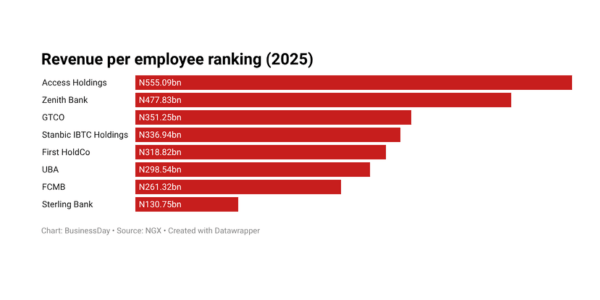
Eight Nigerian banks generated an average revenue of N332.74 million per employee in 2025, underscoring how aggressive investments in technology, digital banking, and artificial intelligence (AI) are transforming workforce productivity across the industry.
An analysis of full-year 2025 financial statements by BusinessDay reveals that lenders are generating more income with leaner workforces as they automate processes, expand digital channels, and deepen technology-driven service delivery.
Access Holdings emerged as the industry leader, generating N555.09 million in revenue per employee, reflecting the growing contribution of its digital banking operations, investment banking business, and technology-led expansion strategy.
Zenith Bank followed closely with N477.83 million, while Guaranty Trust Holding Company (GTCO) posted N351.25 million. Stanbic IBTC Holdings recorded N336.94 million, ahead of First HoldCo’s N318.82 million and United Bank for Africa’s (UBA) N298.54 million.
First City Monument Bank (FCMB) generated N261.32 million per employee, while Sterling Bank recorded N130.75 million.
Revenue per employee is a key efficiency metric that measures the amount of income generated by each staff member. The indicator reflects how effectively a bank deploys its workforce, technology infrastructure, and operating model to create value.
The widening gap between industry leaders and laggards increasingly reflects the ability of banks to leverage digital platforms and automation rather than simply expand physical branches or workforce numbers.
“The banks generating the highest revenue per employee are those that have invested heavily in digital banking, data analytics, automated processes, and alternative income streams,” a Lagos-based banking analyst said.
The push for efficiency comes at a time when traditional lenders are facing growing competition from fintech firms such as OPay, Moniepoint, and PalmPay, whose digital-first operating models allow them to scale rapidly while maintaining lower operating costs.
Fintechs have steadily captured market share in payments, transfers, agency banking, and merchant acquiring services, forcing banks to accelerate investments in technology and customer experience.
To stay competitive, Nigerian lenders are deploying AI-powered customer support systems, automated credit assessment tools, fraud detection platforms, and predictive analytics solutions designed to improve service delivery while reducing operational costs.
The growing adoption of AI is expected to further boost productivity metrics such as revenue per employee in the coming years as banks automate routine functions and streamline operations.
However, the rapid deployment of AI across financial services is also creating new vulnerabilities.
The International Monetary Fund (IMF) recently warned that advances in artificial intelligence could significantly increase cyber risks within the global financial system.
According to the IMF, sophisticated AI tools are making it easier and faster for cybercriminals to identify weaknesses in banking systems, payment networks, and digital infrastructure.
“For Nigeria, where electronic transactions now run into trillions of naira monthly and financial institutions are increasingly interconnected through shared payment rails and digital platforms, the risks could be amplified,” the regulatory body said.
The IMF noted that AI-powered cyberattacks could spread rapidly across financial institutions that depend on common infrastructure providers, cloud computing services, telecommunications networks and payment systems.
This warning comes as Nigerian banks intensify spending on digital transformation initiatives. From AI-enabled customer service platforms to automated fraud monitoring systems and digital lending products, technology is becoming central to growth strategies across the sector.
Wole Odeleye, a financial expert, said AI is quietly revolutionising Nigeria’s banking sector, delivering real results in fraud prevention, customer service, and lending. Top banks like First Bank Holdings, Access Corporation, Zenith Bank, Fidelity Bank, Wema Bank, and even our regulator, the Central Bank of Nigeria, are embracing AI to work smarter.
AI is even greeting customers in the branch. In July 2023, First Bank of Nigeria made headlines by deploying a humanoid robot assistant at its Digital Experience Centre in Lagos. This friendly robot uses AI vision and speech to interact with customers, helping with basic inquiries and guiding people to the right services.
UBA is widely recognised as a leader in banking AI, leveraging Natural Language Processing (NLP) through its flagship assistant Leo. UBA also uses predictive analytics to optimize customer interactions and analyze credit risk.
For Zenith Bank, the bank employs the Ziva AI chatbot for customer service, and applies advanced automation for internal operations, including the digitization of HR processes.
“For the average customer, the impact of AI in service is faster support and more personalisation. Chatbots can handle thousands of inquiries simultaneously without getting tired, ensuring you’re never on the queue.”
“They also learn from each interaction, so over time the bot gets better at recognising what you need. And because they’re software, banks can roll them out on multiple channels (mobile apps, websites, messaging apps) easily. From a business view, these AI agents lower operating costs in call centers and free up human staff to focus on complex or high-value interactions,” Odeleye added.

Join BusinessDay whatsapp Channel, to stay up to date
Open In Whatsapp