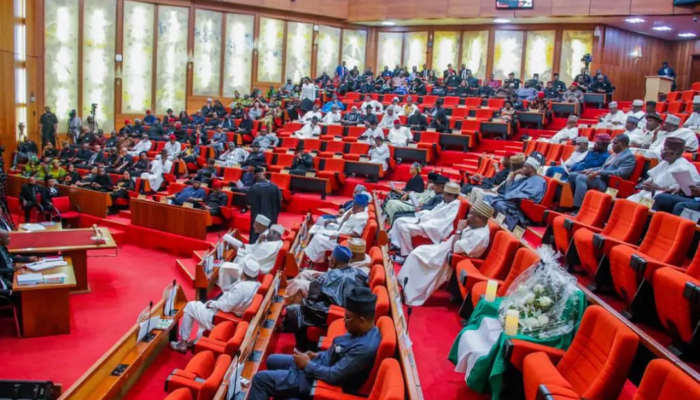
The Senate is expected to give accelerated consideration to the proposed State Police Bill on Tuesday as lawmakers convene an emergency plenary session during their ongoing recess to address urgent national security concerns amid escalating violence, kidnappings and terrorist attacks across the country.
The sitting, scheduled for Tuesday, comes at a time when Nigeria is witnessing some of its worst security challenges in recent years, with persistent attacks by terrorists, bandits, kidnappers, armed herders and other violent groups stretching security agencies beyond their limits and renewing calls for far-reaching reforms.
Speaking to BusinessDay on the agenda for the emergency session, Yemi Adaramodu, the Senate Spokesperson, said national security would dominate deliberations, with the proposed state police legislation expected to receive priority attention.
“The Senate will be considering matters of public interest, especially national security.
“The State Police legislation will undoubtedly be a priority issue.”
He added, “The Senate is expected to receive reports from the relevant committee that earlier got legislative referral for second reading of the State Police Bill.”
“The Senate is desirous of partnering with other arms of government in curbing the undesirable activities of bandits, terrorists and other peace-threatening marauders”, Adaramodu said.
The emergency plenary was announced in a notice issued by Emmanuel Odo, Clerk of the Senate, on the directive of Senate President Godswill Akpabio.
According to the notice, all senators have been directed to reconvene at 11:00 am at the Senate Chamber of the National Assembly Complex, Abuja, despite the upper chamber having adjourned plenary last Thursday until July 2.
“The purpose of this emergency sitting is to enable the Senate consider matters of urgent national importance, particularly issues relating to national security and other critical concerns that require immediate legislative attention,” the notice stated.
The Senate also expressed regret for any inconvenience the emergency session may cause lawmakers and urged all senators to make the necessary arrangements to attend.
Nigeria’s security situation has deteriorated significantly despite increased defence spending and multiple military operations.
The past few months have witnessed a resurgence of deadly attacks in Oyo, Kwara, Benue, Plateau, Zamfara, Katsina, Niger, Sokoto and Kebbi states, resulting in hundreds of deaths and the displacement of thousands of residents.
In Benue State alone, recent attacks on communities in Guma, Logo and other local government areas left scores dead, reigniting national outrage over the inability of security agencies to stem the killings.
Plateau State has similarly witnessed repeated attacks on rural communities, while bandits continue to raid villages and highways across parts of Zamfara, Katsina, Sokoto and Niger States.
Perhaps one of the most disturbing developments in recent weeks was the mass abduction of pupils and teachers in Oyo State.
On May 15, suspected terrorists attacked three schools in Oriire Local Government Area of Oyo State and abducted dozens of pupils and teachers from Baptist Nursery and Primary School, Community Grammar School and L.A. Primary School. Reports indicated that at least 39 pupils and seven teachers were taken away by the attackers, while one teacher was later killed in captivity.
The incident triggered widespread outrage, protests and an indefinite strike by the Nigeria Union of Teachers in Oyo State.
Governor Seyi Makinde later disclosed that intelligence reports suggested that many of the victims were being held within the vast Old Oyo National Park.
The Oyo attack revived painful memories of the Chibok schoolgirls’ abduction and highlighted concerns that school kidnappings, once largely associated with northern Nigeria, are spreading to other parts of the country.
Beyond Oyo, kidnappings have continued to spread nationwide.
In recent months, gunmen have targeted schools, travellers, traditional rulers, farmers, religious leaders and residents across several States.
The growing frequency of abductions has transformed kidnapping into one of Nigeria’s most profitable criminal enterprises and intensified calls for stronger local security structures capable of responding rapidly to emerging threats.
Data from the Armed Conflict Location and Event Data Project (ACLED) further illustrates the scale of the challenge.
According to ACLED’s conflict monitoring data, Nigeria recorded more than 8,600 violent incidents between 2024 and 2025, resulting in over 21,000 fatalities.
The incidents included battles involving armed groups, attacks on civilians and explosions linked to insurgent and criminal activities.
Violence against civilians accounted for a significant proportion of the incidents, reflecting the growing vulnerability of communities across the country.
Against this backdrop, the debate over state police has once again taken centre stage.
Last Thursday, the Senate commenced legislative consideration of the Constitution of the Federal Republic of Nigeria (Sixth Alteration) Bill, 2026 (Establishment of State Police) (SB. 794), one of the most consequential constitutional amendment proposals since Nigeria’s return to democratic rule in 1999.
The bill seeks to move policing from the Exclusive Legislative List to the Concurrent Legislative List, thereby empowering states to establish and operate their own Police formations alongside the federal police.
Leading debate on the bill, Senate Leader Opeyemi Bamidele described the proposal as one of the most significant security reforms contemplated since the return of democratic governance in 1999.
“This constitutional amendment is one of the most significant security reforms contemplated since the return of democratic governance in 1999.
“It addresses a fundamental challenge confronting our nation: the inability of a centralized policing structure to adequately respond to the complex, evolving and localized security threats facing our communities,” he said.
Bamidele noted that Nigeria currently operates a single Police force under Section 214 of the Constitution, a model he argued is no longer sufficient for a country of more than 230 million people facing increasingly complex security challenges.
According to him, the nation is confronted with terrorism, banditry, mass abductions, farmer-herder conflicts, cultism, armed robbery, pipeline vandalism, communal clashes and emerging cyber-enabled crimes, all of which require localised responses.
“Unfortunately, the centralised structure of the Nigeria Police Force has become overstretched, under-resourced and unable to provide the level of security required in a nation of over 230 million people spread across 36 States and the Federal Capital Territory,” he said.
Making a case for the reform, the Senate Leader argued that security operations are often most effective when driven by officers who understand the terrain, language, culture and peculiar security dynamics of the communities they serve.
He said the establishment of State Police would improve intelligence gathering, facilitate rapid response to security threats, strengthen community policing and ease the burden currently placed on the Nigeria Police Force.
“Modern policing relies heavily on intelligence rather than force. State Police will significantly strengthen Nigeria’s intelligence architecture,” he stated.
Under the proposal, the federal police would retain responsibility for interstate crimes, terrorism, organised criminal networks, border security, cybercrime, protection of federal assets and national security operations, while state police formations would focus on maintaining law and order within their respective jurisdictions.
The bill specifically seeks to establish federal and state police structures, define their respective responsibilities, create State Police Service Commissions, provide oversight mechanisms, transfer policing from the Exclusive Legislative List to the Concurrent Legislative List and strengthen cooperative federalism in security administration.
Bamidele argued that the proposal aligns with practices in other federal systems, including the United States, Canada, Australia and Germany, where sub-national policing institutions operate alongside federal law enforcement agencies.
“As such, Nigeria should not remain an exception among federal systems,” he said.

Join BusinessDay whatsapp Channel, to stay up to date
Open In Whatsapp