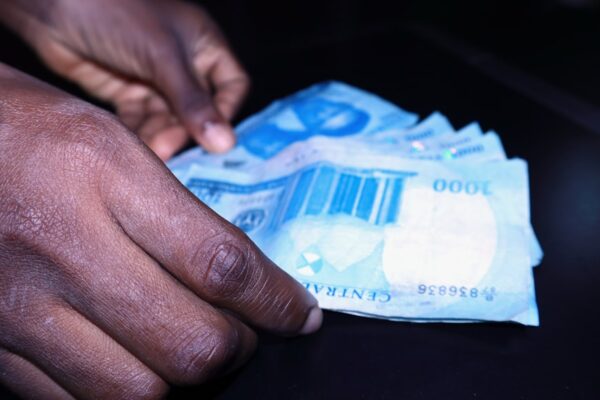
The naira ended the week weaker across foreign exchange (FX) market segments amid slowing market liquidity, despite Nigeria’s external reserves rising to the Central Bank of Nigeria’s (CBN) projected target of $51.04 billion.
Data published by the CBN showed that the naira depreciated by N6.68, representing a 0.48 percent week-on-week decline, as the dollar was quoted at N1,370.46 on Friday at the Nigerian Foreign Exchange Market (NFEM), compared with N1,363.83 recorded on Thursday.
On a day-on-day basis, the local currency weakened by N7.16 or 0.52 percent from N1,363.30 quoted on Thursday. Over the five trading sessions of the week, the naira lost N14.19 or 1.04 percent from its opening rate of N1,356.27.
Read also: External reserves near CBN target as IMF urges slower dollar stockpiling
Although NFEM turnover and transaction figures for Friday were not available as of press time, market activity showed signs of moderation. The number of deals declined slightly by 2.3 percent to 253 on June 18 from 259 deals recorded on June 17. On a weekly basis, total deals executed at the NFEM stood at 1,510 as of Thursday.
Meanwhile, total turnover at the NFEM window rose by 29.25 percent to $378.34 million on June 18 from $292.72 million recorded on June 17. Weekly turnover at the official market reached $2.56 billion, according to CBN data.
At the interbank FX segment, the number of deals dropped by 30.59 percent to 59 on Friday from 85 transactions recorded on Thursday. Total interbank deals for the week stood at 620.
Similarly, turnover at the interbank market declined by 42.95 percent to $39.89 million on Friday from $69.92 million the previous day. Weekly turnover at the segment closed at $544.55 million.
Read also: Naira flat as external reserves hit $51bn, highest since 2009
In the parallel market, also known as the black market, the naira strengthened marginally to N1,400 per dollar on Friday from N1,403 quoted on Thursday, representing a 0.2 percent gain. As a result, the gap between the official and parallel market exchange rates narrowed to N30 per dollar from N40 recorded a day earlier.
Nigeria’s external reserves, which provide the CBN with the capacity to support the naira and meet external obligations, continued their steady upward trajectory, reaching the CBN target of $51.04 billion as of June 18, 2026. This represents an increase of 35.35 percent, or $13.33 billion, compared with $37.71 billion recorded during the corresponding period in 2025, according to data published on the apex bank’s website.
The latest reserve level meets the CBN’s projection made at the end of December 2025, when the bank forecast that external reserves would rise to $51.04 billion in 2026. The projection was anchored on expectations of reduced pressure in the foreign exchange market, stronger oil earnings, and sustained inflows from remittances and foreign portfolio investments.
Read also: Naira gains as external reserves hit new high of $50.04bn
Despite the improvement, the International Monetary Fund (IMF) has recommended a slower pace of reserve accumulation, arguing that such a strategy would allow the naira to move closer to its estimated fair value.
According to the IMF, continued reserve accumulation may be slowing the pace at which the naira adjusts toward its equilibrium exchange rate, even as the policy strengthens Nigeria’s external buffers.
Muda Yusuf, chief executive officer of the Centre for the Promotion of Private Enterprise (CPPE), said recent economic reforms have helped stabilise the foreign exchange market, improve external sector balances, strengthen investor confidence and restore a measure of policy credibility.
“The moderation in exchange rate volatility, the improvement in foreign reserves, the recovery in capital inflows and the stronger performance of many quoted companies underscore the positive outcomes of the stabilisation measures undertaken over the past three years,” Yusuf said.

Join BusinessDay whatsapp Channel, to stay up to date
Open In Whatsapp