Education is the foundation to skills development and jobs, and the surest way out of poverty, empowering generations to earn an income and drive economic growth, the World Bank Group says.
Developing countries, such as Nigeria have made some progress in getting children into the classroom, but investments remain inadequate and learning is not guaranteed.
Though the Nigerian government claims to have repositioned basic education under the Renewed Hope Agenda of Bola Tinubu, not as a peripheral social service, but as a central pillar of economic growth and national development; the evidence seems to hide under the skies like a shy new moon.
According to the Federal Ministry of Education in its special report last month, Nigeria has committed over N100 billion in matching grants accessed, with 4,633 new classrooms built, while 6,114 classrooms were renovated, and 257 new schools built.
Other achievements include 506,000 teachers trained, 7.8 million textbooks distributed, 11,280 school perimeter fences, and 333,862 units of school furniture, among others.
The question is what has changed in the basic education system in the three year of the Tinubu-led administration, apart from well-polished policy announcement, which is functional to PR-branding for public acceptance.
The federal government said it allocated a N42 billion to school feeding allocation, yet Nigeria’s out-of-school crisis shows little sign of easing.
According to data from the Federal Ministry of Education, over 8.6 million pupils benefited its relaunched Renewed-Hope National Home-Grown School Feeding Programme (RH-NHGSFP) to combat child hunger and improve education outcomes, and over 100,000 cooks were employed, while more than 200,000 smallholder farmers supplied locally grown ingredients, supporting nutrition, school participation and rural income generation.
However, BusinessDay findings indicate otherwise, as Abdulsalam Haruna, a teacher in Abuja said that the school feeding programme stop many years ago.
“There’s no school feeding in my school, the programme stopped since last two and half years ago,” he said.
Another teacher from Jikwoyi 1 Primary School in FCT –Abuja said there is nothing like feeding ongoing in school, they announced it last term but none came around.
“The last time my school experienced the school feeding initiative was three years ago.
“School feeding programme is another conduit pipe for embezzlement of public funds, it’s a great scam,” the teacher noted.
Iyabo Apologun, a teacher in Port Harcourt, Rivers State, said, “To the best of my knowledge no feeding has taken place in the school where I teach.”
Abigail Balogun, a teacher in a Lagos State public school said there is no feeding of students going on, though she clarified that her school is not under the federal government.
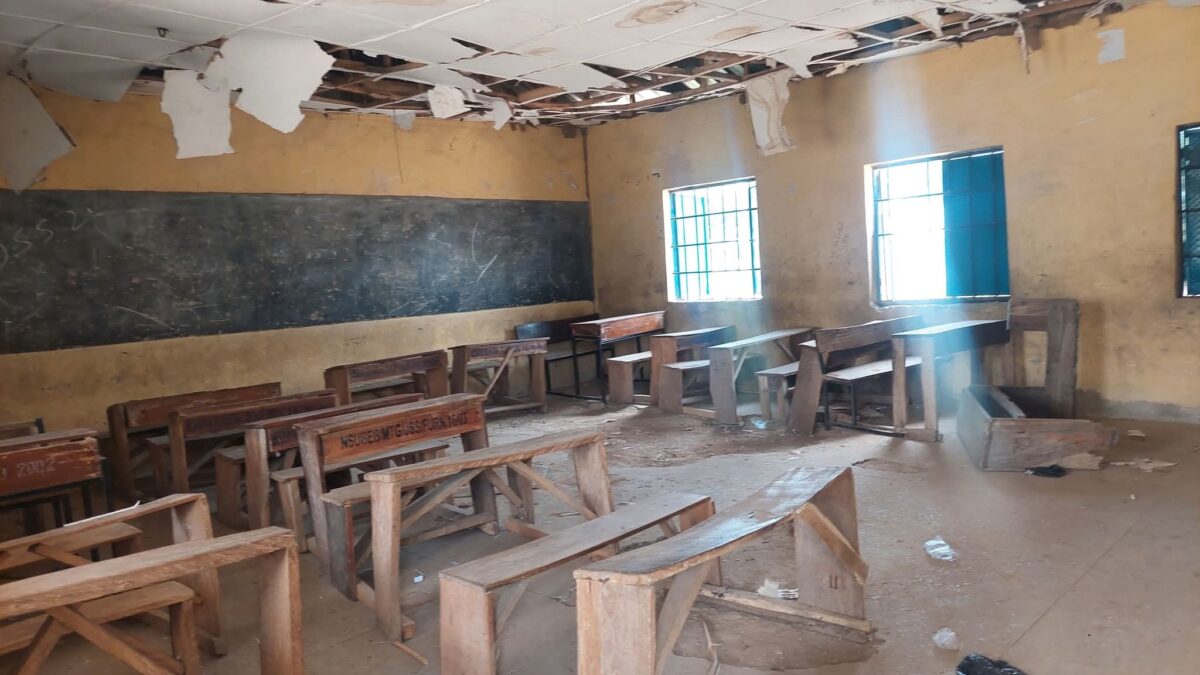
Looking at the infrastructure development, one begins to wonder what the government meant, considering the condition of some schools such Government Day Secondary School, Diko, Niger State, or the state of basic schools in Ohaukwu in Ebonyi State where children sit on bare floors to learn and the walls of the schools constructed with rafters.
Similarly, in Amaba- Ugwueke and Ozara-Isuikwuato both in Abia State, the learning environment are nothing to write home about; many of the children are exposed to snake and scorpions, besides the dilapidated furniture.
The federal government said that over 506,000 teachers have been trained, and over 7.8 million learning materials distributed nationwide, strengthening classroom delivery and improving the foundations for better learning outcomes, and impacting over 3.9 million learners.
Meanwhile, schools are lamenting lack of man-power as teachers are overstretched due to insufficient staff.
Nnenna Elekwachi, a teacher at Central School Amaba-Ugwueke, confirmed the teacher deficit challenge, when she said that due to poor working conditions and teacher shortfall, the school lacks quality teachers.
“Most of the teachers posted here would rather go to the local councils and lobby for transfer, because the amenities are not there.
“We don’t have toilets here, no teachers’ quarters, no drinking water, and electricity is a luxury here. We are understaffed, and it is making the work tedious,” she said.”
The UBEC 2024 report indicates a shortage of 194,876 teachers in public primary schools across the country, while the situation in the secondary education sub-sector is also not encouraging.
The statistics are sobering. Nigeria has at least 131,377 primary schools, serving a combined 24.2 million pupils in public institutions and 7.4 million in private schools.
Jessica Osuere, chief executive officer at RubiesHub Educational Services, emphasised that teaching is becoming less attractive because of poor remuneration, delayed salaries, and limited career incentives.
The truth is that the teaching profession has not fared any better under the incumbent federal government despite all the media hypes.
Abiola Omosebi, a teacher, emphasised the teacher shortfalls have negatively affected the teacher-student ratio.
“The situation is worrisome because in some schools there is about 55 to one teacher ratio, and 116 to 120 students per teacher, especially in public schools.”
This is a far cry from the UNESCO-recommended ratio of 1:25 for lower and middle basic classes, a standard designed to ensure that each child receives the attention required for sound learning and intellectual development.
Compounding the crisis are poor and staggered wages. Although the minimum wage now stands at N70,000 per month, many states still pay teachers below the stipulated minimum wage.
Budgetary allocation to education from state governments has consistently languished between just 5.0 and 8.0 percent in recent years.
Nigeria’s budgetary allocation to education in 2021 was 5.7 percent, and 5.4 percent in 2022, while in 2023 and 2024 it was 7.9 percent and 6.39 percent allocation respectively, in 2025, it was 7.08 percent, and in 2026, the government allocated 6.1 percent.
The conversation on basic education in Nigeria must evolve from access to impact. The goal is no longer simply to get children into school, it is to ensure that every child learns, thrives, and contributes meaningfully to the nation’s future.

Join BusinessDay whatsapp Channel, to stay up to date
Open In Whatsapp