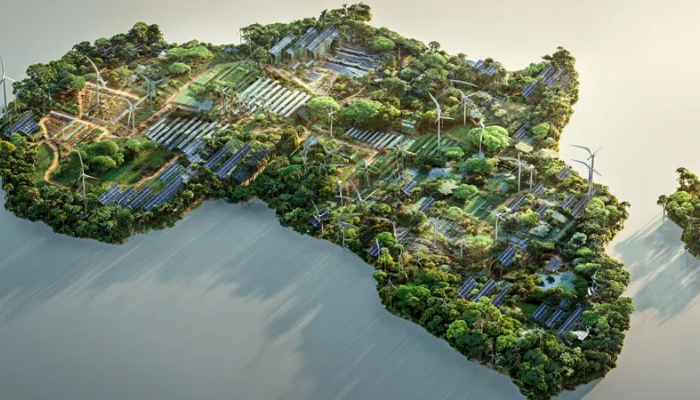
Technology is quietly rewriting Africa’s sustainability story.
For decades, conversations about Africa’s development focused on what the continent lacked, such as reliable electricity, efficient transportation systems, quality healthcare, financial inclusion, and industrial capacity. Today, a different narrative is emerging. From solar mini-grids lighting up remote communities to electric mobility solutions transforming urban transportation and artificial intelligence supporting climate-smart agriculture, green technology is becoming one of Africa’s most powerful economic development tools.
The assertion that technology is rewriting Africa’s sustainability story is not merely aspirational; it is increasingly supported by evidence. Nearly 600 million Africans still lack reliable access to electricity, making energy poverty one of the continent’s greatest barriers to economic growth. Yet technology is enabling Africa to leapfrog traditional development pathways through decentralised renewable energy solutions.
I recently visited a rural community in one of my project’s catchment areas where a solar mini-grid had replaced years of dependence on generators and kerosene lamps. What struck me was not the technology itself but its impact. Small businesses stayed open longer. Students studied after dark. Healthcare facilities stored vaccines safely. Women spent less time sourcing fuel and more time running businesses. In essence, one piece of green technology unlocked multiple Sustainable Development Goals simultaneously.
This mirrors findings from studies across Nigeria and Kenya, where solar mini-grids have improved income levels, productivity, health outcomes, gender inclusion, and economic activity.
The United Nations Sustainable Development Goals remind us that access to clean energy (SDG 7) is closely linked to poverty reduction, quality education, health, gender equality, economic growth, and climate action. The World Health Organization similarly emphasises that clean and sustainable energy is foundational to achieving better health outcomes and reducing harmful air pollution.
This is where ESG becomes more than a reporting framework. It becomes an economic strategy.
Nigeria’s ESG story does not have to begin with compliance. It can begin with innovation.
Take the transportation sector. Across Africa, e-mobility is gaining momentum as countries seek alternatives to expensive fossil fuel options. Electric motorcycles, battery-swapping stations, and clean public transportation systems are emerging in cities like Kigali and Lagos. Companies such as Spiro have deployed tens of thousands of electric motorcycles across African markets, demonstrating that sustainability and profitability can coexist.
The economic implications are profound. Every litre of imported fuel displaced by locally generated renewable energy improves foreign exchange stability. Every electric vehicle assembled locally creates jobs. Every solar-powered enterprise expands productivity while reducing carbon emissions.
The African Development Bank and other development partners recognise this opportunity. Mini-grids, renewable energy systems, and clean technology investments are increasingly viewed not as environmental projects but as economic infrastructure.
Globally, the direction is clear. Renewable energy is becoming cheaper, faster to deploy, and increasingly attractive to investors. Africa added record renewable energy capacity in recent years, and countries such as South Africa, Egypt, Kenya, Morocco, and increasingly Nigeria are attracting significant green investments.
Yet technology alone is not enough.
An African proverb says, ‘The best time to plant a tree was twenty years ago; the second-best time is now.’ The second-best time is now.” The same principle applies to green technology. The hardware may be available, but success depends on the policies, skills, governance structures, and financing mechanisms that enable adoption at scale.
Research consistently shows that governance, financing, and human capital gaps remain larger barriers than the technology itself. Africa’s green future will therefore depend not only on solar panels and electric vehicles but also on leadership, institutional capacity, and investment in skills development.
For Nigeria, the opportunity is enormous. We possess one of the continent’s largest entrepreneurial populations, abundant solar resources, a rapidly growing technology ecosystem, and a youthful workforce eager to innovate. If strategically aligned, green technology can help solve some of our most pressing challenges, which include energy access, unemployment, environmental degradation, and economic diversification.
Recent projections suggest that the green economy could create millions of jobs across Africa by 2030, particularly in renewable energy, manufacturing, mobility, construction, and climate technology sectors.
The future of Africa’s economy may not be built solely in oil fields, mines, or industrial parks. It may also be built in solar-powered villages, electric mobility hubs, smart farms, and technology-enabled communities.
The question is no longer whether green technology can transform Africa. The real question is whether we will move quickly enough to harness its potential.
Those who do will not only lead the sustainability transition; they will lead the next phase of Africa’s economic growth.
Sarah Esangbedo Ajose-Adeogun is the Founder and Managing Partner at Teasoo Consulting Limited, a foremost ESG consulting firm. She is a former community content manager at Shell Petroleum Development Company and served as the special adviser on strategy, policy, projects, and performance management to the government of Edo State. She is also the host of the #SarahSpeaks podcast on YouTube @WinningBigWithSarah, where she shares insights on leadership, strategy, and sustainable growth.

Join BusinessDay whatsapp Channel, to stay up to date
Open In Whatsapp