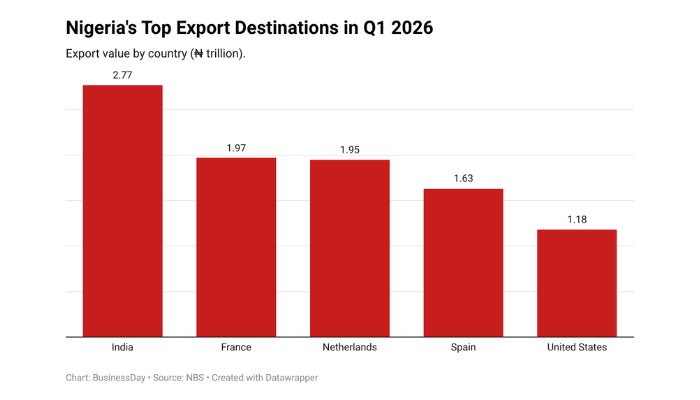
Nigeria’s export earnings rose in the first quarter of 2026, with India, France, the Netherlands, Spain, and the United States emerging as the country’s biggest export destinations, underscoring the continued dominance of crude oil and petroleum products in Nigeria’s external trade.
Data from the National Bureau of Statistics (NBS) showed that total exports increased to N21.17 trillion in Q1 2026, representing a 2.77 percent rise from N20.60 trillion recorded in the corresponding period of 2025 and an 11.63 percent increase from the previous quarter.
India retained its position as Nigeria’s largest export market, receiving goods worth N2.77 trillion, accounting for 13.09 percent of total exports. France followed with imports valued at N1.97 trillion or 9.29 percent, while the Netherlands accounted for N1.95 trillion or 9.22 percent. Spain received exports worth N1.63 trillion, representing 7.68 percent, while exports to the United States stood at N1.18 trillion, accounting for 5.56 percent of total exports. Together, the five countries absorbed 44.84 percent of Nigeria’s total exports during the quarter.
The strong export performance helped Nigeria record a merchandise trade surplus of N7.55 trillion in the first quarter, a sharp 340.88 percent increase from the preceding quarter. According to the NBS, the improvement was largely driven by higher crude oil exports and a significant reduction in petroleum product imports.
Crude oil remained Nigeria’s biggest export commodity, generating N11.20 trillion and accounting for 52.92 percent of total exports. Non-crude oil exports stood at N9.97 trillion, while non-oil exports contributed N3.19 trillion, representing 15.05 percent of total exports.
The NBS said Nigeria’s most exported commodities during the period were crude oil, natural gas, urea, other petroleum gases in gaseous form and kerosene-type jet fuel. These products continued to drive export earnings despite efforts to diversify the economy away from hydrocarbons.
By region, Europe emerged as Nigeria’s largest export destination, accounting for N7.93 trillion or 37.44 percent of total exports. Asia followed with N6.42 trillion or 30.31 percent, while exports to Africa stood at N4.06 trillion, representing 19.19 percent of total exports. Exports to the Americas amounted to N2.61 trillion or 12.35 percent.
Within Africa, Togo was Nigeria’s biggest export destination, receiving goods worth N1.08 trillion. South Africa followed with N887.13 billion, while Côte d’Ivoire, Egypt and Senegal accounted for N505.22 billion, N363.18 billion, and N351.87 billion, respectively. These five countries represented more than three-quarters of Nigeria’s exports to the continent.
Overall, Nigeria’s total merchandise trade stood at N34.79 trillion during the quarter, with exports accounting for 60.85 percent of total trade. On the other hand, total imports stood at N13.62 trillion during the period, representing an 18.17 percent decline from N16.64 trillion recorded in the corresponding quarter of 2025 and a 21.05 percent drop from N17.25 trillion in the preceding quarter.
Analysis of Nigeria’s import sources showed that China remained the country’s largest trading partner, supplying goods worth N5.10 trillion and accounting for 37.42 percent of total imports. The United States followed with imports valued at N2.81 trillion, or 20.60 percent of total imports, while India supplied goods worth ₦992.87 billion, representing 7.29 percent.
Germany ranked fourth with imports valued at N390.35 billion, accounting for 2.87 percent of the total, while the United Arab Emirates completed the top five with N222.47 billion or 1.63 percent of imports. Together, the five countries accounted for nearly 70 percent of Nigeria’s import expenditure during the quarter.
The NBS noted that the most imported products during the quarter were crude petroleum oils, gas oil (diesel), durum wheat, telecommunications and data transmission equipment, and used diesel-powered vehicles.
By product category, machinery and transport equipment constituted the largest import group, valued at N5.01 trillion and accounting for 36.79 percent of total imports. This was followed by mineral fuels valued at N2.65 trillion, representing 19.45 percent, and chemicals and related products worth N2.02 trillion, or 14.84 percent of total imports.

Join BusinessDay whatsapp Channel, to stay up to date
Open In Whatsapp