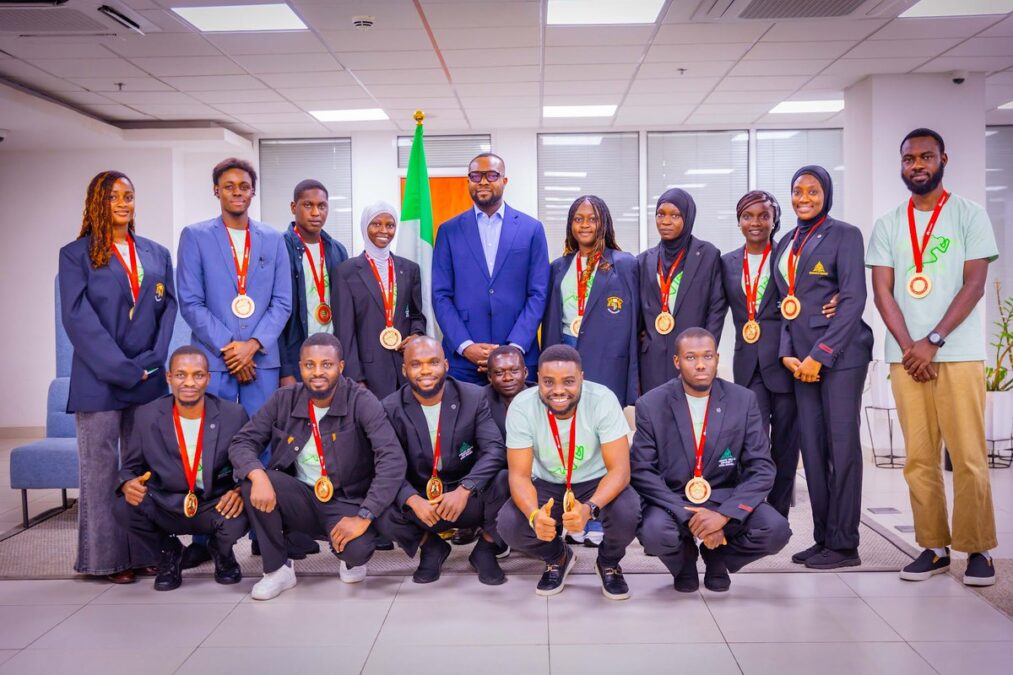
Bosun Tijani, Nigeria’s minister of Communications, Innovation and Digital Economy, is seeking greater investor and industry support for a new generation of young technology innovators after Nigerian students emerged as the most successful competitors outside China at the 2025 Huawei Global ICT Competition.
The minister’s intervention signals a broader push by the federal government to ensure that breakthrough innovations developed by Nigerian students do not end as competition projects but evolve into commercially viable solutions capable of addressing local challenges and creating economic value.
Read also: Bosun Tijani: From Tech Darling to Cabinet Realist
Tijani made the commitment after hosting the 15 Nigerian students who represented the country at the global finals of the Huawei ICT Competition in China and returned with an impressive haul of awards.
“I am looking forward to connecting these young innovators with the right support and exposure to ensure their passion and creativity can be further built on,” the minister said.
The students, drawn from Ahmadu Bello University, University of Lagos, Federal University of Technology Minna, University of Port Harcourt, Nasarawa State University Keffi and Igbinedion University Okada, competed in the Network, Cloud, Computing and Innovation categories after advancing through national and regional stages of Huawei’s year-long ICT Academy programme.
At the global finals, Team Nigeria secured two Grand Prizes in the Network and Innovation tracks, two First Prizes in the Cloud category and a Second Prize in Computing, making Nigeria the highest-performing country outside China for the third consecutive year.
Beyond the medals, however, attention has shifted to what many observers consider the more important story: how to transform student innovation into scalable products and businesses.
Particularly notable was the Innovation Team from Ahmadu Bello University, which developed a solar-powered diagnostic solution capable of testing for malaria and intestinal parasites in under three minutes without internet connectivity.
Built using Huawei’s artificial intelligence, cloud and Ascend technologies, the solution was designed to operate in rural and underserved communities where healthcare infrastructure and internet access remain limited.
For policymakers and industry stakeholders, the project highlights the untapped commercial potential within Nigeria’s growing pool of digital talent.
The country’s repeated success at international technology competitions has reinforced its reputation as one of Africa’s leading sources of tech talent. Yet many promising innovations fail to progress beyond prototype stage due to limited access to funding, mentorship, industry partnerships and commercialization pathways.
Tijani’s pledge to connect the students with support networks suggests an acknowledgement of this gap.
Nigeria’s innovation ecosystem has matured significantly in recent years, producing globally competitive developers, engineers and startup founders. However, translating academic excellence into sustainable businesses remains one of the sector’s biggest challenges.
Read also: Bosun Tijani declares end to excuses for poor telecom services
The latest Huawei success story arrives as the federal government intensifies efforts to position technology as a key driver of economic growth, job creation and global competitiveness.
Under the ministry’s digital economy agenda, initiatives such as the Three Million Technical Talent programme (3MTT), startup support schemes and expanded digital infrastructure investments are intended to strengthen Nigeria’s technology ecosystem and create opportunities for young innovators.
The real measure of success will not be the trophies won in international competitions but whether innovations such as the ABU diagnostic device can attract investors, secure regulatory approvals and eventually reach the communities they were designed to serve.
For Nigeria, the Huawei ICT Competition results provide further evidence that the country is producing world-class talent. The next challenge is ensuring that these innovators receive the exposure, capital and institutional support required to convert global recognition into transformative solutions and thriving technology enterprises.
As the students return from China with international acclaim, the government’s focus appears to be shifting from celebrating achievement to building the ecosystem needed to sustain it.


Join BusinessDay whatsapp Channel, to stay up to date
Open In Whatsapp