For generations, Africa has exported raw materials while importing many of the finished products consumed by its people. But a powerful class of homegrown industrialists is challenging that pattern, investing billions of dollars in refineries, steel plants, fertiliser factories, sugar complexes, and consumer goods manufacturing.
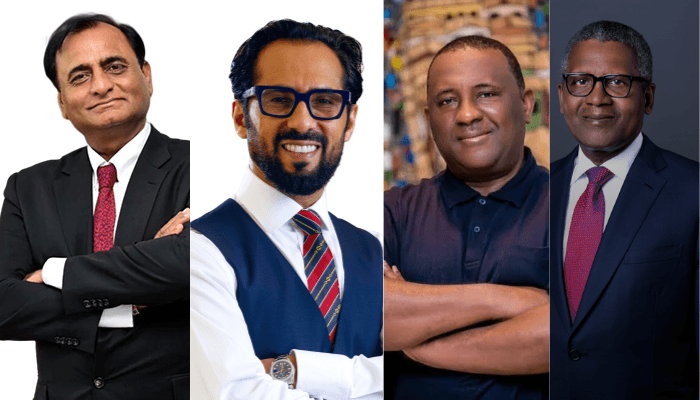
From Nigeria to Kenya, Tanzania, and Uganda, these entrepreneurs are not only building some of Africa’s largest companies but also transforming the continent’s economic landscape. Still, they are also reshaping supply chains, creating thousands of jobs and pushing the continent towards greater industrial independence. According to the list by Data Bites, here are the people powering Africa’s industrial transformation.
Read also: Dangote revives Olokola Free Trade Zone, targets biggest industrial hub
Narendra Raval: Building East Africa’s manufacturing powerhouse
Narendra Raval’s journey from a Hindu priest to one of East Africa’s leading industrialists is among the region’s most remarkable business stories.
After arriving in Kenya as a young priest, Raval left the temple and entered the building materials trade in 1986 with his wife. That modest venture eventually became Devki Group, a diversified industrial conglomerate with interests in steel, cement, aluminium, packaging, aviation, mining and fertilisers.
Today, Devki operates 19 factories across nine industries and employs more than 14,000 workers, making it Kenya’s largest private-sector employer.
The group’s latest milestone is a $550 million steel plant in Tororo, Uganda, its first major expansion outside Kenya. The facility sits on more than 400 acres and is expected to produce one million tonnes of steel annually by 2027.
The project is expected to create thousands of jobs, strengthen regional trade and reduce East Africa’s dependence on imported steel.
“Uganda will be on the global map as a primary steel producer,” Raval said.
Mohammed Dewji: the billionaire turning a family business into an East African giant
Mohammed Dewji, popularly known as Mo Dewji, is Tanzania’s best known industrialist and one of Africa’s youngest billionaires. He transformed MeTL Group, a family business established by his grandparents and expanded by his father, into one of East Africa’s largest indigenous conglomerates.
After studying at Georgetown University and briefly working at McKinsey, Dewji took over the company at a young age and expanded its operations across manufacturing, agriculture, energy, logistics, textiles, food processing and consumer goods.
Today, MeTL Group operates across more than 30 industries and serves markets across Tanzania, Mozambique, Rwanda, Uganda and several other African countries.
One of its newest investments is a $50 million soft drinks factory planned in Mombasa, Kenya, where the company intends to challenge multinational brands with its affordable Mo Cola, Mo Xtra and Mo Malto products.
The investment represents MeTL Group’s first major manufacturing project in Kenya and reflects Dewji’s broader strategy of expanding African owned consumer brands across the continent.
Read also: Luxury stock surge propels SA’s Rupert past Nigeria’s Rabiu on billionaire list
Abdul Samad Rabiu: the industrialist powering Nigeria’s manufacturing growth
Abdul Samad Rabiu is the founder and chairman of BUA Group, one of Nigeria’s largest industrial conglomerates with interests in cement, sugar refining, foods, infrastructure and agriculture.
The son of renowned businessman Isyaku Rabiu, he built BUA into a multi-billion-dollar enterprise that has become one of the major forces driving Nigeria’s manufacturing sector.
His latest flagship investment is the Lafiagi integrated sugar project in Kwara State, a massive complex designed to reduce Nigeria’s dependence on imported sugar.
The project includes large-scale sugar plantations, a sugar processing factory, housing, schools and healthcare facilities for workers and the surrounding communities. It will also produce 35 megawatts of electricity from bagasse and 20 million litres of industrial ethanol annually.
Beyond Lafiagi, BUA operates two of Africa’s largest sugar refineries in Lagos and Port Harcourt with a combined capacity of 1.5 million tonnes annually. The group also controls BUA Cement, one of Nigeria’s biggest cement producers, and BUA Foods, a major player in the country’s food industry.
Aliko Dangote: The billionaire building Africa’s largest industrial empire
Aliko Dangote is Africa’s richest man and one of the world’s most influential businessmen. From a small commodities trading business started in 1977, he built Dangote Group into a manufacturing giant operating across cement, fertiliser, food processing and energy in more than 17 African countries.
His most ambitious achievement is the $20 billion Dangote Refinery in Lekki, Lagos, the world’s largest single train refinery with a capacity of 650,000 barrels of crude oil per day. The refinery began fuel production in 2024 and supplies petrol, diesel and jet fuel to Nigeria while exporting products to Africa, Europe, the United States and Saudi Arabia. Following a successful performance test of about 700,000 barrels per day in 2026, the company plans to expand capacity to 1.4 million barrels daily by 2028.
Dangote’s ambitions stretch beyond oil. Through Dangote Fertilizer Limited, he has built one of the world’s largest granulated urea plants in Ibeju Lekki. The company recently secured a $600 million financing facility from Africa Finance Corporation to expand production in Nigeria and develop a new $4 billion fertiliser complex in Ethiopia.
Read also: Dangote targets $4bn annual forex earnings from fertiliser exports
The Ethiopian project will produce three million tonnes of urea annually and includes a 110-kilometre pipeline, a 120-megawatt power plant, a polypropylene packaging facility and a two-million-tonne NPK blending plant.
“What AFC has actually given us this money for is a company where, by the next three years, we will be able to have exports of over $4 billion worth of urea fertiliser. I think this will be a major contribution to the foreign exchange income of the country,” Dangote said.
The billionaire is also expanding his industrial footprint in Southern Africa. Dangote Group has committed at least $1 billion to Zimbabwe for investments in cement manufacturing, power generation and a more than 2,000 kilometre petroleum pipeline linking Namibia’s Walvis Bay to Bulawayo.
He is also studying plans for another 650,000-barrel-per-day refinery in East Africa, with Kenya’s port city of Mombasa considered a potential location.
Together, Dangote, Raval, Dewji and Rabiu represent a new generation of African industrialists whose investments are redefining what is possible on the continent. Their factories, refineries and manufacturing plants are not only generating wealth but are laying the foundation for a more self sufficient African economy.

Join BusinessDay whatsapp Channel, to stay up to date
Open In Whatsapp