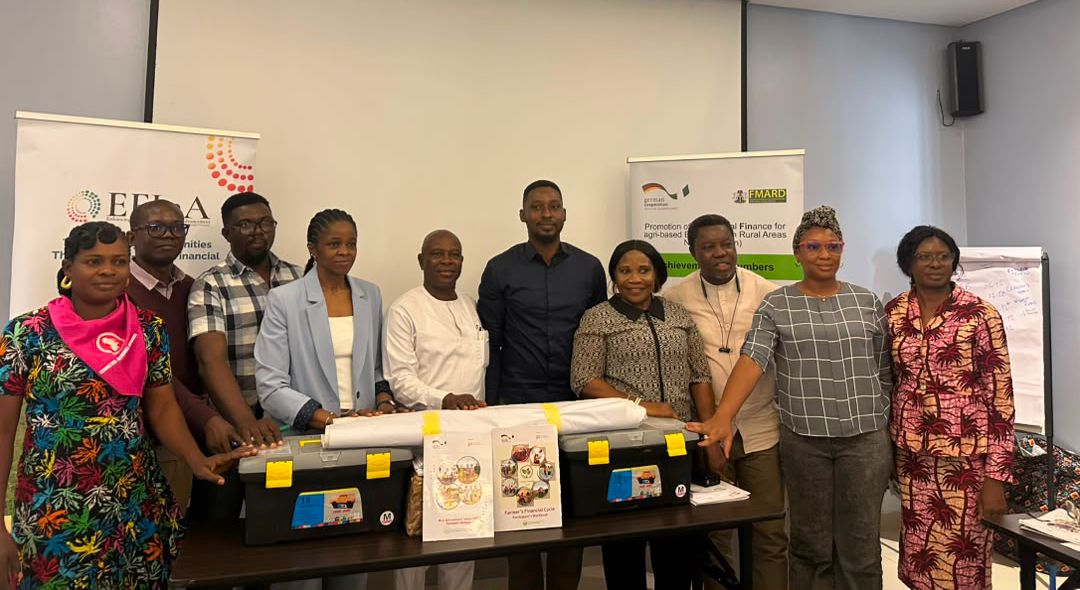
EFInA (Enhancing Financial Inclusion and Advancement) and the German government-funded Global Project Promotion of Agricultural Finance for Agri-based Enterprises in Rural Areas (GP AgFin) have concluded a nationwide capacity-building programme aimed at strengthening financial inclusion among rural and agricultural communities in Nigeria.
The initiative trained civil society organisations (CSOs), microfinance banks (MFBs), fintechs, and digital financial service providers that work closely with smallholder farmers, women-owned enterprises, and underserved rural populations.
Participants were drawn from all six geopolitical zones, including national farmers’ associations, women-focused organisations, grassroots groups, and financial institutions focused on agricultural and low-income market segments.
The programme was delivered through two specialised training tracks designed to improve both financial literacy and agricultural financing capabilities.
Under the Farmers Financial Literacy (FFC) and Micro Agric-Enterprise Training (MAT) track, CSOs and associations received standardised financial education materials and Training-of-Trainers support, enabling them to cascade financial knowledge to their members and ultimately reach hundreds of smallholder farmers and micro-business owners.
The second track focused on Agriculture Value Chain Financing (AVCF) and Business Model Analysis (BMA), providing microfinance banks and financial service providers with practical skills in agricultural lending, cashflow-based credit assessment, women-focused product development, and consumer protection.
According to EFInA, the programme was designed to address a long-standing challenge within Nigeria’s financial inclusion journey: while access to financial services has expanded, many rural and agricultural communities continue to face barriers to meaningful and sustainable financial participation.
Speaking on the significance of the initiative, Foyinsolami Akinjayeju, chief executive officer of EFInA, said the programme reflects the organisation’s commitment to translating financial access into improved livelihoods.
“EFInA exists to turn data into action for inclusive financial systems that improve lives and livelihoods. For years, data has been telling us the same thing: financial services access in Nigeria is growing, but depth remains shallow for too many people, particularly women, rural populations and agricultural communities,” she said.
She noted that the partnership with GIZ’s GP AgFin Project was established to ensure institutions closest to underserved communities are equipped to deliver sustainable financial solutions that improve resilience and economic outcomes.

Join BusinessDay whatsapp Channel, to stay up to date
Open In Whatsapp