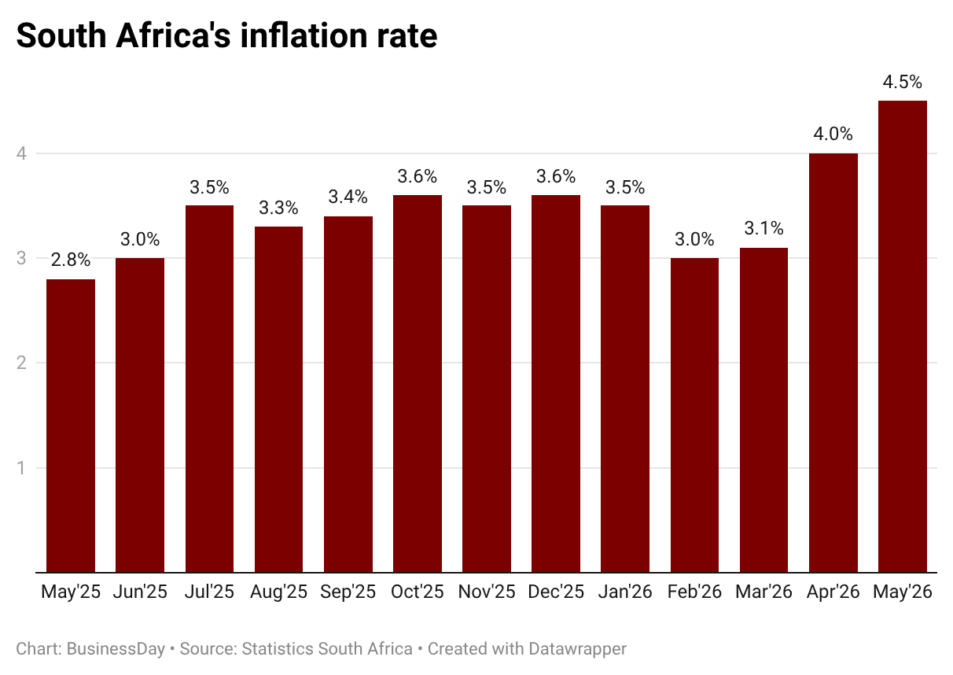
South Africa’s annual inflation rate accelerated to its highest level in almost two years in May, driven primarily by soaring fuel costs linked to escalating tensions in the Middle East and higher domestic electricity tariffs.
Consumer inflation rose to 4.5 percent in May from 4.0 percent in April, marking the third consecutive monthly increase and the highest reading since July 2024, according to data released by Statistics South Africa (SSA) on Wednesday. The figure came in below the 4.7 percent forecast by economists surveyed by Bloomberg.
On a monthly basis, consumer prices increased by 0.7 percent, compared with a 1.1 percent rise.
The rise in inflation for the continent’s biggest economy was largely concentrated in transport and housing-related costs. Transport inflation surged to 9.4 percent from 4.9 percent in April, while housing and utilities inflation edged higher to 5.3 percent from 5.2 percent, reflecting the pass-through effects of rising fuel prices and Eskom’s latest electricity tariff increase.
Core inflation, which excludes food, non-alcoholic beverages, fuel and energy, climbed to 3.8 percent from 3.6 percent, its highest level in more than 18 months, indicating broader underlying price pressures.
Fuel prices were the single biggest contributor to the increase in headline inflation. The fuel index jumped by 14.3 percent month-on-month, pushing annual fuel inflation to 28.7 percent.
Over the past year, petrol prices have risen by 24.8 percent, while diesel prices have surged by 53.8 percent.
The significance of fuel costs is evident in the inflation measure excluding fuel. Annual inflation excluding fuel remained unchanged at 3.7 percent last month, showing that most of the recent acceleration in consumer prices stemmed directly from higher energy costs.
Food inflation continues to ease
SSA further reveled that inflation for food and non-alcoholic beverages slowed to 1.9 percent from 2.9 percent and remains well below the peak of 5.7 percent recorded in July of last year.
Deflation in cereal products deepened, with annual prices declining by 1.4 percent compared with a 1.2 percent fall in April. Maize meal prices were 4.4 percent lower than a year earlier, while brown bread was 0.3 percent cheaper.
Meat inflation also moderated significantly, slowing to 7.3 percent from 9.4 percent in April. Prices for stewing beef and beef mince fell by 3.0 percent and 2.4 percent respectively between April and May.
Fruit and vegetable prices remained firmly in deflationary territory, declining by 8.5 percent and 6.0 percent year-on-year. Both categories have recorded annual price declines since October 2025.
Some food categories, however, showed signs of renewed pressure. Inflation in milk, dairy products and eggs rose to 0.9 percent from 0.1 percent in April, while inflation in the broader “other food” category accelerated to 4.9 percent from 4.1 percent.
Non-alcoholic beverages also recorded stronger price growth, with inflation rising to 4.9 percent from 4.6 percent. Tea prices continued to climb, with annual inflation for black tea reaching 8.3 percent and rooibos tea increasing to 7.5 percent.
The country s inflation uptick mirrors a broader trend across several African economies facing renewed energy-related price pressures.
In Kenya, inflation accelerated to 6.7 percent in May, its highest level since January 2024, largely due to rising transport costs following fuel price increases.
Ethiopia’s inflation rate climbed to 13.4 percent from 11.7 percent, returning to double-digit territory as fuel and food prices rose. Nigeria’s inflation rate also increased for a third consecutive month, reaching 15.93 percent from 15.69 percent.
Ghana and Rwanda likewise recorded higher inflation readings, underscoring the growing impact of elevated energy costs across the continent.
The inflation outlook could, however, improve in the coming months following a ceasefire agreement between the United States, Israel and Iran, which has helped calm global energy markets after nearly four months of heightened tensions.
Oil prices retreated from above $100 to below $80 per barrel after the announcement, easing concerns over potential supply disruptions in the Middle East, a region that accounts for a significant share of global crude exports. Lower crude oil prices typically filter through to domestic fuel costs, transport expenses and broader consumer prices.
If the ceasefire holds and oil prices continue to soften, May’s inflation spike may prove to be a temporary setback rather than the start of a broader inflation resurgence across South Africa and much of Africa

Join BusinessDay whatsapp Channel, to stay up to date
Open In Whatsapp