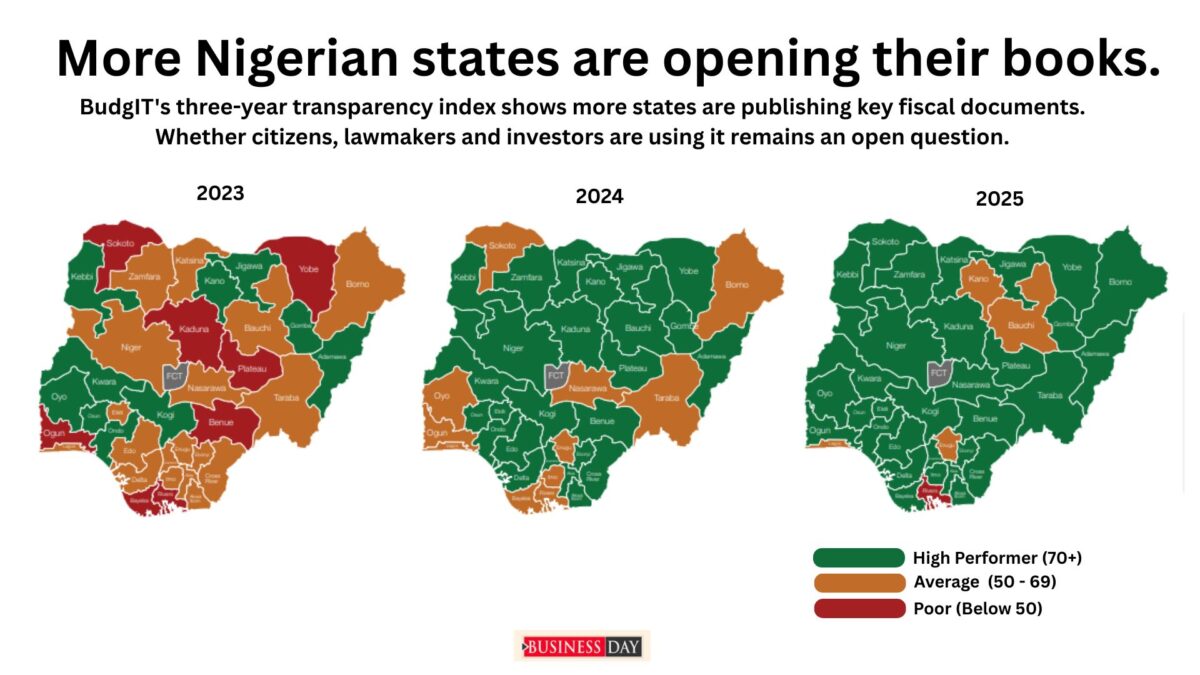
Nigeria’s states are becoming more transparent about how they manage public finances, offering a rare sign of governance progress in a country where accountability concerns often overshadow reform efforts.
A three-year review of fiscal disclosure practices across the country’s 36 states shows a steady increase in the publication of key budget documents, spending reports, and fiscal data. The report recently released by BudgIT showed that by 2025, 31 states ranked as high performers on fiscal transparency, compared with just 10 in 2023, while the number of states classified as poor performers has all but disappeared.
BudgIT’s State Fiscal Transparency League Trend Analysis Report for 2023 to 2025 reveals that beyond the headline improvement, transparency gains are uneven among the states, selective and vulnerable to political disruption.
“By 2024, there was marked improvement, with several states transitioning into the high-performing category and no state classified as poor, indicating broad-based progress. This positive trend peaked in 2025, highlighted by Ekiti’s exceptional achievement of a perfect score across all four quarters, while Rivers recorded a significant decline, likely associated with its change in administration during the cycle” the report read.
BudgIT argued in the report that there is still a wide gap between the best and the worst performers, making the gains fragile and unpredictable.
“States are more willing to publish less politically sensitive documents like the Approved budget than more accountability driven disclosures such as proposed budget, audit reports, and procurement information suggesting that openness is selective in many cases” the report read.
The result is that the system is becoming more open, but not necessarily more accountable.
Between the highest and lowest performers
The contrasting experiences of Ekiti and Rivers states illustrate the challenge. Ekiti recorded a perfect transparency score in 2025 after steadily improving over the three-year period, demonstrating how institutional commitment can entrench disclosure practices.
Rivers, by contrast, suffered one of the sharpest declines in the rankings following political turmoil and the disruption of normal governance processes, highlighting how quickly transparency gains can unravel when institutions prove weaker than politics.
Perhaps the most striking finding is that economic size appears to offer little guarantee of openness. Lagos, home to Africa’s largest urban economy and one of the continent’s most sophisticated tax systems, remained an average performer throughout much of the review period. The result suggests that transparency is driven less by economic capacity than by political incentives and administrative discipline.
The broader question for investors, development partners and citizens is whether recent improvements represent the emergence of durable governance institutions or merely a period of unusually strong compliance. As Nigerian states assume greater responsibility for economic development amid fiscal pressures and declining federal resources, the quality of financial disclosure is becoming more than a governance metric. It is increasingly a measure of institutional resilience, policy credibility and long-term investment readiness.
The trend points in the right direction. But the gap between the best and worst performers, together with evidence of selective disclosure and political backsliding, suggests that Nigeria’s transparency story is still a project in progress.
BudgIT called for more active citizens engagement and legislative oversight, noting that the improvement in transparency alone cannot drive the needed reforms without institutional accountability mechanisms.

Join BusinessDay whatsapp Channel, to stay up to date
Open In Whatsapp