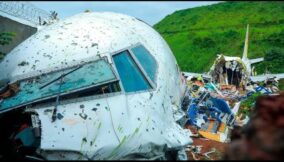
Six days after a privately operated aircraft made an abnormal landing on a public roadway near Asaba, Delta State, before departing for Lagos without regulatory approval, critical questions regarding flight details, safety oversight, and passenger manifests remain unanswered.
The prolonged silence from regulatory bodies has fueled growing unease within the aviation community. Just 24 hours after the June 10 incident, the Nigerian Safety Investigation Bureau (NSIB) confirmed it had recovered and secured the Cockpit Voice Recorder (CVR) and Flight Data Recorder (FDR) from the Bombardier Challenger CL-601 aircraft, bearing registration N989BC and operated by VMO Aero Limited.
However, nearly a week after the NSIB secured these critical “black boxes,” the bureau has yet to release a preliminary report or basic factual data. Essential details—including the official flight plan, the exact timeline of the occurrence, the takeoff time, and the number of souls on board- remain shrouded in secrecy.
BusinessDay findings reveal that basic flight parameters and manifest data are typically extracted and made available within 48 hours of an occurrence, well ahead of a formal preliminary investigation report. The delay in releasing these baseline facts is increasingly raising suspicion among industry stakeholders.
Adding to the industry’s worry is the advanced age of the flight crew. The aircraft was commanded by a 75-year-old pilot and a 70-year-old co-pilot—a revelation that stands in stark contrast to domestic safety benchmarks.
While Nigerian Civil Aviation Regulations (Nig. CARs) have historically prohibited commercial pilots over the age of 65 from commanding flights, the Nigerian Civil Aviation Authority (NCAA) quickly downplayed any legal infractions.
Read also: Asaba landing: VMO Aero defends ‘unstable approach’ maneuver
The regulator argued that because the United States acts as the “State of Registry” for the N-registered aircraft, the U.S. Federal Aviation Administration (FAA) holds primary jurisdiction over crew licensing, effectively shielding the pilots from domestic age limits.
However, a newly uncovered regulatory document heavily complicates the NCAA’s defensive stance. According to the Federal Republic of Nigeria Official Gazette No. 70, published on November 28, 2025, the NCAA explicitly issued Civil Aviation Order NCAA/CAO/2025/001, which amended Part 2 of the Personnel Licensing regulations.
Under the newly enacted Section 2.3.1.5(c), the regulator created a window for veteran aviators, stating that an individual above the age of 65 holding a pilot license issued under this part may continue to serve as a flight crew member on civil aircraft.
Crucially, this 2025 amendment is not an open-ended clearance; it introduces rigid sovereign boundaries. The updated regulation mandates that such flights are strictly restricted to general aviation operations and flight instructional purposes within Nigeria only, provided the pilot holds a valid Class 1 medical certificate.
This precise legal update has forced a wave of tough technical questions regarding the crew’s legal capacity to operate within domestic airspace. Because the law specifically limits this age variance to pilots holding local licenses operating civil aircraft of Nigerian registry, the legal status of a 75-year-old pilot commanding a foreign, N-registered hull on a domestic route remains deeply ambiguous.
“It remains ambiguous how a 75-year-old pilot operating a foreign, N-registered aircraft fits into this framework.
“If the operation did not strictly align with these newly updated general aviation restrictions or lacked proper cross-border validation, the pilots’ capacity to command that flight should have been legally restricted,” a stakeholder who would not want to be mentioned said.
Stakeholders say these issues expose lapses in regulatory oversight.
Seyi Adewale, chief executive officer at Mainstream Cargo Limited, told BusinessDay that the recent incident raises more questions than answers, berating the sector and plausibly the regulator.
“Such questions may include: which aviation policy, practice direction, or domesticated ICAO regulations are superior when compared to those domesticated in other countries, including those operated from the USA? What local laws and regulations do aircraft with foreign registrations operate under within our country?
“Are these foreign-registered aircraft empowered to fly in our skies to any destination, at will? How many airports or aviation centres are designated as Free Trade Zones, and what control or oversight do they have over these foreign-registered aircraft?” Adewale queried.
He stressed that these are the concerns that should unravel the mysteries and corrective actions needed to resolve or prevent future occurrences of this worrisome, illegal, dangerous, and unsafe landing and take-off of the foreign-registered aircraft on a road specifically designed only for vehicles, and impliedly making the appearance that Nigeria’s aviation sector is unsafe.
Read also: NSIB retrieves cockpit voice, flight data recorders in probe of aircraft roadway landing in Delta
John Ojikutu, industry expert and the CEO of Centurion Aviation Security and Safety Consult, told BusinessDay that there are serious implications for the security of the Nigerian airspace with the presence of a foreign-registered aircraft flown by a foreign pilot (licensed or not) without a security clearance.
“What or who did it carry at this time of unsettled or escalating insecurity in every part of our country? Aviation facilities are resources for attacks as well as targets. Pictures from ARISE show the aircraft well parked and the landing door opened to the ground,” Ojikutu said.
He called on the National Intelligence and the Department of State Services (DSS) to intervene, as this could mean another security concern or threat on air.
“The ownership of the aircraft has been denied by the first call owner, but what does the NCAA record say about this?”
Olumide Ohunayo, industry analyst and director of research at Zenith Travels, told BusinessDay that if the regulators and the ministry keep the same tab they keep on the non-scheduled operators, we won’t be having these safety issues.
“Unfortunately, this is not a Nigerian problem alone. There has always been that rogue relationship between the non-scheduled commercial operators and the non-scheduled private aircraft. These operators illegally use these aircraft for commercial purposes, and at the end of the day, it brings problems and questions on the safety and security of the aviation industry,” Ohunayo said.

Join BusinessDay whatsapp Channel, to stay up to date
Open In Whatsapp