Nigeria’s states have entered 2026 with some of their largest budgets on record. Supported by improved federal allocations and ambitious revenue projections, many governments are promising major investments in infrastructure, healthcare, education, agriculture and other development priorities.
Record budgets are creating high expectations across the country. But the first-quarter numbers suggest that many states are still struggling with a familiar challenge in turning budget promises into completed projects.
For policymakers, development practitioners, investors, and citizens, this distinction matters. Budgets may indicate government priorities, but implementation determines whether roads are constructed, hospitals are equipped, schools are improved, and public services become more accessible. Ultimately, development is measured not by what governments plan to spend, but by what they actually deliver.
An analysis of Q1 2026 budget implementation reports from Bayelsa, Ekiti, Enugu, and Niger states provides useful insight into this challenge. The states were selected because they represent different geopolitical regions, fiscal capacities, and budget sizes and publish comparable first-quarter implementation reports. Together, they offer a snapshot of how state governments are translating budget plans into actual spending during the opening months of the fiscal year.
The data points to a clear pattern. While revenue performance varies across states, implementation of capital expenditure remains significantly weaker than recurrent spending.
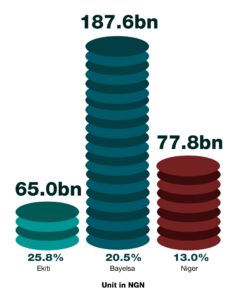
Among the states reviewed, Ekiti recorded the strongest revenue performance. Against a projected annual revenue target of N252.2 billion, the state generated N65.0 billion in the first quarter, representing 25.8 percent of its annual target. Bayelsa followed with N187.6 billion, equivalent to 20.5 percent of projected annual revenue, while Niger generated N77.8 billion, representing 13.0 percent of its target.
Enugu recorded the weakest performance among the states reviewed. Against an ambitious annual revenue projection of N1.26 trillion, the state generated N101.8 billion during the first quarter, representing only 8.1 percent of its annual target.
These figures suggest varying levels of fiscal performance. More importantly, they indicate that states are continuing to mobilise resources despite economic pressures.
In recent years, public finance discussions have largely focused on whether states can generate enough revenue to fund development. The first-quarter figures suggest that an equally important question is whether available revenues are being converted into projects and services that citizens can see and use.
Bayelsa budgeted N661.5 billion for capital projects in 2026 but spent N77.5 billion during the first quarter, translating to an implementation rate of 11.7 percent. Ekiti spent N16.9 billion out of a capital budget of N193.7 billion, equivalent to 8.7 percent implementation. Niger recorded a similar pattern, spending N79.3 billion from a capital budget of N783.7 billion, representing 10.1 percent execution.
The most striking case was Enugu. Despite approving a capital budget of approximately N1.3 trillion, the state spent only N31.4 billion during the first quarter, resulting in a capital implementation rate of just 2.4 percent.
During the first quarter, capital spending is often lower than spending in subsequent quarters, and major projects require procurement processes, contractor mobilisation, technical approvals, and administrative procedures before substantial funds can be released. However, the consistency of the pattern across multiple states suggests that implementation challenges remain a significant issue within subnational public finance.
Bayelsa implemented 17.4 percent of its recurrent budget during the quarter, compared with 11.7 percent of its capital budget. Ekiti executed 23.3 percent of recurrent spending but only 8.7 percent of capital spending. Niger implemented 15.7 percent of recurrent expenditure compared with 10.1 percent of capital expenditure.
Even Enugu, despite recording relatively weak performance overall, implemented recurrent expenditure at more than twice the pace of capital spending.
What this means is that states are generally finding it easier to finance salaries, overheads, and routine government operations than to deliver development projects. While recurrent expenditure is necessary to keep government functioning, it is capital expenditure that creates the infrastructure and public assets capable of improving economic productivity and living standards.
Citizens do not experience government performance through revenue targets, budget speeches or expenditure projections. They experience government through the quality of roads they travel on, the schools their children attend, the healthcare facilities available in their communities and the reliability of public services. When capital spending remains slow, the benefits of larger budgets become less visible to the people those budgets are intended to serve.
Comparing this with what evidence has shown from the 2025 first half data
Data from the first half of 2025 showed similar trends across several states. Ekiti generated N27.5 billion in internally generated revenue against a full-year target of N29.1 billion, achieving 94.6 percent performance, followed by Bayelsa, which realised N154.4 billion in total revenue during the same period.
Yet capital expenditure implementation remained relatively weak. Ekiti implemented only 30.5 percent of its capital budget during the first half of 2025, while Enugu achieved just 11.9 percent. The continuation of this pattern into 2026 suggests that the challenge facing many states may no longer be primarily about raising revenue. Increasingly, it appears to be about execution.
For years, efforts to strengthen state finances have focused on expanding internally generated revenue and reducing dependence on federal allocations. Those goals remain important. However, as revenues improve, equal attention must be paid to implementation capacity, project planning, procurement efficiency, and budget accountability.
States that consistently raise more money but struggle to execute capital projects effectively may find it difficult to translate fiscal gains into meaningful development outcomes.
The lesson from the first quarter of 2026 is therefore straightforward. Bigger budgets alone do not guarantee development. What matters is how effectively those resources are converted into completed projects and improved public services.
As states continue to benefit from stronger fiscal inflows, the focus of public debate should increasingly shift from how much money governments receive to how well they spend it. Until capital project implementation improves, larger budgets may continue to generate impressive headlines without producing equally impressive results on the ground.
Thaddeaus Jolayemi is Senior Program Officer at BudgIT.

Join BusinessDay whatsapp Channel, to stay up to date
Open In Whatsapp