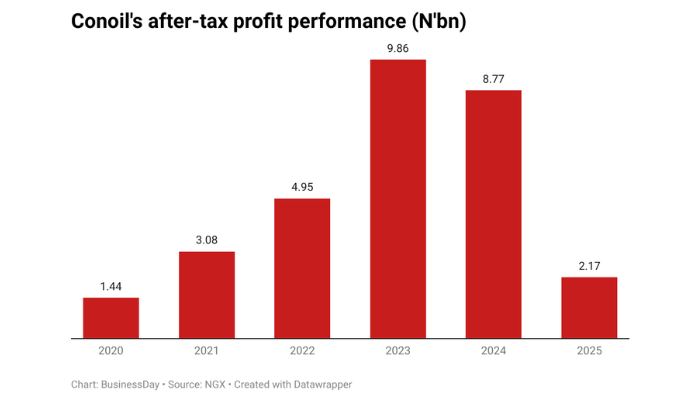
Conoil Plc reported its weakest profit performance in five years after rising finance costs and increasing debt obligations eroded earnings despite maintaining over N300 billion in annual revenue.
The downstream oil marketer posted a profit after tax of N2.18 billion for the year ended December 31, 2025, representing a 75.2 percent decline from N8.77 billion recorded in 2024. Profit before tax fell by 75.7 percent to N2.68 billion from N11 billion a year earlier, while revenue declined by 6.6 percent to N301.72 billion from N323.13 billion.
The result marks a sharp reversal from the strong profitability recorded in recent years and reflects mounting pressure on marketers operating in an environment characterised by elevated borrowing costs and tighter liquidity conditions.
An analysis of the company’s income statement shows that while revenue softened modestly, the biggest blow came from financing expenses. Cost of sales fell to N279.04 billion from N296.77 billion, leading to a gross profit of N22.68 billion compared with N26.35 billion in the previous year. However, finance costs surged by 172.7 percent to N10.78 billion from N3.95 billion, significantly reducing earnings before tax.
The increase in interest expenses more than offset savings achieved from lower distribution costs. Distribution expenses declined to N4.05 billion from N6.89 billion, but administrative expenses increased to N5.32 billion from N4.60 billion. As a result, profit margins narrowed substantially, with net profit representing less than one percent of turnover.
The weak earnings performance also affected shareholder returns. Earnings per share dropped to 314 kobo from 1,264 kobo, while the company proposed a dividend of 200 kobo per share compared with 350 kobo paid in the previous year.
A review of the balance sheet reveals that the company expanded its asset base during the year, although much of the growth was financed through additional borrowing. Total assets rose by 21.2 percent to N139.37 billion from N114.95 billion. The increase was driven primarily by a significant expansion in property, plant and equipment, which rose to N10.81 billion from N3.97 billion, as well as higher receivables.
Trade and other receivables climbed to N90.59 billion from N71.90 billion, reflecting increased credit sales. Trade debtors alone rose by 69.9 percent to N74.94 billion from N44.10 billion, underscoring the growing amount of working capital tied up in customer balances.
While inventories declined to N22.39 billion from N29.25 billion, the reduction was insufficient to offset the increase in receivables, resulting in additional funding pressure on the business.
To support operations and working capital needs, borrowings almost doubled during the year. Current borrowings increased to N54.90 billion from N28.68 billion, helping push total liabilities to N100.13 billion from N75.46 billion. Shareholders’ funds, however, remained largely unchanged at N39.24 billion.
The growing reliance on debt is reflected in the company’s gearing ratio, which rose to 1.40 times from 0.73 times in the previous year. This indicates that debt now significantly exceeds equity and explains the sharp rise in finance costs that weighed heavily on profitability.
The cash flow statement presents an even more challenging picture. Although the company remained profitable, its ability to convert earnings into cash weakened considerably. Net cash generated from operating activities dropped to N269.6 million from N8.80 billion in 2024.
The deterioration was largely driven by an N18.79 billion increase in trade and other receivables as well as continued investment in working capital. The figures suggest that a substantial portion of revenue recorded during the year had not yet translated into cash receipts, leaving the company increasingly dependent on external financing.
Conoil also increased capital expenditure, spending N7.65 billion on property, plant, and equipment compared with N3.16 billion in the previous year. At the same time, interest payments rose to N10.78 billion, while dividend payments amounted to N2.43 billion. These outflows contributed to a net cash decrease of N20.58 billion during the year.
Management attributed the negative cash position largely to increased investment in inventory and the need to drive sales through credit transactions.
Conoil has gained 3.63 percent year-to-date on that price valuation, ranking it 91st on the NGX in terms of year-to-date performance. The company share price rose from N187.20 per share in January 2, and is currently trading at N194.00 at the close of trading on Friday.

Join BusinessDay whatsapp Channel, to stay up to date
Open In Whatsapp