

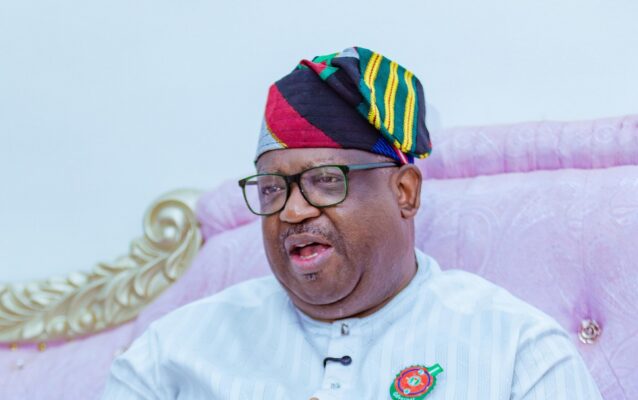
When political leaders, investors, business executives and development partners gathered in Victoria Island early this week for the third edition of the Invest Lagos Summit, Governor Caleb Mutfwang of Plateau State seized the opportunity to tell a compelling story about a state he believes is ready for economic transformation.
While the summit was designed primarily to attract fresh capital inflows into Lagos and strengthen its reputation as Africa’s business gateway, Mutfwang used the platform to position Plateau as one of Nigeria’s most promising investment destinations. Before an audience of local and international investors, he outlined opportunities in agriculture, mining, tourism, livestock development and health tourism, presenting Plateau as a state open for business and ready for partnerships.
The governor’s presentation at the opening ceremony of the two-day event scheduled for June 8-9 and monitored on television by BusinessDay in Jos reflected a broader strategy by his administration to diversify the state’s economy, create jobs and attract private sector investments by leveraging Plateau’s comparative advantages in food production, favourable climate, tourism assets and mineral resources.
Agriculture emerged as the centrepiece of Mutfwang’s investment pitch. He argued that Plateau possesses the capacity to contribute significantly to Nigeria’s Gross Domestic Product through enhanced food production, food security and food sovereignty.
“Today, Plateau State feeds Nigeria with what we used to call Irish potatoes, but today we call them Plateau potatoes. We feed the whole of West Africa and even our neighbours in Chad and Niger with potato supplies from Plateau State,” he said.
The governor linked his passion for agricultural development to his upbringing as the son of a farmer, explaining that his firsthand experience of the challenges faced by rural farmers inspired his administration’s determination to modernise the sector and improve productivity.
“Having grown as the son of a farmer, I knew the pains my parents and grandparents went through, and we decided that we must revolutionise that sector. One of our goals is to move potato yield from seven tonnes per hectare to 20 tonnes per hectare. One of the key ingredients in achieving this target is seed multiplication,” he said.
Beyond potatoes, Mutfwang highlighted Plateau’s position as Nigeria’s leading supplier of fresh vegetables, a status that has made the state a critical contributor to the country’s food supply chain. However, he acknowledged that inadequate storage infrastructure continues to result in significant post-harvest losses.
To address this challenge, he disclosed that discussions were ongoing with investors interested in developing cold-chain infrastructure capable of preserving produce and strengthening agricultural value chains across the state.
The governor also unveiled developments under the Special Agro-Industrial Processing Zones programme supported by the African Development Bank. According to him, Plateau has secured approval to participate in the programme’s second phase after studying lessons from the initial implementation stage.
A major component of that strategy revolves around the development of infrastructure around the state’s airport corridor. Mutfwang revealed that his administration had acquired a vast expanse of land intended to serve as a hub for agro-processing, logistics and export activities.
“As I speak, we have negotiated and acquired 500 hectares of land around the airport, which has been approved to become a cargo international airport. We have also signed an MoU with the Federal Airports Authority of Nigeria to improve facilities there,” he said.
The governor further explained that the airport economic zone would host processing facilities designed to add value to agricultural products before they reach domestic and international markets.
“By next week, I will break ground for the first meat-processing centre in the agro-processing zone. We are also building a new ultra-modern abattoir and relocating processing activities to the economic zone around the airport.”
His vision extends beyond supplying food to Nigeria’s commercial capital. Mutfwang told investors that Plateau intends to become a major exporter of agricultural products, particularly livestock products, to international markets.
“We are targeting not only to feed Lagos but also to export to the Middle East. We are leveraging our advantage as one of the best places to breed cattle in Nigeria and are embarking on an ambitious livestock development programme aimed at converting conflict into profit,” Mutfwang stated.
The governor explained that the state is developing the entire livestock value chain, including feedlots, fodder production, logistics systems and processing facilities. The initiative, he noted, seeks not only to generate economic growth but also to address longstanding conflicts associated with livestock production by creating structured commercial opportunities.
Although agriculture dominated much of his presentation, Mutfwang also highlighted Plateau’s vast opportunities in tourism and mining. Long known as the “Home of Peace and Tourism,” the state boasts unique landscapes, rock formations, waterfalls, wildlife attractions and a temperate climate that distinguishes it from many parts of Nigeria.
He said the government is working to unlock these assets while simultaneously exploring new opportunities in health tourism. According to him, feasibility studies for health tourism projects are nearing completion, creating another potential avenue for investment and economic diversification.
The governor’s presentation aligned with the broader objective of the Invest Lagos Summit, which seeks to connect investors with viable opportunities across Nigeria.
Organised by the Lagos State government in partnership with the Commonwealth Enterprise and Investment Council (CWEIC) under the theme, “Lagos: Business Gateway to Africa,” the summit brought together influential stakeholders from government and the private sector to discuss technology, infrastructure, manufacturing, finance, energy and urban development.
By showcasing Plateau’s strengths at such a high-profile gathering, Mutfwang effectively expanded the conversation beyond Lagos, positioning Plateau as an emerging destination for investors seeking opportunities in agriculture, mining, tourism and industrial development.
His closing remarks reflected the confidence with which he believes Plateau is entering a new era of economic growth.
“Two years ago, I was looking for N200 million. Today, if you give me N1 billion, it will be spent and turned into profit on the Plateau,” he said.
For many participants at the summit, the statement captured the essence of Mutfwang’s message: Plateau is no longer merely seeking investment; it is presenting itself as a state prepared to transform investment into measurable economic returns.

Join BusinessDay whatsapp Channel, to stay up to date
Open In Whatsapp


