…UNILAG holds 7th Arthur Mbanefo Lecture
As Africa grapples with persistent infrastructure deficits, energy shortages, and economic headwinds, Kola Adesina, the group managing director at Sahara Power Group, has outlined six critical pillars he believes are essential to unlocking the continent’s vast potential.
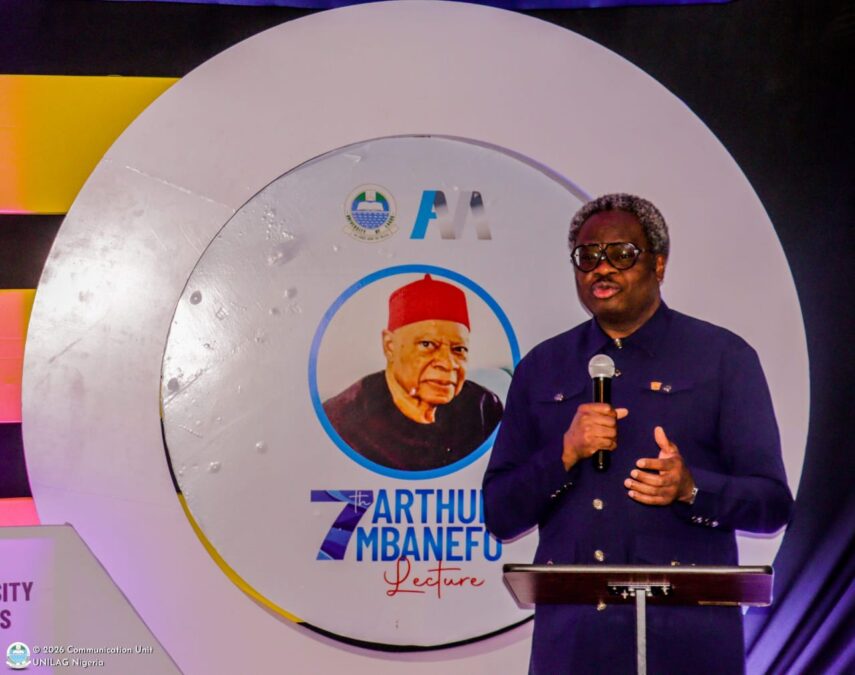
Adesina, who was the guest lecturer at the seventh Arthur Mbenafo Lecture organised by Arthur Mbanefo Digital Research Centre (AMDRC), University of Lagos, said Africa does not lack intelligence, ambition, and rhetoric as a continent, but certainly do not lack results.
Speaking on the topic “Illuminating Africa: from Rhetoric to Results, The Way, the How, the Who and the When”, said, “Every generation of African leadership has come with good intentions. Yet the distance between intention and actualization remains one of the most stubborn challenges of our time.”
He emphasised the need to move beyond rhetoric and focus on practical actions that can drive inclusive growth, strengthen institutions, and deliver measurable results across Africa.
To close the gap, Adesina highlighted what he described as the six non-negotiable pillars of a working Africa, which he said demands bold, deliberate, and urgent choices for the present and the future.
“Building a working Africa doesn’t happen by accident. It requires intention, sacrifice, structure and being honest about the ingredients that are non-negotiable.
“It requires trust, collaboration, building people, infrastructure, policy consistence and innovation and tech adoption. We can’t illuminate Africa with banditry,” he said.
He emphasised that without trust between citizens and institutions, investors and government, communities and leadership, nothing of lasting value can be built.
Besides, Adesina noted the need to build people, when he said, “Infrastructure without human capital is like scaffolding without a building. We must invest relentlessly in education not just access to classrooms, but quality of learning,” he said.
He said that Mbanefo did not just talk what Africa could be, he built things, honoured commitments, showed up with integrity, and invested in people.
“In doing so, he gave us a template, not for rhetoric, but for results. Let us honour his memory not with words, but with work,” he said.
Folasade Ogunsola, the vice-chancellor at UNILAG, applauded Mbanefo, describing him as a man whose life, vision and enduring legacy of an extraordinary statesman, philanthropist, commitment to knowledge and national development inspired the establishment of AMDRC.
“Through his generosity, AMDRC has become vibrant hub for scholarship, innovation, and digital learning within our university.
“Although Arthur Mbanefo transitioned to glory last year at the age of ninety-five, his ideals remain very much alive. His life exemplified the transformative power of knowledge. We are therefore honoured to continue this annual lecture, not just as a tribute to his memory but also a reaffirmation of the values he held dear,” she said.
Ernest Ebi, chairman of AMDRC in his speech, emphasised that for six years, the annual lecture has served as a platform for intellectual engagement, innovation, and policy resolution.
“For the first time, however, we are holding this lecture without our benefactor. It was his generosity, vision, and commitment to learning that made this centre possible. While we mourn his departure, we celebrate a life rich in impact, wisdom, service, and philanthropy.
“As we remember him, we celebrate not only his generosity and humanity, but also his extraordinary contributions to Nigeria and the world. Who does serve Nigeria with distinction as a patriot, diplomat, educationist, and administrator? He was an exceptional national and international personality,” he said.
Moreover, he said that Mbanefo earned national honours, professional respect, and the admiration of many through his exemplary leadership, integrity, and commitment to national development, across several decades of public service.
Segun Aina, the chairman of the occasion disclosed that lectures such as the seventh Arthur Mbanefo lecture provide a platform for reflection, intellectual inquiry, and inter generational dialogue.
“They preserve institutional memory while challenging each generation to reimagine the future and advance the ideas inherited from those who came before us.
“At a time when the world is experiencing unprecedented technological disruption, geopolitical shifts, climate challenges, demographic transitions, and economic transformation, societies are increasingly defined by their capacity to generate knowledge, foster innovation, and translate ideas into tangible progress,” he said.
Aina emphasised that the defining question before the continent today is no longer whether Africa should develop, the question is how we accelerate implementation, who must lead and collaborate, which institutions must be strengthened, what partnerships must be formed, and perhaps most importantly, when decisive action must occur.
“The answer, I believe, is now. Africa’s future cannot be deferred to another generation. The urgency of our time demands courageous leadership, strategic thinking, institutional effectiveness, innovation-driven solutions, and measurable execution.
“If Africa is to be truly integrated with energy access for all, economically, technologically, socially, environmentally, and intellectually, we must embrace a culture of accountability, collaboration, and results; and this calls for deeper partnership among academia, government, industry, development institutions, civil society,” he said.

Join BusinessDay whatsapp Channel, to stay up to date
Open In Whatsapp