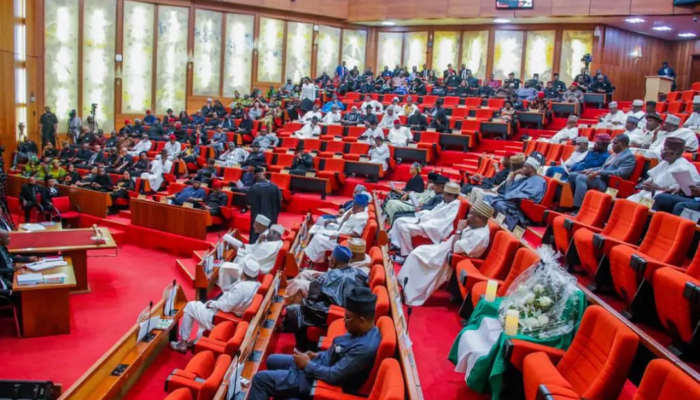
The Senate on Thursday extended the implementation period of the capital component of the 2025 Appropriation Act from June 30 to September 30, citing the need to complete ongoing projects and ensure the efficient utilisation of released funds.
The resolution followed the adoption of a motion moved by the Senate Chief Whip and considered by lawmakers after a closed-door session.
The extension, however, appears to contradict assurances given by President Bola Tinubu and the leadership of the National Assembly that the practice of running multiple budgets concurrently would come to an end.
While presenting the 2026 Appropriation Bill to a joint session of the National Assembly in December, Tinubu had acknowledged that operating several budgets simultaneously had created implementation challenges and pledged that all outstanding budgets would be fully implemented by March 31, 2026.
Similarly, Senate President Godswill Akpabio had assured Nigerians that the National Assembly would pass the 2026 budget by March 31 to sustain the January-to-December budget cycle.
Presenting the motion, Solomon Adeola, the chairman, Senate committee on Appropriation, noted that despite substantial releases made to Ministries, Departments and Agencies (MDAs), a significant portion of the funds remained unutilised.
Read also: N210trn: Senate distances itself from Kyari arrest warrant, Oshiomhole’s remarks on NNPCL
“The Senate further notes that, despite substantial releases made by the Federal Government to Ministries, Departments and Agencies (MDAs) for the execution of approved projects and programmes, a significant proportion of the funds released remains unutilised due to procurement timelines, project implementation challenges, and other administrative processes,” the motion stated.
The Senate also observed that several critical projects were nearing completion but required additional time for execution, certification and payment.
“The Senate is aware that a number of strategic capital projects across critical sectors of the economy are at advanced stages of completion and require additional time for execution, certification, and payment,” Adeola stated.
Lawmakers warned that allowing the implementation period to lapse could undermine ongoing government interventions and result in waste.
“The Senate is further aware that failure to extend the implementation period of the 2025 Appropriation Act may result in the abandonment of critical projects, wastage of already committed public resources, and disruption of ongoing government interventions,” Adeola’s motion stated.
The Senate further expressed concern that some projects captured in the 2025 budget might not be reintroduced in subsequent budgets, thereby creating funding gaps and hindering national development objectives.
According to the motion, extending the validity period of the capital component of the budget would “facilitate the efficient utilisation of released funds, improve budget performance, enhance service delivery, and support economic growth.”
The lawmakers added that they were convinced that “granting a further extension of the implementation period is in the national interest and will ensure value for money in public expenditure.”
Consequently, the Senate resolved to support an amendment to the 2025 Appropriation Act by extending the implementation period of its capital component from June 30, 2026, to September 30, 2026.
Speaking after the adoption of the motion, Akpabio said the extension was necessary to guarantee effective budget implementation and accountability.
“In accordance with the law and the constitutional powers vested in the National Assembly, what we have done this afternoon is to ensure the proper implementation of the budget,” he said.
“As clearly stated in the motion, we are extending only the capital component of the 2025 Appropriation Act, as amended.”
Akpabio recalled that when President Tinubu presented the budget, it was envisaged that a significant portion of the capital expenditure would be implemented within the approved period, while the remainder would be accommodated in subsequent budget cycles.
“You will recall that when Bola Ahmed Tinubu presented the budget to the National Assembly, it was anticipated that 30 per cent of the capital expenditure captured in the budget would be implemented within the approved timeframe, while the balance would be accommodated within subsequent budgetary provisions,” he said.
He explained that implementation delays had made it necessary for the National Assembly to first extend the budget’s lifespan to June 30, 2026.
“However, owing to delays in implementation, the National Assembly was compelled to extend the implementation period to June 30, 2026, to allow for the completion of ongoing projects and the utilisation of released funds,” he said.
According to him, although payments had commenced on several projects, many obligations remained outstanding.
“Although payments have commenced, a considerable number of obligations remain outstanding. It has therefore become necessary, in the interest of effective budget execution and accountability, to further extend the implementation period beyond June 30, 2026, to September 30, 2026,” Akpabio stated.
He expressed optimism that the additional three-month window would enable the government to settle outstanding commitments and complete ongoing projects.
“We are hopeful that within this additional period, all outstanding commitments under the affected component of the budget will be fully settled, while implementation of projects and programmes provided for under the subsequent budget cycle can proceed unhindered,” he said.

Join BusinessDay whatsapp Channel, to stay up to date
Open In Whatsapp