
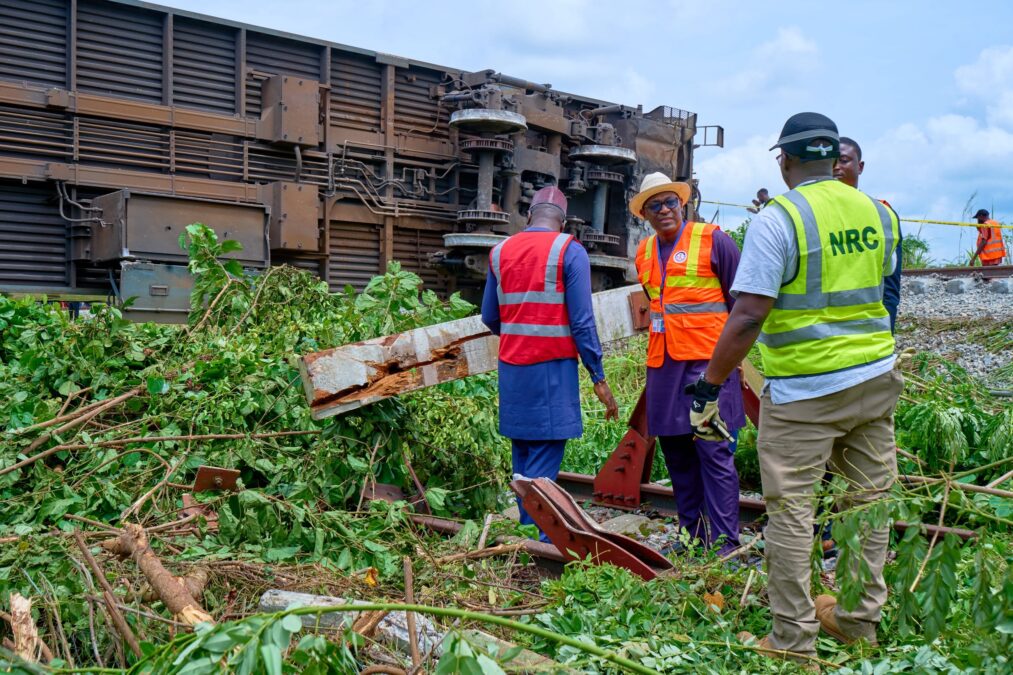
The Nigerian Safety Investigation Bureau (NSIB) has announced progress in its investigation of the train derailment that occurred along the Warri-Itakpe rail corridor on Monday, June 8, 2026, retrieving critical evidence to uncover the cause of the accident.
In a statement signed by Funke Adebayo-Arowojobe director, public affairs and family assistance, NSIB, disclosed that Alex Badeh Jr., director general of the NSIB, led the Bureau’s investigation team to the accident scene to initiate an inquiry.
Badeh was accompanied by Kayode Opeifa, managing director of the Nigerian Railway Corporation (NRC), and Funsho Adebiyi, permanent secretary of the Federal Ministry of Transportation, as part of a coordinated response involving relevant transportation stakeholders and authorities.
According to the statement, investigators conducted documentation of the accident site, examined the affected rail equipment and infrastructure, gathered operational and technical information, and interviewed relevant personnel connected to the operation of the train.
Read also: Warri–Itakpe train derails, four coaches run off track — NRC
It added that recovered evidence obtained from witness interviews, operational records, maintenance documentation, and other investigative sources will be subjected to detailed examination by the Bureau’s specialists.
Speaking at the accident scene, Badeh expressed the Bureau’s condolences to those affected by the accident.
“Our thoughts and deepest sympathies are with the families who have lost loved ones, those who sustained injuries, and every passenger affected by this tragic occurrence. We understand the pain and uncertainty such an event brings, and we want the public to be assured that the NSIB has commenced a thorough and evidence-based investigation.
“We will follow the facts wherever they lead and generate actionable safety recommendations aimed at systematically addressing identified risks and preventing a recurrence on our railway network,” he said.
As part of the visit, Badeh demonstrated the Bureau’s commitment to the human dimension of transportation safety by personally meeting with passengers affected by the derailment.
He commiserated with the families of those who lost their lives, conveying the condolences of the NSIB and the government.
He also visited injured victims receiving treatment at various primary healthcare centres and hospitals, where he offered words of comfort, support, and reassurance.
The Bureau stated that they are working in close collaboration with the NRC, Federal Ministry of Transportation, Federal Ministry of Health, and other relevant federal and state agencies throughout the investigation process.
NSIB also acknowledged the cooperation of the NRC, whose support facilitated the efficient mobilisation of resources and access to operational facilities and information required by the investigative team.
The NSIB emphasised that its investigation is strictly safety-focused and non-punitive.
“The purpose of the investigation is not to apportion blame or determine civil or criminal liability, but to establish the circumstances of the occurrence, identify causal and contributing factors, and determine measures that can enhance the safety of rail transportation operations in Nigeria.
“Upon completion of the investigation process, the Bureau will publish its findings and issue safety recommendations aimed at strengthening rail transport safety and reducing the likelihood of future occurrences,” the Bureau stated, noting that further updates will be provided as more information becomes available.
The NSIB is the multimodal transport agency charged with the mandate of promoting transport safety and conducting objective, comprehensive, and accurate investigations into transport accidents and incidents in Nigeria with the aim of identifying the probable causes and advocating for safety improvements based on our findings.

Join BusinessDay whatsapp Channel, to stay up to date
Open In Whatsapp