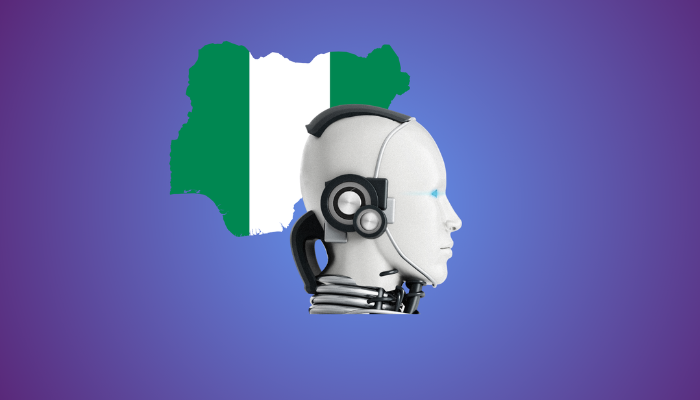
Children’s Day found me joining virtually from Atlanta for a live interview with the Jasiri programme on News Central, discussing plans for Nigerian children beyond the just-concluded celebrations. But even as I spoke, my mind kept drifting.
It went to the children the Louis Awode Foundation recently visited during outreach across Ogun State; kids crowded around borrowed laptops, hands raised, questions tumbling over each other. Children who had never touched a computer and, in a single afternoon, wanted to understand everything. Their excitement was not surprising. The surprise was how long they had waited for that moment.
Then I thought about the rest of the world. And the contrast was difficult to sit with.
Right now, nations are pouring billions into artificial intelligence. Silicon Valley, Shenzhen, London, and Seoul are not debating whether to prepare their young people for the AI era. They already are.
Coding is in primary schools. Robotics clubs meet after class. Machine learning is on the curriculum. And in too many Nigerian classrooms, children are still waiting for textbooks.
Is Nigeria preparing its children for the future or for a world that no longer exists?
Last month, I served as an international judge at DECA’s annual competition in Atlanta, where over 15,000 high school students competed in business case challenges. I judged forty of them individually. What struck me was not their polish. It was their expectation, the quiet, unshakeable assumption that the future of business belongs to them. DECA built that. Deliberately. Someone decided those students deserved to be competition-hardened, globally aware, and ready to lead.
I left inspired and deeply unsettled. Because while the Western world systematically produces confident, globally minded young leaders, too many Nigerian children are still waiting for their first real chance to be seen.
The greatest threat AI poses to Nigeria is not robots replacing workers. The real danger is subtler: nations that invest in their people today will dominate tomorrow’s economies, while those that do not will become dependent on innovations built elsewhere.
The Industrial Revolution rewrote the global hierarchy. So did the Digital Revolution. The AI Revolution will do it again. The question is whether Nigeria intends to help write that future or merely read about it.
There is a particular frustration in watching us celebrate our youth demographic while underinvesting in it. We call young people our greatest asset, then send millions of them into schools with crumbling infrastructure, absent internet, and curricula that have not meaningfully evolved in decades.
Potential is not a strategy. A child cannot compete globally on potential alone.
Here is what I know from the ground: Nigerian children are not the problem. During the Foundation’s recent school outreach across Ogun State, over 460 students participated in digital skills sessions. The energy in those rooms was extraordinary. Give a child a device and fifteen minutes of guidance, and she will teach herself. Give a student a stage and he will rise to it.
When given the opportunity, they rise. When given the tools, they learn. When given encouragement, they dream bigger.
The failure is not theirs. Government must fund digital infrastructure and get technology into classrooms, not as a pilot programme, but as a national standard. The private sector must build pipelines, not just sponsor events. Civil society must keep creating the access that institutions are too slow to provide. And all of us must stop treating investment in children as philanthropy.
It is not charity. It is nation-building.
The AI race has already begun. The starting gun fired years ago. Nigeria cannot afford to remain at the starting line, not for any reason, and certainly not for lack of capable children.
For the child in Ogbere, the pupil in Ijebu-Ode, the student in Kano, the learner in Maiduguri, the millions of young Nigerians whose futures depend on the decisions we make today. We must choose to run. The future is not waiting.
And neither should we.
image.png
Louis Awode is an education advocate, social impact leader, and entrepreneur. He is the Founder of the Louis Awode Foundation, where he works to advance educational opportunities and youth development initiatives.

Join BusinessDay whatsapp Channel, to stay up to date
Open In Whatsapp