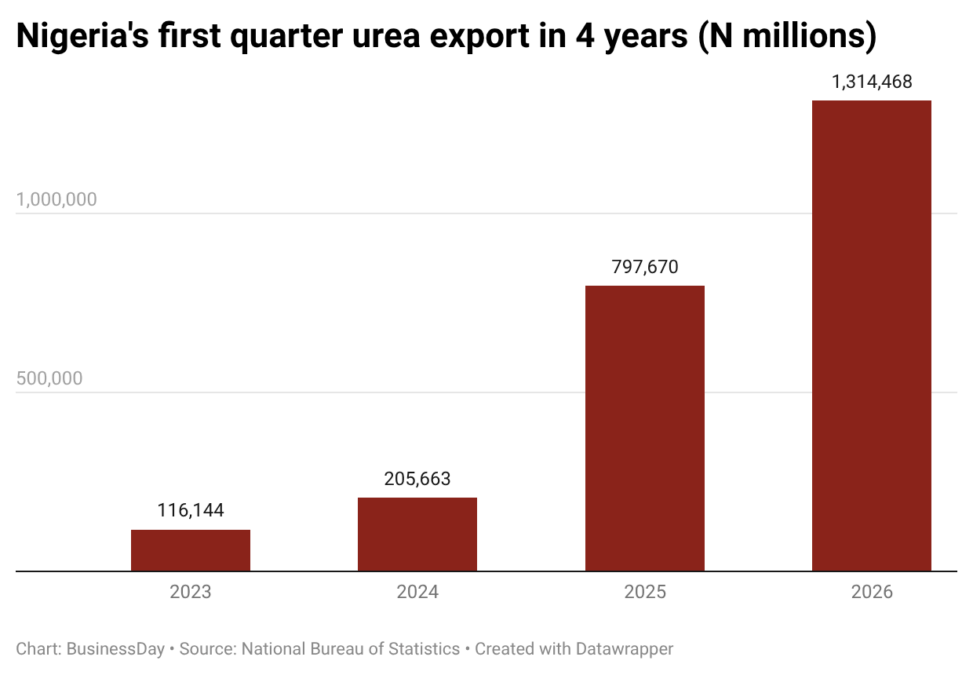
Nigeria’s urea exports surged 64 percent year-on-year in the first quarter of the year as geopolitical conflict in the Middle East disrupted a key shipping route accounting for 35 percent of global supplies.
The country’s urea exports jumped to ₦1.3trn in the first quarter of 2026 from ₦797.7bn in the corresponding period of 2025, according to recent data from the National Bureau of Statistics (NBS).
Middle East conflict re-routes global trade
The conflict has effectively closed the Strait of Hormuz, driving fertiliser prices higher and diverting global demand to alternative producers. Nigerian fertiliser manufacturers are capitalising on the tight market conditions, ramping up shipments to major international destinations including Brazil, the United States, India, Ethiopia, and Ukraine.
The export surge has provided a significant boost to Nigeria’s non-oil export earnings. Gideon Negedu, the former Executive Secretary of the Fertiliser Producers and Suppliers Association of Nigeria (FEPSAN), stated that the country is positioned to see sustained growth in revenue as global demand intensifies.
“For our local urea industry, the current surge in demand is a boon,” Negedu said in a previous interview with BusinessDay.
Read also: Manufacturers face margin squeeze as China freight rates jump
High gas prices squeeze European output
While the European Union produces its own nitrogen-based fertilisers, the process relies heavily on imported natural gas. Gas prices in Europe have risen by more than 20 percent since the outbreak of hostilities, forcing regional producers to cut urea output as manufacturing costs become prohibitive.
Consequently, European and Middle Eastern production cutbacks have forced continental buyers to turn to imports, further accelerating the demand for Nigerian product.
An employee at Indorama, speaking on the condition of anonymity, confirmed a substantial rise in international orders since February. “We are seeing a consistent increase in orders, though we are prioritising our existing customer commitments first,” the source said, adding that the export volume is expected to rise even further in the second quarter.
Domestic prices rise amid capacity utilisation
Nigeria possesses three major urea production plants—Notore, Indorama, and Dangote—with a combined capacity of 6.5 million metric tons. These facilities are fully operational, having produced approximately 3.65 million metric tons of urea in 2023.
Aliko Dangote, the President of the Dangote Group, stated that the company’s manufacturing capacity has played a vital role in cushioning the global supply shock across West, Central, and East Africa. According to him, the company has actively redirected shipments to African markets that were previously not major export destinations.
However, the export boom has severely impacted the domestic market. The local price of a 50kg bag of urea has surged 53 percent from an average of ₦33,000 in February to ₦50,500 currently, adding significant pressure to food inflation across the country.

Join BusinessDay whatsapp Channel, to stay up to date
Open In Whatsapp