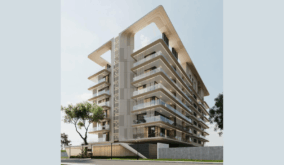
Jim Ovia, the billionaire founder of Nigeria’s largest bank by market value, has made an unexpected full-time pivot to real estate, betting that luxury residential real estate in Lagos will yield higher returns than commercial lending.
Ovia, who concluded a 12-year tenure as chairman of Zenith Bank Plc on May 5, is deploying capital into the premium residential sector through Quantum Luxury Properties Ltd. His much-talked-about project, the 26-floor Metropolitan Towers on the Lagos Lagoon, features unit prices starting at $1.85 million. A sister development, the 44-unit Quantum Luxury Towers, prices apartments from $2.8 million, targeting high-net-worth individuals (HNIs).
Both developments, which are selling fast according to Ovia, are located strategically where he constructed Civic Towers and Civic Centre, where events are held.
Ovia is part of a broader trend of non-traditional developers aggressively building across commercial and residential hubs in Nigeria’s commercial capital.
Tony Elumelu has been in the market for a long time with his Afriland Properties, which has left strong footprints in that market. Afriland Properties is a Property Development Company located on Broad Street, Lagos Island, Lagos. The company has two ongoing projects, eight completed projects and five high-profile key contacts.
Similarly, Matthew Ashimolowo, the Senior Pastor of the Kingsway International Christian Centre (KICC), is a prominent Nigerian real estate developer, investor, and the Chairman of Makarios Luxury Properties Limited and Meridian Luxury Properties Limited. He is well known for developing massive luxury and destination estates in the fast-growing Ibeju-Lekki corridor of Lagos, Nigeria.
Read also: Nigerian tycoon-backed financier eyes East Africa expansion in bold pan-African growth push
One of these flagship projects is Makarios the Luxury Place—an 84-acre multimillion-dollar development along the Lekki-Epe Expressway featuring revolutionary amenities, residential plots, and commercial hubs.
Another is Makarios Champions Place – a sports-themed estate designed specifically for football fans, where streets and sections are named after major European football clubs like Chelsea, Arsenal, and Manchester United.
Though it is not primarily a commercial real estate developer, the Redeemed Christian Church of God (RCCG), especially its larger, autonomous parishes, frequently undertakes massive real estate development and infrastructural projects to fund charitable works and accommodate its vast congregations.
An example of such projects is Trinity Towers, built in Oniru, Victoria Island, Lagos, by the RCCG City of David parish. The 14-storey tri-tower commercial edifice was specifically designed to generate rental income to fund their extensive Corporate Social Responsibility (CSR) and charitable programmes.
Ovia may have left Zenith Bank; however, the billionaire remains the lender’s largest individual shareholder, suggesting that he is far from a clean break with the institution he ran as chief executive officer for two decades.
Till date, Nigeria has an ever-widening housing gap estimated variously at 17 million, 20 million, 22 million and 28 million units, depending on who is talking and on which side of the divide he stands.
This, along with the country’s growing population and rapid urbanisation, is helping to drive up property values across income levels. Though the shortage is more pronounced at low-income levels, it is also creating strong demand for luxury properties in Lagos, where Ovia’s new developments are selling out.
Read also: Nigerian Banker Jim Ovia bets on luxury real estate after Zenith exit
Ovia said in a recent interview that “I’m moving into real estate full-time.” Analysts, taking a cue from his investment track record, are of the view that his move follows a series of successful investment exits he had done in the past.
The analysts recall his selling Visafone Communications to MTN Group Limited a decade ago, and making an early bet on Moniepoint Inc., the Nigerian fintech that became a unicorn last year. These precedents suggest Ovia has a proven ability to identify high-growth opportunities and exit at peak valuations.
According to the analysts, Ovia’s declaration that real estate is more profitable than banking reflects the lucrative returns available in Nigeria’s luxury property market, where a 20-million-unit housing deficit is driving up values.
Samuel Ajose, chairman/CEO, Levitical Group, confirmed to BusinessDay in an interview recently that luxury real estate delivers premium returns on investment, which is why, according to him, most investors in real estate flock to that segment of the market, as against the low-mid-income market where demand is higher and where the deficit resides the most.
According to Johnson Chukwuma, a civil engineer and estate manager, investment interest heavily favours luxury real estate because it offers a rare combination of scarcity, capital appreciation, and economic resilience.
“High-net-worth investors prize prime locations for their exclusivity, using these tangible assets to hedge against inflation while securing their wealth across generations, Chukwuma explained further.
He said that investing in luxury real estate comes with benefits, one of which is the potential for appreciation in value. “This means that the value of your property can increase over time, resulting in a significant profit when you decide to sell. And when it comes to luxury real estate in Nigeria, the potential for appreciation in value is even higher,” he said.
He cited a recent study by the Nigerian Institution of Estate Surveyors and Valuers, which says that property prices in Nigeria’s high-end market have seen a steady increase of about five percent per year over the last decade. “This trend is expected to continue, making luxury real estate in Nigeria a smart investment for those looking to make a profit in the long-term,” he assured.

Join BusinessDay whatsapp Channel, to stay up to date
Open In Whatsapp