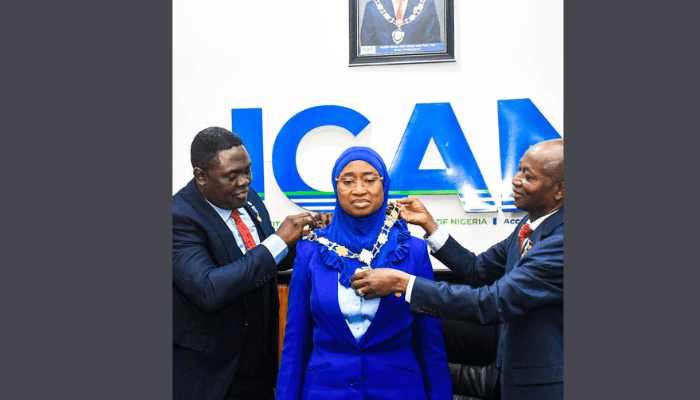
When Queensley Seghosime was invested last week as the 62nd president of the Institute of Chartered Accountants of Nigeria (ICAN), the ceremony at the institute’s Victoria Island headquarters carried weight well beyond the usual rituals of professional succession.
For six decades, ICAN has operated as a foundational pillar of Africa’s leading economy, certifying the professionals who manage the wealth of its corporations and state institutions.
But as artificial intelligence, automation, and financial technology aggressively reshape global commerce, the legacy institution faces an existential challenge of rapid transformation or imminent obsolescence.
A distinguished tax administrator from Edo State, Nigeria, Seghosime, takes the helm at a pivotal moment when Nigeria’s economy is struggling with fiscal deficits and weak governance despite being Africa’s largest potential market for transparent financial reporting.
No wonder her nine-point agenda, unveiled at her inauguration, aims to transform ICAN from a respected but Nigeria-centric credentialing body into a globally competitive force.
“Membership of ICAN must be both prestigious and beneficial,” Seghosime said in her acceptance speech.
“We will strengthen engagement, partnership, professional mobility, and higher development opportunities for our members.”
Seghosime’s career history includes 26 years spent in senior positions at the Federal Inland Revenue Service (now the Nigerian Revenue Service), where she served as Coordinating Director for Compliance and Enforcement. She has represented Nigeria at the OECD and the Commonwealth Association of Tax Administrators. She currently runs Quebaan Professional Services, an advisory firm covering tax, governance, audit, and dispute resolution.
Redefining a Profession at an Inflection Point
For much of its history, ICAN has been defined by compliance and ledgers. Under Seghosime, the emphasis shifts to real-time data synthesis, sustainability reporting, and digital assurance.
Her administration plans to deploy AI and proctored online examinations, which build on work started by her predecessor, Haruna Yahaya, to modernize how chartered accountants are trained and tested.
ICAN, founded in September 1965, has over 63,000 members. It is one of the largest chartered accountancy memberships in Africa, with membership that recently grew to nearly 70,000 following the induction of over 2,000 new members.
The institute now stands at the intersection of several colliding forces of a Nigerian economy under structural stress, the global profession’s reckoning with automation, and Africa’s increasing appetite for the kind of credible financial infrastructure that attracts long-term capital.
So the broader ambition is economic. In a country where informal transactions still dominate and tax-to-GDP ratios languish below 11 percent, a digitally fluent accounting profession could be transformative.
The GDP Case for a Stronger ICAN
The accounting profession rarely features in Nigeria’s mainstream development conversations, which tend to orbit oil revenues, monetary policy, and agricultural output. That framing understates its economic significance.
Nigeria loses an estimated $15 billion to $18 billion annually to illicit financial flows, tax evasion, and transfer mispricing, according to research by the Global Financial Integrity network. Much of this is enabled by inadequate financial oversight and a weak audit culture.
A professionalised, digitally-empowered crop of accountants embedded across the public sector, small and medium enterprises, and capital markets could, credibly, recover a meaningful fraction of that leakage.
The tax-to-GDP ratio, currently among the lowest on the continent at roughly 10 percent against a sub-Saharan Africa average closer to 16 percent, represents hundreds of billions of naira in foregone revenue annually.
Seghosime’s own background as a tax enforcement architect makes her unusually well-positioned to understand this link between professional standards and fiscal yield.
There is also the investment channel. Development finance institutions, including the International Finance Corporation (IFC), the African Development Bank (AfDB), and Afreximbank, now apply rigorous financial due diligence before committing capital to African private sector projects.
Foreign portfolio investors in Nigerian equities and bonds depend on financial statements that meet credible international standards. A trusted accounting profession does not merely record economic activity; it also aids it by making Nigeria legible to global capital.
Estimates from comparable emerging markets suggest that improvements in audit quality and financial reporting standards can reduce firms’ cost of capital by one to two percentage points, effectively unlocking investment that would otherwise not flow.
If ICAN’s reforms succeed in raising the profession’s quality, breadth, and ethical rigour over this decade, the cumulative effect on GDP through improved tax compliance, better corporate governance, deeper capital market participation, and more investable public accounts could conservatively add 0.5 to one percent of GDP annually by 2030.
Against a current GDP of roughly $375 billion in official terms, that is a tangible number.
The road ahead will require sustained investment, collaboration, and innovation, but the vision signals a clear ambition: to build a future-ready accounting profession that can compete and lead in a rapidly evolving global marketplace.
What remains to be seen is whether the ambition encoded in Seghosime’s nine-point agenda translates into the execution discipline required to deliver it.
By prioritising innovation, strengthening member value, embracing digital transformation, and deepening stakeholder engagement, Seghosime’s roadmap offers a foundation for sustainable growth and enduring impact.
The journey towards building tomorrow’s ICAN now presents the 62nd president of the institute, and the accounting ecosystem, the opportunity to create a more resilient, inclusive, and globally competitive institution for generations to come.

Join BusinessDay whatsapp Channel, to stay up to date
Open In Whatsapp