At least 32 people have been killed and more than 100 injured after a powerful 7.8 magnitude earthquake struck off the coast of Mindanao in the southern Philippines, triggering tsunami warnings across parts of Asia and the Pacific.
According to BBC, the earthquake hit at 7:37 a.m. local time on Monday, sending residents fleeing from homes, schools and businesses as buildings collapsed and landslides swept through affected communities. Authorities said nearly two dozen people remain missing, while about 10,000 residents have been evacuated as rescue teams continue search and recovery operations.
Read also: Nigerians in Philippines, Cambodia give FG seven-day ultimatum over compulsory diaspora dues
The hardest hit areas were in southern Mindanao, where local officials reported widespread destruction. In Sarangani province, close to the earthquake’s epicentre, at least 17 people died, many of them after a landslide struck the area. Power and communication services were temporarily disrupted before being restored.
According to the BBC, another 10 people were killed in General Santos City, the largest urban centre nearest the epicentre. The city, known as the Philippines’ tuna capital and the hometown of former world boxing champion and politician Manny Pacquiao, also recorded dozens of injuries and missing persons.
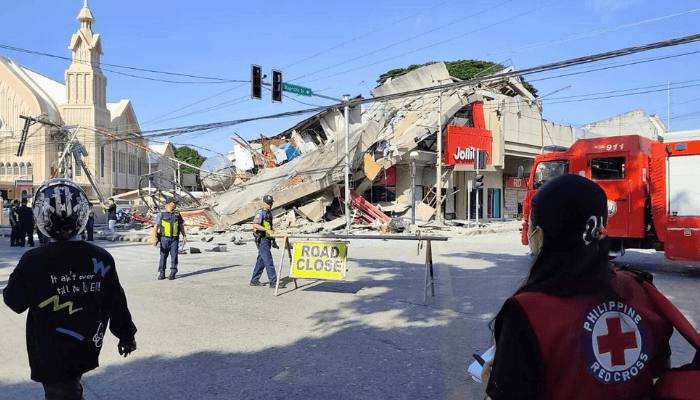
Images and videos circulating online showed the scale of the destruction, including footage of a Jollibee fast food restaurant reduced to rubble. Landslides were also reported in several communities, cutting off access to some areas.
Read also: Meet the envoys representing Nigeria in Portugal, Togo, Sweden, Greece and the Philippines
Ferdinand Marcos Jr, Philippine President said government agencies had been mobilised to respond to the disaster.
“The national government is moving and we will not leave Mindanao behind,” Marcos said in a statement.
The president also ordered the suspension of classes in affected areas. The earthquake struck on the first day of the new school year, forcing thousands of students and teachers to evacuate classrooms.
Read also: Aramco expands global retail network with 25% stake in Philippines’ Unioil
A video shared by a primary school in Davao Occidental showed frightened pupils crouching on shaking ground as a nearby shelter collapsed. School authorities later confirmed that no injuries were recorded among students or staff.
The Philippine Institute of Volcanology and Seismology recorded more than 130 aftershocks following the initial quake, with magnitudes ranging from 1.3 to 6.7, raising concerns about further damage in weakened structures.
The earthquake also prompted tsunami alerts in the Philippines, Indonesia, Japan and Australia. While some warnings were later lifted, authorities reported small tsunami waves reaching several coastal areas.
According to the BBC, waves measuring up to 1.4 metres were recorded in parts of the Philippines, while smaller waves were detected along the coasts of Indonesia and Palau. In Japan, officials observed tsunami waves in Okinawa and the Ogasawara Islands after earlier warning residents to prepare for waves of up to one metre.
The Philippines sits on the Pacific Ring of Fire, one of the world’s most active seismic zones, making earthquakes a frequent occurrence. While many are relatively minor, stronger tremors have repeatedly caused significant loss of life and damage across the archipelago.
Officials said casualty figures remain provisional and could rise as emergency teams continue assessments in remote and heavily affected areas.

Join BusinessDay whatsapp Channel, to stay up to date
Open In Whatsapp