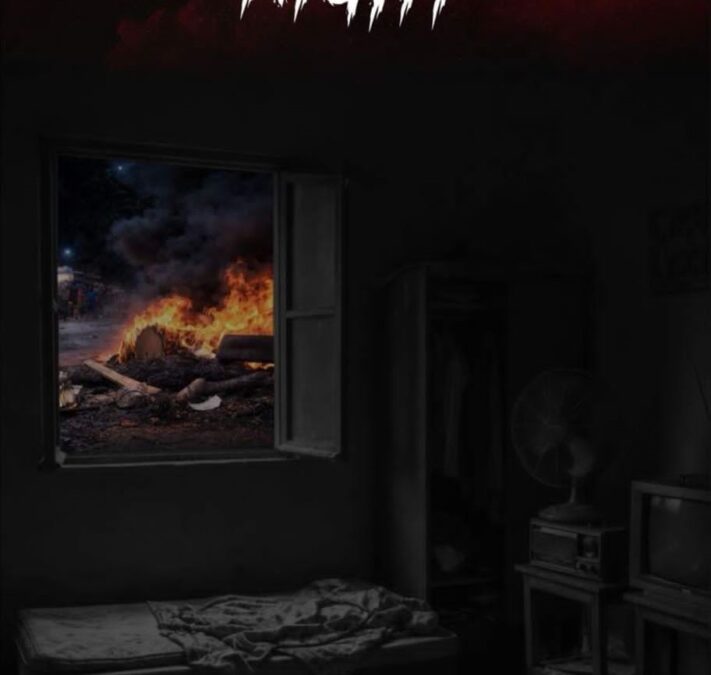
Once again, theatre lovers are set for an enthralling command performance by one of the gifted hands in the theatre business in Nigeria.
Riding on the success of his many plays, Ozi Okoli, a playwright and media personality, is opening the stage for yet another masterpiece from his creative juices.
This time, Okoli is staging ‘Restless Night’, a satirical stage play and his latest offering, in a tripartite event to mark his 50th birthday anniversary.
The playwright, who is also the supervising producer of the play, will on June 13, 2026, his birthday, cut his anniversary cake, launch his book and stage a command performance of ‘Restless Night’.
The command performance of the newly published play takes place at Alliance Francaise (Mike Adenuga Centre), 9 Osborne Road, Ikoyi, Lagos. There are many reasons the play is a must-watch.
First, it is staging against all odds as the playwright lost his father and mentor on May 1, 2026.
“While I mourn the departure of my beloved father and co-event planner, Elder Noel Uzochukwu Okoli on May 1, 2026, and burial fixed for August in Anambra State, the show must go on,” he said, reflecting on his loss.
Again, you need to see ‘Restless Night’ because of the relatable storyline. The two-performers play is a darkly comic and haunting satire that explores how insecurity and armed banditry have transformed everyday life in contemporary Nigeria. Through the sharp, absurd, and often hilarious exchanges of two friends—Sunny and Frayo—the play exposes a society where gunshots interrupt jokes, fear coexists with laughter, and survival depends as much on humour as on hope. As private memories collide with public violence, Restless Night lays bare the cost of failed leadership, institutional decay, and freedom without peace, asking audiences to confront the unsettling normalisation of fear in a nation trapped in a cycle of restless days and sleepless nights.
Also, the well-arranged plot carries along the audience in a connected narrative, as the play unfolds in five scenes, largely within and around the modest room shared by Sunny and Frayo. Yet, throughout the play, gunshots and radio news of bandit attacks repeatedly interrupt conversations, reinforcing a sense of constant danger and “restless nights.”
The excitement starts from the Scene I, which is subtitled ‘Fear and Comic Relief’, where Sunny wakes Frayo with disturbing news about armed bandits attacking communities—kidnapping chiefs, worshippers, and killing indiscriminately. Frayo initially doubts the reports, leading to humorous exchanges.
But the fear of insecurity is contrasted with comic storytelling, including Frayo’s absurd choir audition experience and satirical commentary on religion, language, and social hypocrisy. The scene ends with chaos and gunshots, forcing the men to hide.
The Scene II takes the comic further, amid little probing of why insecurity has become a ‘normal’ thing as bandit attacks are repeated from a new perspective, opening discussion between Sunny and Frayo on the issue, with humour.
The subsequent scenes up till Scene V dwell on relatable challenges in the society today. Beyond insecurity, they explore poor leadership, corruption, violence, among other themes, all with unending comic relief that keep the audience asking for more.
As well, in his director’s note, the director of the play, offered reasons to see the play. Restless Night, according to him, is conceived as a theatrical meditation on insecurity as a lived, repetitive experience rather than a single catastrophic event.
The play, according to him, unfolds in cycles—of dialogue, memory, fear, and interruption—mirroring the psychological exhaustion of communities trapped in perpetual violence.
“My directorial approach treats the domestic space shared by Sunny and Frayo not merely as a room, but as a fragile refuge constantly invaded by offstage gunfire, rumours, and political failure.
“Comedy, in this production, is not relief but resistance: laughter becomes a survival strategy through which the characters assert humanity in the face of fear. The final transformation of the protagonists into police officers is staged not as triumph but as an ambivalent gesture, raising questions about agency, responsibility, and the limits of institutional redemption. This production invites the audience to witness how national crises seep into private life, turning ordinary nights into restless ones,” he said.
Meanwhile, Okoli has some takeaways for the audience as captured in the overall message of the play.
According to him, ‘Restless Night’ argues that Nigeria’s insecurity is not just a security failure but a moral and institutional one. “Through comedy and repetition, it shows how citizens live in constant fear, yet still find ways to laugh, love, and hope. The transformation of Sunny and Frayo into police officers suggests that change is possible—but only through integrity, courage, and collective responsibility,” he insisted.
As he turns 50, Okoli, through the command performance is urging Nigeria’s to fight back insecurity through ‘integrity, courage, and collective responsibility’.
The above is captured in Scene V, subtitled ‘Transformation and Hope’, where, in a dramatic twist, Sunny and Frayo reappear as police officers, they reunite joyfully, recounting their bravery in counter-terrorism operations across several Nigerian states and forests.

Join BusinessDay whatsapp Channel, to stay up to date
Open In Whatsapp