
…As Patrick Lumumba, Kenyan law professor, wants Africa to trace its history and seek unity first
Some big ticket projects so far executed by the Niger Delta Development Commission (NDDC) to defend the environment seemed to stand out on the World Environment Day 2026.
The environment is the biggest challenge facing the oil region since 1956 for which the Commission and its precursor, OMPADEC, were set up.
The NDDC is on record to have executed several key environmental interventions and environmental initiatives that prioritized the nine states of the Niger Delta. These include mangrove flood control, desilting schemes in many local waterways, water hyacinth removal, and reforestation projects (planting over 1.2 million seedlings).
Others include solar-powered water projects to reduce reliance on polluted sources, and region-wide tree-planting and waste-to-wealth campaigns.
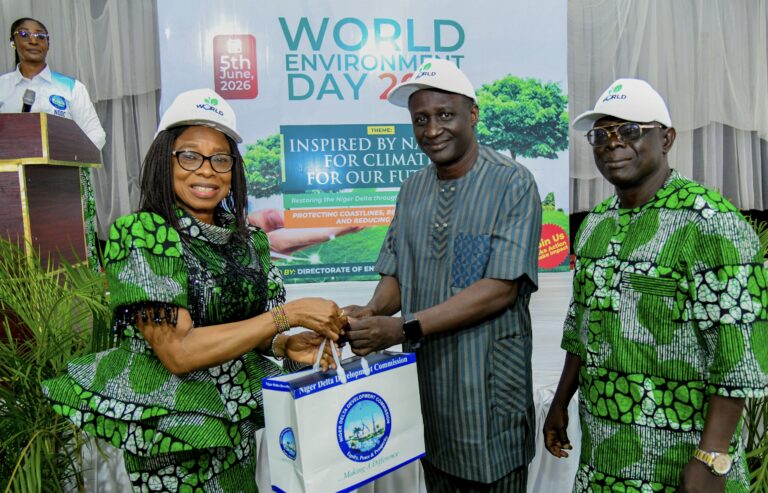
The NDDC thus joined the global community to celebrate the World Environment Day 2026 in Port Harcourt where it reaffirmed its commitment to climate action, environmental protection, and sustainable development across the Niger Delta region.
Speaking at the event, Victor Antai, NDDC Executive Director (Projects), said the Commission remained focused on implementing strategic environmental projects to restore degraded ecosystems and build climate resilience in communities across the region.
Antai, who was represented by Henry Okokon, the Director II, Environmental Protection and Control, noted that the 2026 World Environment Day theme, “Inspired by Nature. For Climate. For Our Future,” underscored the urgent need for collective action to address environmental challenges facing communities in the Niger Delta and beyond.
According to him, the Niger Delta had borne the environmental consequences of intensive resource exploitation for decades, with oil spills, gas flaring, coastal erosion, flooding, deforestation, and poor waste disposal continuing to threaten livelihoods, biodiversity, and sustainable development.
The Executive Director stated that under the leadership of Samuel Ogbuku, the NDDC Managing Director, the Commission has continued to place environmental sustainability at the centre of its development agenda, recognising that meaningful socio-economic progress could only be achieved within a healthy and resilient ecosystem.
He highlighted several interventions being implemented by the Commission, including environmental remediation and ecosystem restoration programmes, flood and erosion control projects, sustainable waste management initiatives, and climate-resilient livelihood schemes, all designed to improve environmental health and enhance community action.
Antai further disclosed that the NDDC was strengthening partnerships with research institutions, environmental agencies, development partners, and civil society organisations to promote the conservation of mangrove forests, wetlands, and other critical ecosystems that serve as natural buffers against climate-related disasters.
He emphasised the importance of environmental education and awareness creation, noting that the Commission was engaging schools, youth groups, women’s associations, and community stakeholders to foster a culture of environmental stewardship among the people of the region.
The Executive Director called on stakeholders, particularly operators in the oil and gas sector, to strengthen compliance with environmental regulations, embrace cleaner technologies, and demonstrate greater commitment to environmental remediation and sustainability.
He also urged communities across the Niger Delta to support conservation efforts, report environmental violations, and adopt environmentally responsive practices to contribute to a healthier, more sustainable environment.
A major challenge of the oil region is scarcity of kerosene and high cost of gas to power kitchens instead of firewood which causes deforestation. The Commission is not known to have created any intervention in that regard.
Earlier, in a welcome address, Anthonia Akpan, the Director, Environmental Protection and Control, described World Environment Day as an annual event established by the United Nations to serve as a global platform for promoting environmental awareness.
She observed that climate change was no longer a distant concept but a reality affecting communities across the Niger Delta through rising sea levels, flooding, environmental degradation, and unpredictable weather patterns.
She noted that the Commission subjected major projects to Environmental Impact Assessments in compliance with statutory requirements, ensuring that development projects were implemented in harmony with environmental sustainability objectives.
According to Seledi Thompson-Wakama, Director, Corporate Affairs of the Commission, the Director observed that the NDDC had maintained active engagement with oil and gas companies on pollution prevention and control issues while organising environmental summits that generated practical recommendations on integrated waste management, shoreline protection, canalisation, land reclamation, and biodiversity conservation.
She did not mention outcomes of such engagements or how they helped to reduce harmful activities on the environment especially spillages and pipeline vandalism.
Iwekumo Agbonzu, a professor and guest speaker at the event, observed that climate change was not only a global environmental issue but also a local development challenge requiring coordinated responses from governments, institutions, communities, and individuals.
NDDC boss pushes for investment in education:
Meanwhile, Ogbuku, the NDDC boss, has stressed the need for increased investment in education as a key element in reorienting the children and laying the groundwork for a better future for Niger Deltans and Nigerians.
Ogbuku spoke during the plenary session of the 2026 Law Week of the Nigerian Bar Association, Yenagoa Branch, at the Nigerian Content Development and Monitoring Board (NCDMB) Conference Hall, Nigerian Content Tower, Yenagoa, Bayelsa State.
The 2026 Law Week, with the theme “Securing the Future,” was attended by Patrick Lumumba, the renowned Kenyan professor, lawyer and activist, who was the keynote speaker; Goodluck Jonathan, the former President of Nigeria; Heineken Lokpobiri, Minister of State for Petroleum Resources (Oil); among others.
The plenary session which focused on the topic “National Assets Protection: Nigeria’s Shared Responsibility,” featured discussions with key stakeholders, including security agencies, regulatory bodies and development agencies.
The NDDC CEO said in securing the future, Nigerians must also think of the past, because the nation has missed its way and there is a need to rediscover our purpose.”
Pouring lamentation over corruption, Ogbuku said; “We must invest in the right education for our children. Western culture has polluted our society, and only the right education can save our country.”
Goodluck Ebele Jonathan, Chairman of the plenary session, shared Ogbuku’s views on the need to reform the education system to adequately prepare young Nigerians for the future.
In his keynote address, Lumumba stressed the need for unity among African countries to pave the way for true independence and prepare the continent for the future. “To talk about our future, we must find out who we are and decolonise our minds because Africans were wired to fail by the colonial masters.”
In his remarks, Douye Diri, the Governor of Bayelsa State, called on the Nigerian Bar Association to intensify efforts to enforce discipline and best practices among its members.
Also speaking, Clement Kekemeke, the NBA Branch Chairman, challenged legal practitioners to go beyond routine practice and actively contribute to societal development.

Join BusinessDay whatsapp Channel, to stay up to date
Open In Whatsapp