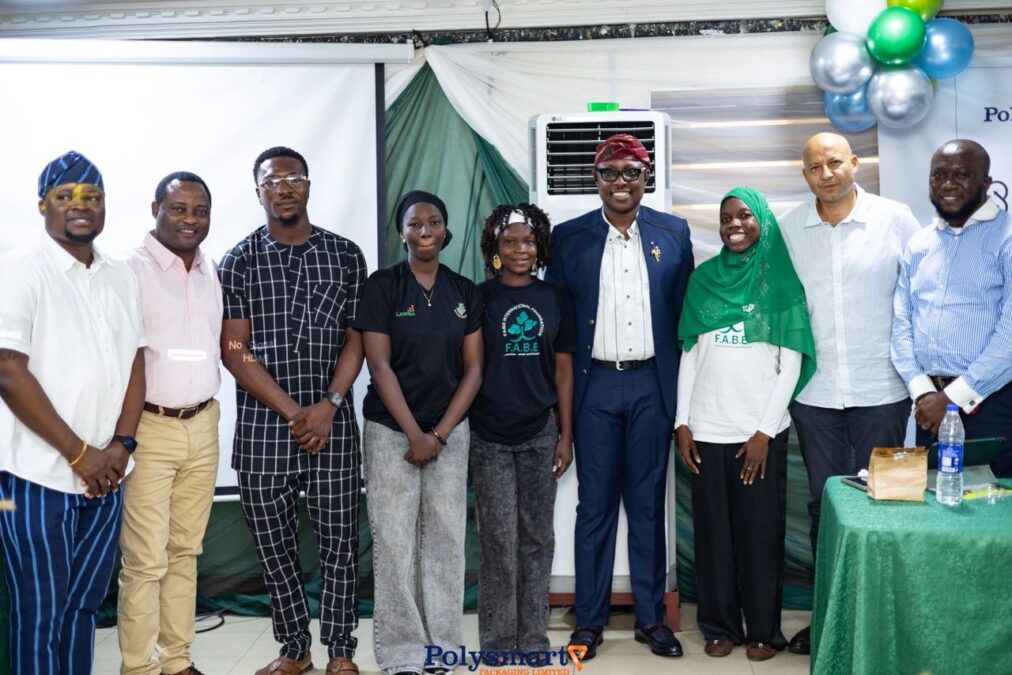
The Federal Government has been urged to develop a national policy framework to drive greater youth participation in the recycling industry.
The call was made by Polysmart Packaging Limited during a recent capacity development seminar held in Lagos in collaboration with Switch Recycling Innovations Ltd. and the Lagos State Recyclers Association.
Speaking at the event, Ernest Ubasineke, Group Head, Quality Assurance and Control at Polysmart Group, said the indiscriminate disposal of plastic waste across the country underscores the need for a coordinated national framework for plastic collection and recycling.
“We need a national policy and greater awareness. Currently, a lot of plastics are disposed of indiscriminately. We do not have a national framework for collecting plastics, so different states operate their own policies. If we establish a national framework and create more awareness, collection points for PET bottles can be provided across communities.
This will encourage more people to participate in the business, as collection remains one of the biggest challenges,” he said.
According to Ubasineke, gathering discarded plastic bottles is particularly challenging because they are scattered across streets and communities.
“Getting people to go out and collect these bottles is difficult because they are not concentrated in one place. They are littered everywhere, and I think this presents a major opportunity for young people,” he added.
He explained that Polysmart is helping to bridge the gap through technology-driven solutions that make it easier for households to dispose of used plastic bottles responsibly.
“With what Polysmart is doing, we are creating awareness around recycling. We have an app through which households can log in, select a location and submit their bottles. We are also using the platform to develop agents within communities. Young people can tap into this programme and become our agents.”
Ubasineke noted that estates in urban centres such as Lagos can serve as collection hubs for PET bottles, creating significant economic opportunities.
“That is a programme we started four years ago, and it continues to create avenues for young people to participate in the recycling value chain,” he said.
Also speaking, Femi Idowu-Adegoke, Special Adviser on One Health to the Minister of State for Health and Social Welfare and an environmental sustainability expert, highlighted the economic potential of efficient PET bottle aggregation.
“If you look at the numbers, Nigeria generates enormous volumes of PET bottle waste daily. Even at conservative estimates, the economic value runs into hundreds of millions of naira every day. Beyond the bottles themselves, there is an extensive value chain with products manufactured from recycled materials, creating additional economic opportunities,” he said.
He described recycling as a multi-billion-naira industry that requires greater awareness, organisation and structure.
“It is already a multi-billion-naira industry. The challenge is that we are not talking enough about it, aggregating it effectively or structuring it properly. If I had N1 million to invest today, I would invest it in collection because if collection is not done properly, every other activity along the value chain will suffer,” he added.
Taiwo Adewole, Country Manager at Eco-Cycle Plastic, emphasised the critical role consumers play in ensuring the success of recycling initiatives.
“Consumers deserve significant credit. If they separate waste at source, the quality standards we seek in recycling can be achieved. When bottles are cleaned and properly segregated at the household level, they are less likely to end up in bins, on the streets or at dumpsites. Consumers are therefore a critical part of the recycling ecosystem,” he said.
Adewole also criticised the widespread perception that waste management is solely the responsibility of the government.
“Many people believe waste collection is strictly a government responsibility and that there is no law requiring individuals to separate waste. They assume waste management should be handled by local governments. However, with the growth of recycling and the circular economy, people are beginning to realise that waste has value. As I always say, waste is not waste until it is wasted,” he said.
Speaking on Polysmart’s strategy for driving innovation and growth in Nigeria’s recycling industry, Wasiu Balogun, Group Managing Director of Polysmart Packaging, said the company has consistently invested in innovation and technology to remain ahead of industry trends.
“The first thing we did was design a technology-driven collection system. Through our mobile application, we connect households with agents and agents with our branches. From the comfort of their homes, users can download the app, request pick-up of recyclables and receive cashless payments.
This remains one of the most significant innovations introduced into the industry since we started operations,” Balogun said.
This version is edited to meet standard business journalism style, improve readability, and eliminate grammatical and structural inconsistencies.

Join BusinessDay whatsapp Channel, to stay up to date
Open In Whatsapp