

…UK, France among European buyers
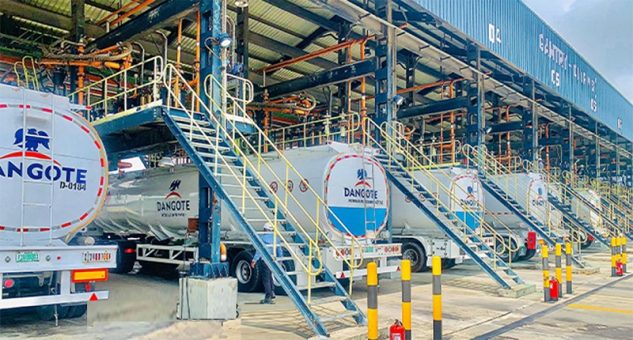
Dangote Petroleum Refinery & Petrochemicals has processed crude oil at 700,000 barrels per day, clearing its own nameplate capacity by 50,000 barrels in a performance test conducted by independent process licensors.
The result, disclosed by the refinery, cements its standing as the world’s largest single-train petroleum refinery, a title it has held since commissioning but is now, for the first time, backing with hard throughput numbers.
Nigeria has for decades been a paradox: one of Africa’s top crude producers and, simultaneously, a country that spent billions importing refined fuel it could not make at home.
Dangote’s refinery, planted on a 2,635-hectare plot at Lekki Free Zone outside Lagos, was built as the direct answer to that embarrassment. Whether it fully delivers on that promise is still being written, but 700,000 barrels a day is a credible opening argument.
Devakumar Edwin, vice-president for oil and gas at Dangote Industries, framed the milestone as a waypoint rather than a destination.
The refinery, he said, is targeting 1.4 million barrels per day within 30 months, a figure that would make it not just the largest single-train facility on earth, but potentially the largest refinery of any configuration.
That would put it ahead of South Korea’s Ulsan complex and Saudi Aramco’s Ras Tanura, both perennially cited in capacity rankings. Edwin did not detail the capital outlay required to double throughput, nor the timeline for securing the additional feedstock contracts such an expansion would demand.
The refinery began fuel production in 2024 under the ownership of Aliko Dangote, the Nigerian industrialist whose net worth has fluctuated dramatically alongside the fortunes of his flagship cement business and, more recently, this refinery.
Since first fire, the plant has steadily ramped output of petrol, diesel, aviation fuel, and other refined products, finding buyers not only in Nigeria but across several African countries and in Europe, the United Kingdom, France, Spain, Italy, and the Netherlands among them.
It has supplied gasoline to the American market and jet fuel to Saudi Arabia, a detail that carries a certain symbolic weight given the Kingdom’s own refining heritage.
The geopolitical timing has worked in the refinery’s favor. Disruptions stemming from Middle East tensions have pushed African governments to diversify their energy supply chains, and Dangote’s plant has stepped into that gap. In April, according to S&P Global Commodities, Dangote Petroleum became the world’s largest exporter of jet fuel for that month, a data point the company has moved quickly to publicize.
On the domestic front, the refinery’s expansion carries implications for Nigeria’s foreign exchange position. The country has historically haemorrhaged hard currency importing petroleum products, straining central bank reserves and contributing to recurring naira weakness.
By substituting domestic refining capacity for those imports, Dangote’s facility provides at least partial relief, though analysts note that distribution bottlenecks inside Nigeria, ageing pipelines, and logistics gaps remain a separate, unresolved constraint on how fully those savings materialise at the pump.
Looking downstream, the company has flagged plans to supply liquefied petroleum gas and industrial feedstocks, including polypropylene, which feeds packaging manufacturing, and Linear Alkylbenzene, a precursor used in detergent production. Both represent higher-margin derivatives that could strengthen the refinery’s economics beyond simple fuel throughput.
The 2028 target, a 1.4 million barrel-per-day capacity, would coincide, if achieved, with a period when global oil demand projections diverge sharply depending on the pace of energy transition. Proponents argue that African demand alone justifies the expansion.

Join BusinessDay whatsapp Channel, to stay up to date
Open In Whatsapp

