Amid growing concerns for better access, good quality, the need to address challenges and a better future for learning in Africa, notable stakeholders in the education and related sectors gathered recently in Lagos for the way forward.
For three days (May 13-15, 2026), they were hosted at the newly upgraded Wole Soyinka Centre for Culture and Creative Arts (formerly National Theatre) in Iganmu, Lagos, venue for the 25th Nigeria International Book Fair (NIBF 2026).
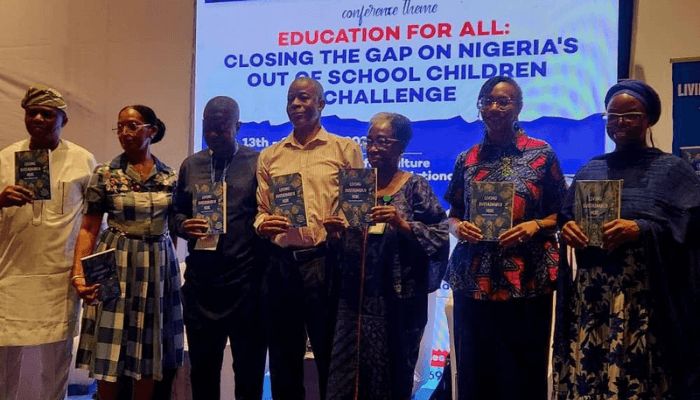
The landmark 25th anniversary edition, which focused on the theme: “Nigeria’s Out of School Children Challenge: Education for All – Closing the Gap”, also offered a veritable platform for the public presentation and preview of ‘Living Sustainably Here: African Perspectives on the SDGs’ by Selina Publications.
It featured panel discussions, essay readings by contributors, and the unveiling of the anthology’s official website.
The preview witnessed an African-wide gathering of educators, publishers, librarians, booksellers, and development practitioners, who lent their voices to topical issues in the sector, especially quality of education, access to knowledge, libraries, publishing, and reading culture.
Of course, Olatoun Gabi-Williams, editor of the book being previewed, captured the essence of the gathering in his earlier welcome address, which also set the tone for the event’s discussions by restating the theme and reasons ‘education should be for all’.
He noted that the project being launched was envisioned to translate the global language of sustainable development into a lived African experience.
While the SDG chart goals, targets, and indicators are colourful, he argued that the Sustainable Development Goals still sound and feel abstract; the anthology was conceived to bring them closer to everyday life.
“We do this through the work of publishers, librarians, educators, scientists, artists, and innovators—an ever-widening community of professionals across the continent,” he said.
“Living Sustainably Here” seeks to show that sustainability is not an abstract idea “out there,” but something already being practised, negotiated, worked around, and shaped right here using what we have.
“At the heart of the anthology is one key idea: sustainability is a systems challenge. It connects education, energy, culture, technology, governance, and the environment. These are not separate worlds—they are deeply interconnected”.
Introducing the three volumes, Gabi-Williams explained that ‘Paths to Knowledge’, the first volume, is focused on books, libraries, literacy, and education as foundations for development, while ‘OurDigital Lives and Indigenous Pathways’, the second volume, explores how knowledge is created and shared across digital and cultural systems.
‘Africa Under Pressure’, the third volume, engages questions of energy, equity, justice, and social responsibility.
“Together, they present sustainability not as theory, but as lived experience,” Gabi-Williams concluded.
Speaking in a panel session where the participants debated the declining reading culture in Nigeria and the role bookshops, schools, and families can play in rebuilding it, Ore Lesi, founder of W.Tee and bookseller at Patabah Books, noted that for the desired change to happen, many bookstores that are operating as commercial spaces evolve into community hubs for readers and creatives interact effectively, while also insisting that being only transactional spaces will deny bookstores the opportunity to boost reading culture.
Arguing that reading culture begins at home, she blamed the poor reading culture on parents, saying, “You cannot ask children to read when you are constantly fiddling with your phone”.
In another panel session, which interrogated if education should be to pass examinations or prepare students for the future, Moline Sade Marriott, director, Banana Island International School, decried that education should not just be for measuring learning outcomes, but also for preparing students for real-world realities.
Marriott lamented that the international school models seem to unintentionally prepare students for export rather than national development.
“Is that what we want?” she asked. “And this needs to be interrogated. It is not helping the system.”
In her contributions in the conversation on the ‘Role of Publishers and Booksellers in Realising the UN SDGs’, Lily Nyariki, a Kenyan contributor, decried that poor book distribution is still one of Africa’s biggest educational challenges. “Curated reading lists are meaningless if books do not physically reach classrooms and communities that need them,” Nyariki said.
But Kenza Sefrioui, a Moroccan writer, in her essay, is worried over the decline of Morocco’s public library system despite investments in literary festivals and cultural showcases.
The same is also Nkem Osuigwe’s essay on libraries across West Africa. According to her, community libraries should function as educational safety nets for people excluded from formal learning systems.
Lending voice to the conversation on ‘The New African Publishers: Towards the Promised Land’, Gabi-Williams urged fellow African publishers to view publishing not as commerce, but as cultural infrastructure essential for preserving memory, identity, and meaning.
The conference also raised concerns about the frequent change of school textbooks, which often prevents younger siblings from inheriting textbooks previously used by older children, increasing educational costs for families.
As well, the growing push for Open Science and Open Educational Resources (OER) was highlighted, particularly around questions of equity, ownership, and access.
However, the anthology contributes to conversations around SDG 4 (Quality Education), SDG 11.4 (Protection of Cultural Heritage), SDG 10 (Reduced Inequalities), SDG 16 (Peace, Justice and Strong Institutions), and SDG 17 (Partnerships for Development).

Join BusinessDay whatsapp Channel, to stay up to date
Open In Whatsapp